
Deciduous trees
White willow
Salix alba L.
Synonyms: silver willow, vetla, beloloz, Argorips alba Raf., Argorips cerulea Raf., Salix pallida Salisb. nom. illeg., Salix pameachiana Barratt.
White willow (Salix alba L.) – the typical species of deciduous shrubs and trees of the genus Salix (willows) of the family Salicaceae. Naturally distributed in Europe (except the Far North), in Western Siberia, Asia Minor and Iran. Naturalized in North America. Grows in floodplains, on riverbanks, around bodies of water, ponds, irrigation channels, near roads and dwellings. Lives more than 100 years.
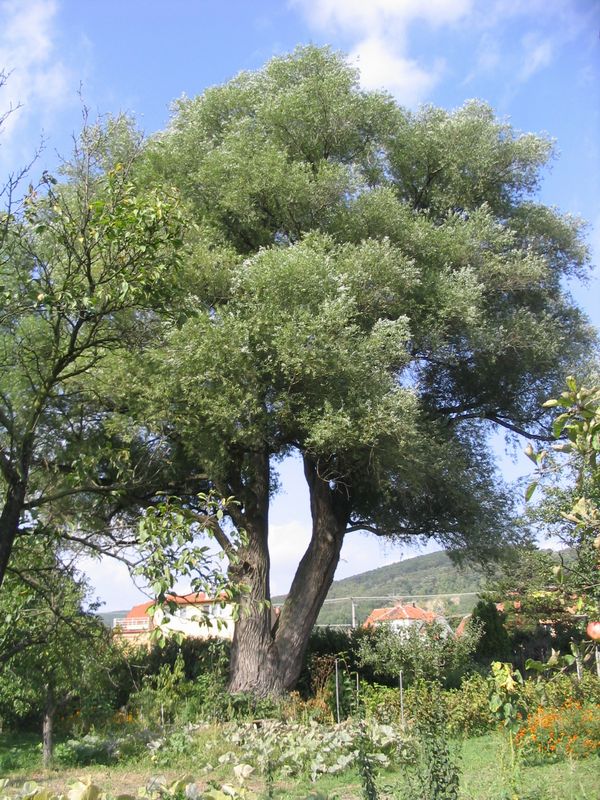
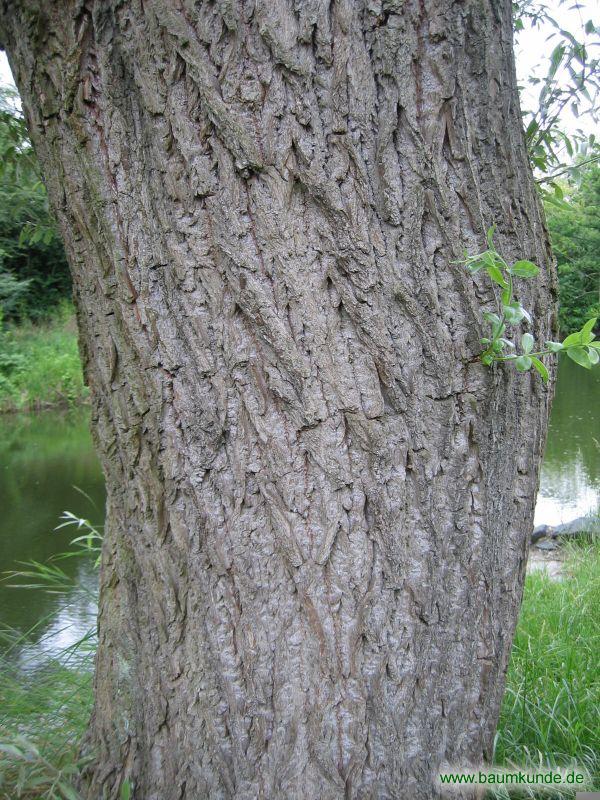
It is a large tree 25-30 m tall with a broadly rounded, often weeping crown. Grows fast; in the first 10-20 years annual increase is 50-100 cm, after 15 years – 20-30 cm, after 20 years growth slows down. Trunk up to 1 m in diameter, covered with dark gray or almost black bark with longitudinal fissures. Young shoots reddish-brown or olive-green, with silvery-pubescent tips, brittle at the joints, pubescent. Old shoots glabrous, not brittle, flexible, glossy, yellowish-brown. Lower branches often droop to the ground.
Buds reddish-brown or yellowish, oblong-oval, 5-8 mm long and 1.5-3 mm wide, glabrous or appressed-hairy, appressed to the shoot. Bud scale 1, cap-shaped. Leaf primordia in the flower buds 4-5. Catkins green, slightly pubescent.
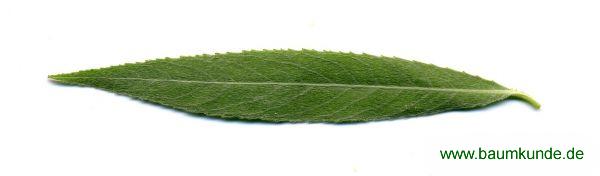
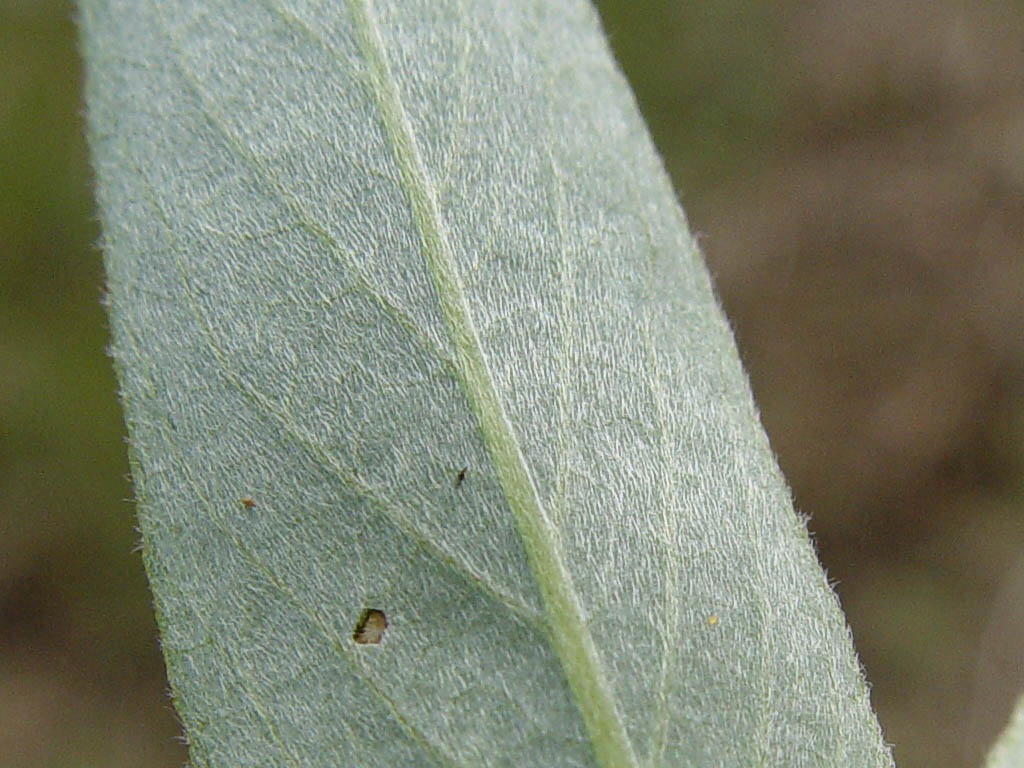
Leaves alternate, linear-lanceolate or lanceolate, 5-12 (15) cm long and 1-3 cm wide, acute, with a finely serrate margin, with appressed silky silvery pubescence on both sides when unfolding, later light green above and silvery beneath, with a midrib and lateral veins (from 12 to 15 pairs).
Petiole with several glands at the top, short (0.2-1 cm long). Stipules narrowly lanceolate, pubescent, with a glandular margin, early deciduous. In autumn the leaves turn bronze-yellow and remain on the branches for a long time.
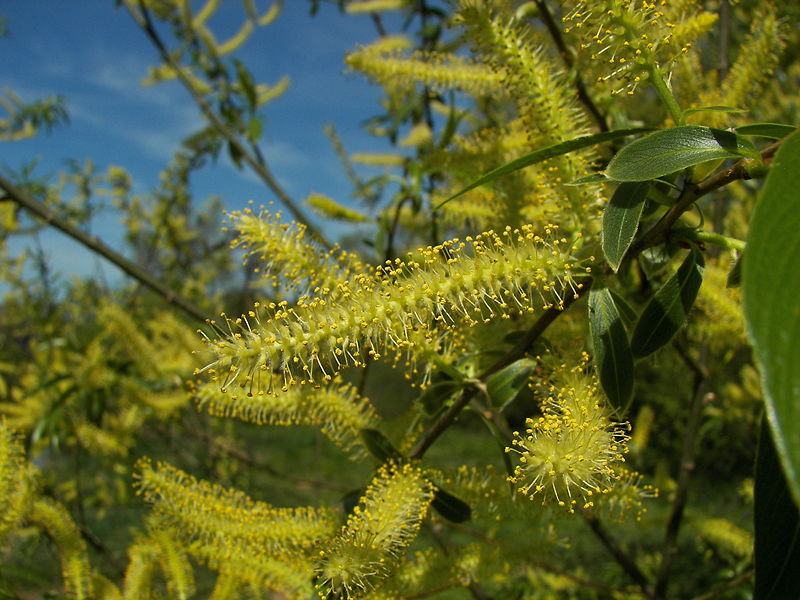 | 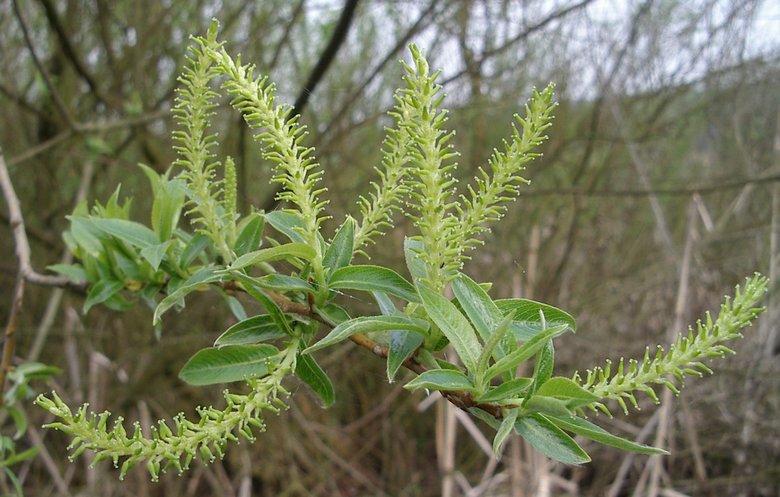 |
| Male inflorescences | Female inflorescences |
Blooms in April-May, simultaneously with leaf emergence. The flowers are loose cylindrical catkins, 3-5 cm long, fairly thick. Bracts concave, greenish or yellowish, with a hairy base, early deciduous in female flowers. Stamens 2, free, hairy below. Anthers bright yellow, later reddish. Nectaries 2 – anterior and posterior, less often bifid. Ovary glabrous, blunt, ovoid-conical. Style very short or short, often slightly bifid. Stigma bifid, yellow, with oblong lobes.
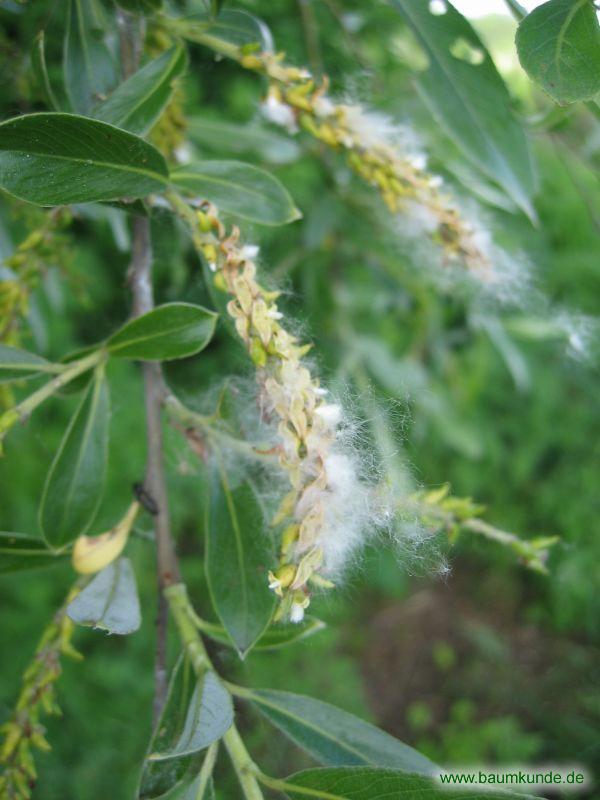
Fruits
Fruits – small oblong-pear-shaped capsules 4-6 mm long, opening into 2 valves, borne on short stalks up to 1 mm. Seeds small, with snow-white hairs, ripen in May-June. Fruits annually.
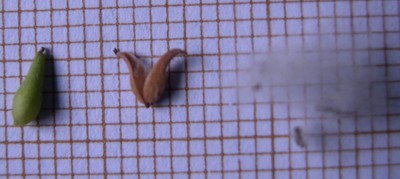
Chromosome number. 2n = 76
Subspecies:
- Salix alba subsp. alba
- Salix alba subsp. caerulea (Sm.) Rech.f. [syn. Salix caerulea Sm.]
- Salix alba subsp. vitellina (L.) Arcang. [syn. Salix vitellina L.]
Hybrids:
- with Salix babylonica L. – Salix × sepulcralis Simonk.
- with Salix fragilis L. – Salix × rubens Schrank
- with Salix pentandra L. – Salix × lispoclados Dode
- with Salix triandra L. – Salix × undulata Ehrh.
Decorative forms:
- f. argentea = f. regalis = 'Sericea' = 'Splendens' = var. sericea (Eng. silver willow) — silvery leaf color on both sides
- 'Britzensis' = 'Chermesina' — orange-red shoots in winter
- subsp. caerulea — 'Coerulea' — bluish leaves
- 'Hutchinson’s Yellow' — golden-yellow shoots
- 'Liempde' — pretty narrow-conical crown
- 'Ovalis' — oblong-elliptic leaves
- 'Pendula' — weeping crown
- 'Tristis' — weeping crown and bright-yellow shoots
- subsp. vitellina = var. vitellina = 'Vitellina' — silvery leaves and yellow shoots
- 'Vitellina Britzensis' — orange-red shoots
- 'Vitellina Pendula' — long yellow shoots
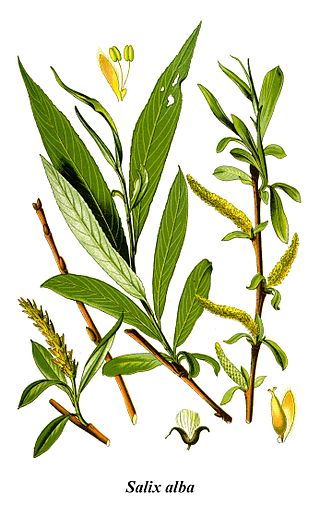
O. V. Tome «Flora von Deutschland, Österreich und der Schweiz», 1885
Hardiness zone: 4a (-32)
Location: light-loving, moisture-loving, easily tolerates waterlogging and temporary flooding, can grow on waterlogged soil. Undemanding and very hardy, tolerates urban conditions well.
Soil: requires waterlogged soil or abundant watering (especially for young plants during hot dry periods), there are also drought-tolerant forms, for example S.alba. Not demanding in fertility, grows on any cultivated soil, including sandy, swampy, poor or stony soils. Does not like calcareous soils. Optimal pH = from 5.1 to 7.5 (8). Prefers deep loams or sandy loams, fairly loose.
Planting: Planting is best carried out in spring before bud burst. When establishing a 'willow bed' (stands of willow) it is recommended to work the soil in autumn to a depth of 30-80 cm, depending on its fertility and dryness. The top organic layer should be turned down. Recommended spacing between seedlings should be no less than 0.6-2 m, depending on the species. Planting depth – 40-70 cm. Transplanting is recommended up to 3-4 years of age. On heavy soils drainage of crushed stone or sand with a layer of 20-30 cm is recommended.
Pruning: tolerates cutting and pruning well. Regular pruning of dead shoots and shaping of the trunk and crown is recommended. For creating hedges annual stump cutting is necessary.
Care: practically requires no care.
Propagation: by cuttings and seeds. Seeds lose viability within 2-3 days. Cuttings can be used both summer and hardwood. Rooting almost 100%. Can be propagated even by stakes driven into the ground, especially on flooded sites.
Pests: Cecidomya saliciperda, Cecidomya salicis, Tortrix (Helias) Chlorana, Agrotis vallugera, Bombyx Salicis, Curculio crux, Phratora vulgarissima, Phratora vitellinae, Galer ucacapreae, Galer lincola.
Diseases: affected by fungal diseases – fungi of the genera Melampsora, Rhytisma, Erysiphe.
Uses: used in solitary and group plantings, for decorating water bodies, marshy, waterlogged or otherwise unsuitable sites, for soil stabilization on slopes and embankments, for creating fast-growing hedges or screens. Effective in compositions of large parks and forest parks. Can be used for rapid greening of new developments. A good honey plant.