
Deciduous trees
Sharp-leaved willow
Salix acutifolia Willd
Synonyms: krasnotal, shelyuga, red willow.
Sharp-leaved willow (Salix acutifolia Willd.) – a species of deciduous shrubs and trees of the genus Salix (willows) in the family Salicaceae. The native range includes Lithuania, Finland, Belarus, Ukraine (practically throughout the territory, except Crimea and the Carpathians), the European part of Russia, Western Siberia, and Central Asia. Grows on continental and riverside sands.
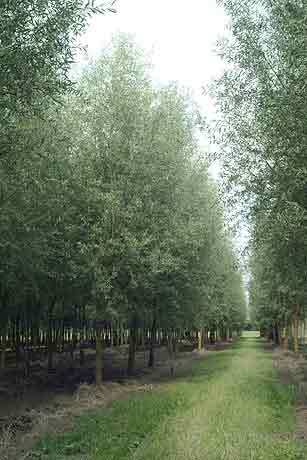
It is a tree or tree-like shrub 10-12 m in height. Crown up to 6 m in diameter, spreading, oval, of medium density. Branches flexible, thin, rod-like, reddish-brown, less often bright red, covered with a bloom or pale yellow without it.
Buds black-brown or reddish, glabrous, elongated, up to 6 mm long, appressed. Stipules acute, lanceolate, serrate. Indumentum on buds, branches and leaves completely absent.
Leaves linear-lanceolate or lanceolate, less often linear, 6-15 cm long and 0.7-1.2 cm wide, long-acuminate, with a cuneate base, glandular-serrate, dark green above, glossy, bluish-green or glaucous beneath. Petioles yellow-red, without glands, up to 1 cm long. In autumn leaves turn bright yellow.
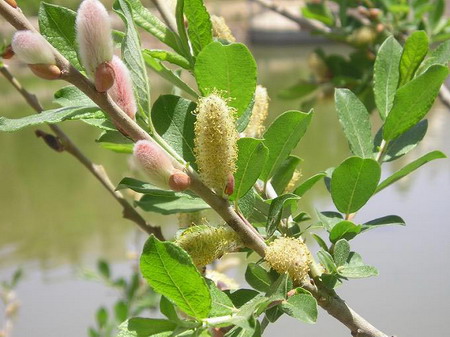
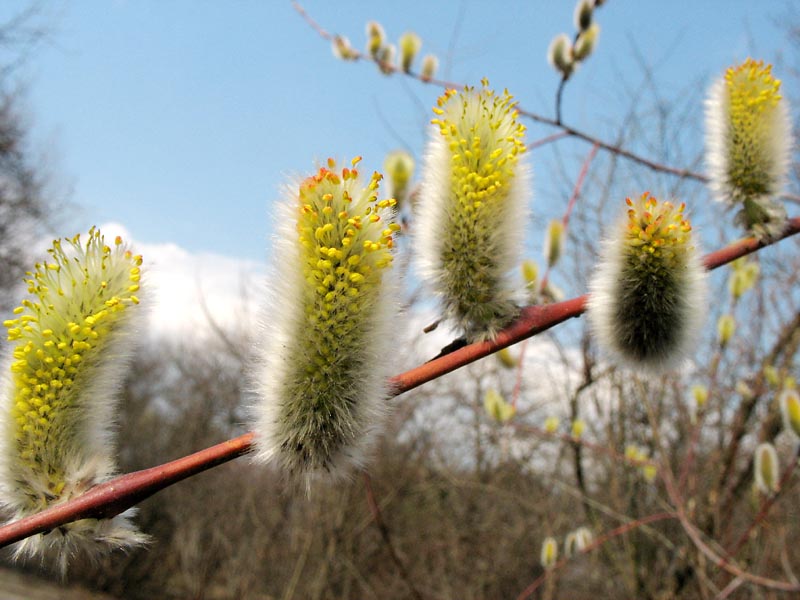
Flowers in March-April, before leafing. Catkins almost sessile or sessile, 2.5-3.5 cm long, ovate or cylindrical. Stamens 2, filaments glabrous, anthers yellow; nectary 1, ribbon-shaped, posterior. Ovary ovoid-conical, almost sessile or on a short stalk, glabrous. Style long, stigma elongated with spreading lobes.
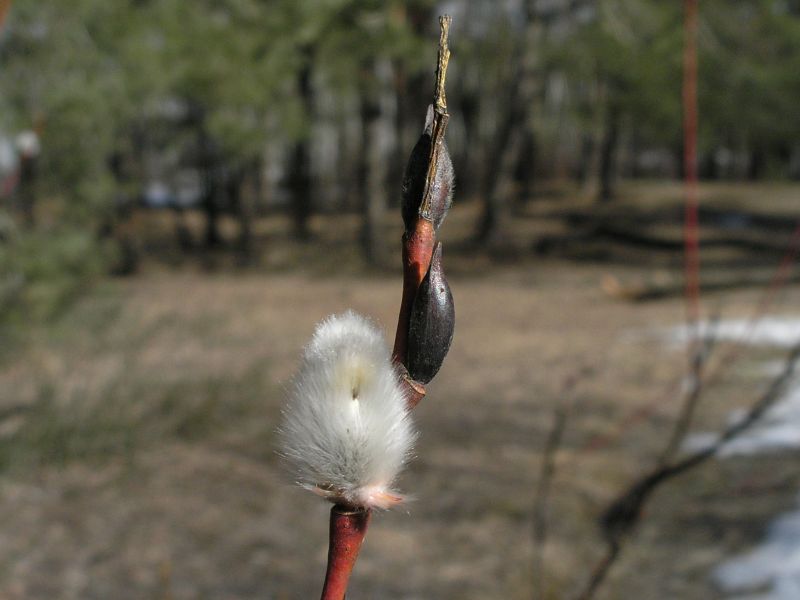
Fruits – dry capsules white or brown in color. Fruits in April-June.
Hybrids:
- with Salix caprea L. – Salix × smithiana Willd.
- with Salix cinerea L. – Salix × holosericea Willd.
- with Salix dasyclados Wimm. – Salix × stipularis Sm.
- with Salix triandra L. – Salix × mollissima Ehrh.
Subspecies:
- ssp. veriviminalis (Nasarow) Hyl.
- var. semiviminalis (E.L. Wolf) Poljak.
- yezoensis C.K. Schneid.
Hardiness zone: 4b (-29)
Location/exposure: light-loving, moisture-loving, tolerates waterlogging and temporary flooding, can grow on waterlogged soils. Undemanding and very hardy, tolerates urban conditions well.
Soil: prefers sandy soils, likes non-turfed sands.
Planting: Planting is best carried out in spring before bud break. When establishing an "ivnyak" (a willow stand/thicket) it is recommended to cultivate the soil in autumn to a depth of 30-80 cm, depending on its fertility and dryness. The top vegetative layer should be turned downwards. The recommended distance between seedlings should be no less than 0.6-2 m, depending on the species. Planting depth – 40-70 cm. Transplanting is recommended up to 3-4 years of age. On heavy soils drainage of crushed stone or sand 20-30 cm thick is recommended.
Pruning: tolerates clipping and pruning well. Regular removal of dead shoots and formation of the trunk and crown are recommended. For creating hedges, annual pollarding on the stump is necessary.
Care: requires virtually no care.
Propagation: by cuttings and seeds. Seeds lose viability after 2-3 days. Both green and woody cuttings can be used. Rooting success is almost 100%. It can even be propagated by stakes driven into the ground, especially on flooded sites.
Pests: Cecidomya saliciperda, Cecidomya salicis, Tortrix (Helias) Chlorana, Agrotis vallugera, Bombyx Salicis, Curculio crux, Phratora vulgarissima, Phratora vitellinae, Galer ucacapreae, Galer lincola, Arvicola terrestris.
Diseases: affected by fungal diseases – fungi of the genera Melampsora, Rhytisma, Erysiphe.
Uses: Branches and roots are widely used for weaving baskets and furniture, and for fences. The wood is soft and elastic. A dry rod is brittle. Widely used for sand stabilization. Tanning substances are obtained from the bark. A good early honey plant. Ornamental in solitary and group plantings. Used to create hedges and in plantings along water bodies and roads. On Palm Sunday branches are used to decorate homes.