
Deciduous trees
Willow
SALIX
Synonyms: rakita, vetla, verba, lozina, loza, talnik, shelyuga, lozniak, tal.
Willow (Salix L.) – a genus of the family Salicaceae. The Latin name derives from the words "sal" (near) and "lis" (water). It appeared on Earth early; leaf impressions are found in Cretaceous deposits. Eight willow species were first described in the 1st century by the Roman learned writer Pliny the Elder, author of the encyclopedic work of antiquity "Natural History".
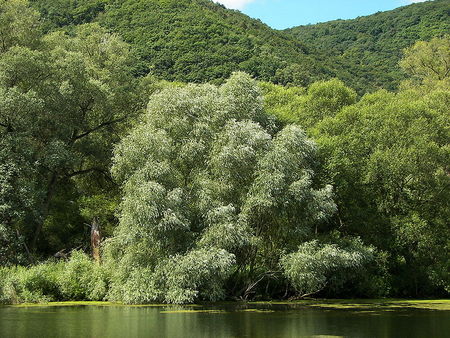
Members of the genus are mainly distributed in the cool regions of the Northern Hemisphere and extend beyond the Arctic Circle. Several species occur in the tropics; more than 65 species are found in North America. They usually grow along the shores of lakes, swamps, rivers, in floodplains, gullies and depressions, forming shrubby thickets and willow woods.
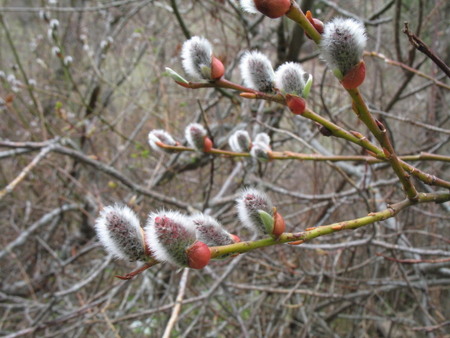
These are deciduous, less often evergreen, unisexual, dioecious trees, shrubs or subshrubs up to 10–15 (30–40) m tall. Crown shape varies widely, most often spreading, broad, open. Trunk branched. Shoots thin, flexible, filiform, covered with dull or glossy bark, green, purple or other colors. Winter buds are covered with several scales fused at their edges into one cap-like scale which, when the bud expands, separates at its base and later falls off whole. The apical bud usually dies and a lateral bud produces a vigorous shoot, replacing the dead bud.
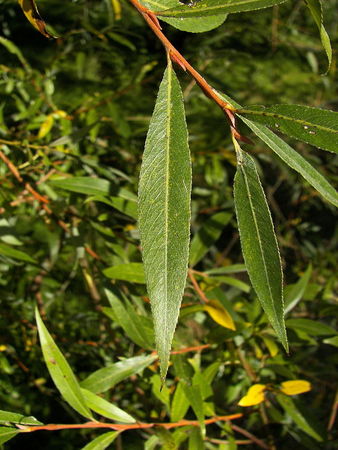
Leaves alternate, less often opposite, petiolate, simple, entire, varying in shape from round to narrowly linear, tapering to a slender pointed tip, finely toothed, less often entire, with pinnate venation, glabrous or hairy. Stipules are small and caducous or large and persistent, sometimes absent, and are a good species characteristic. The blade is glossy, bright green on both surfaces or only on the upper surface; the lower surface is often grayish or bluish due to hairs or a glaucous bloom. Petiole cylindrical, rather short.
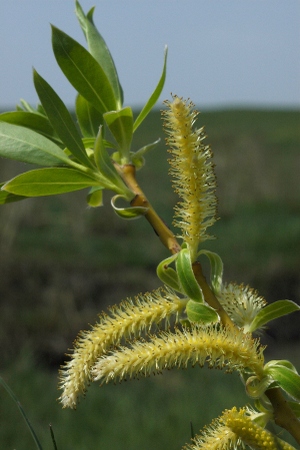
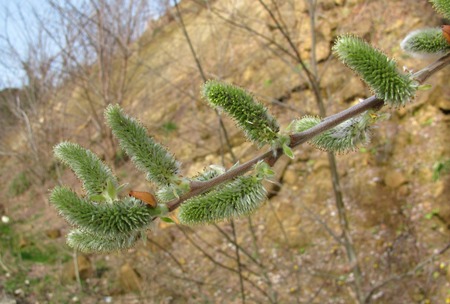
Some species flower before leafing, others in late spring concurrently with leaf unfolding or after it. Flowers are small, inconspicuous, without a perianth, sessile, growing in the axils of entire, often pubescent bracts with long white hairs; they are produced in large numbers on a soft axis and thus form cylindrical, dense, catkin-like inflorescences, erect, of varying length and color. Instead of a perianth there are one or two (or more) nectariferous glands that merge into a glandular lobed disk. Male inflorescences contain 1–2 stamens, less often 3–9. Pollinated by insects; pollen is sticky. Female flowers consist of a pistil made of carpels with a two-part style.
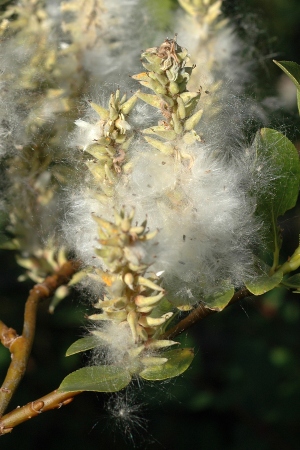
The fruit is a conical capsule that splits open with two valves. Seeds are small, covered with white down, easily carried long distances by wind.
Species: the genus Willow comprises over 370 species, about 100 of which are used in ornamental horticulture. The most popular are:
- Iva ostrolistnaya (sharp-leaved willow), red verba, red shelyuga, krasnotal, verbolaz – Salix acutifolia Willd.
- White willow, silver willow, vetla – Salix alba L.
- Seatless willow (Iva sidyachaya) – Salix apoda Trautv.
- Dwarf willow – Salix arbuscula L.
- Arbutifolia willow, chozenia, koreyanka – Salix arbutifolia Pall.
- Arctic willow – Salix arctica Pall.
- Eared willow – Salix aurita L.
- Babylonian willow – Salix babylonica L.
- Goat willow, bredina – Salix caprea L.
- Caspian willow, aktal – Salix caspica Pall.
- Grey willow, ash-leaved – Salix cinerea L.
- Heart-leaved willow – Salix cordata Michx.
- Wolf-willow, beautiful willow, yellow shelyuga, purple willow – Salix daphnoides Vill.
- Woolly-shoot willow – Salix x dasyclados Wimm.
- Two-colored willow – Salix discolor Muhlenb.
- Elaeagnus-like willow, hoary willow – Salix elaeagnos Scop.
- Brittle willow, rakita – Salix fragilis L.
- Glaucous-silky willow – Salix glaucocericea Flood.
- Slender-stem willow – Salix gracilistyla Miq.
- Spear-leaved willow – Salix hastata L.
- Herbaceous willow – Salix herbacea L.
- Entire-leaved willow – Salix integra Thunb L.
- Woolly willow – Salix lanata L.
- Lappish willow, Lopar willow – Salix lapponum L.
- Shining willow – Salix lucida Muhlenb.
- Matsudana willow, Peking willow – Salix matsudana Koidz.
- Myrsin-like willow – Salix myrsinites L.
- Myrtilloides willow, bog willow, vaccinium-like – Salix myrtilloides L.
- Weeping willow – Salix x pendulina Wender
- Five-stamen willow, laurel-leaved, chernotal – Salix pentandra L.
- Phyllo-leaved willow – Salix phylicifolia L.
- Purple willow – Salix purpurea L.
- Creeping willow – Salix repens L.
- Prostrate willow – Salix reptans Rupr.
- Net-leaved willow – Salix reticulata L.
- Notched willow – Salix retusa L.
- Rosemary-leaved willow – Salix rosmarinifolia L.
- Round-leaved willow – Salix rotundifolia Trautv.
- Mournful willow – Salix x sepulcralis Simonkai.
- Three-stamen willow, almond willow, loza, belotal – Salix triandra L.
- Ussuri willow, Sakhalin willow – Salix udensis Trautv.
- Bear-ear willow – Salix uva-ursi Pursh.
- Hemp willow, osier, basket willow – Salix viminalis L.
- Smith's willow - Salix ×smithiana Willd.
- Far Eastern willow - Salix subopposita
Hardiness zone: 3a. Some species can be damaged by late spring frosts but recover quickly. The most warmth-loving species are recommended to be covered in youth with kraft paper or spruce boughs.
Location: light-loving, less often shade-tolerant. Moisture-loving, tolerates waterlogging and temporary flooding, can grow on marshy soil. Undemanding and very hardy.
Soil: requires waterlogged soil or abundant watering (especially for young plants during hot dry periods); there are also drought-tolerant species, e.g. S. alba. Not demanding of fertility; grows on any cultivated soil, including sandy, swampy, poor or stony soils. Dislikes calcareous soils. Optimal pH = from 5.1 to 7.5 (8). Prefers deep loams or sandy loam soils, fairly loose.
Planting: when establishing a "willow stand" (willow thicket) it is recommended to work the soil in autumn to a depth of 30–80 cm, depending on its fertility and dryness. The top organic layer should be inverted downwards. Recommended spacing between seedlings is not less than 0.6–2 m, depending on the species. Planting depth – 40–70 cm. Transplanting is recommended up to 3–4 years of age. On heavy soils drainage of crushed stone or sand 20–30 cm thick is recommended.
Pruning: tolerates trimming and pruning well. Regular removal of dead shoots and shaping of the trunk and crown is recommended. For creating hedges, annual cutting to the stump is necessary.
Care: practically requires no care.
Propagation: easily propagated by cuttings or simple poles, also by layering. Cuttings should be taken in autumn from shoots not yet fully lignified. In winter cuttings are recommended to be stored in damp burlap or in a box of sand. Does not produce suckers from the stump and does not form root suckers. Seeds retain viability for more than 3–4 weeks; they germinate very quickly, within several days or even hours.
Pests: Cecidomya saliciperda, Cecidomya salicis, Tortrix (Helias) Chlorana, Agrotis vallugera, Bombyx Salicis, Curculio crux, Phratora vulgarissima, Phratora vitellinae, Galerucacapreae, Galer lincola.
Diseases: affected by fungal diseases – fungi of the genera Melampsora, Rhytisma, Erysiphe.
Uses: used in solitary and group plantings, for decorating water bodies, marshy, waterlogged or otherwise difficult sites, for soil stabilization on slopes and banks, for creating fast-growing hedges or screens. Low-growing species with prostrate or spreading habit look effective on rockeries. Good early honey plant. Widely used in medicine. Wood is used for handicrafts. Foliated branches can be used as fodder for livestock. Bark is used for tanning leather. Rods and bark are used for making woven products and furniture.