
Indoor plants
Saintpaulia
Saintpaulia


- Edged (picotee) Saintpaulias
- Fancy Saintpaulias
- Chimeras
- Classic type
- Star-shaped type
- Bell-shaped
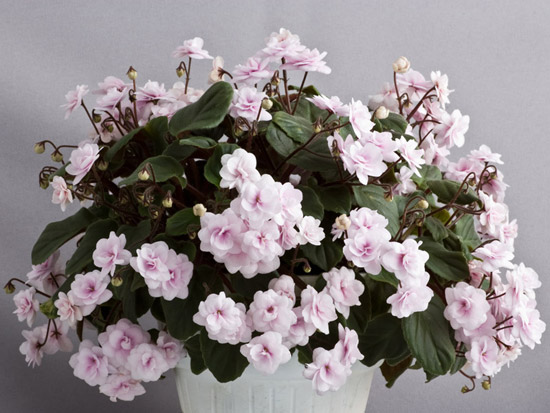
Some violet cultivars have additional underdeveloped petals in the center of the flower, and depending on the number of these petals violets are classified as:
Semi-double – having 1-2 additional small petals in the center. Double – having a large number of additional petals. The arrangement of these petals varies by cultivar; some take a spherical form, others are flatter.

Saintpaulia 'Funambule'
In addition, Saintpaulias are classified by leaf type. Primarily violets are distinguished as "boy" and "girl." In a "girl" variety there is a light spot on the upper side at the base of the leaf; in "boy" varieties the leaves are completely green. "Lance" leaves are longer and pointed at the tip; "Spoon" leaves have edges that curl upward.
Leaves can also have a smooth edge, a ruffled edge, serrated or wavy. They can be solid-colored or variegated. Leaf hairiness also varies — there are smooth-leaved forms, densely haired forms, and sparsely haired forms.


Left - 'Rainbow Connection', right - 'Private Dancer'
Saintpaulias also differ in overall plant size. The most common "size" is a rosette 20-40 cm in diameter, but there are large cultivars reaching 40-60 cm, miniatures up to 15 cm, and even micro-miniatures down to 6 cm in diameter. It should be noted that plant size largely depends on pot size and potting mix. In nutrient-rich soil in a large pot even a miniature violet will grow to medium size. There are also trailing (ampelous) Saintpaulias; their foliage is more voluminous and the stems hang over the edge of the pot.

Saintpaulia 'Trojka'
Temperature: Moderate, ideally 21-22 °C, without sharp fluctuations. Winter temperature not below 16 °C. Saintpaulias do not tolerate cold drafts.
Light: Bright light with shading from direct sun during the hottest hours. The best location is a windowsill of an east- or west-facing window. It is desirable that light illuminates the plant evenly from all sides; plants are periodically turned on the windowsill for this reason. To achieve year-round flowering of Saintpaulias, artificial lighting is used. Fluorescent lamps of about 40 W are best. Place them at a height of about 30 cm above the shelf with the plants. Duration of artificial lighting – 14 hours per day.

Saintpaulia 'Sharon'
Watering: Water as the root ball begins to dry, i.e. the soil should always be slightly moist but not waterlogged. Water for watering should be warm, soft, and settled for at least 12 hours. When watering, try to avoid getting water on the leaves. You can water from the saucer.
Air humidity: Saintpaulias like humid air (about 50%). However, spraying Saintpaulias is not recommended – only during flowering with a very fine mist. The best method is to place pots on a tray with wet pebbles or moist peat. Cover central heating radiators with wet towels.
Repotting: For growing Saintpaulias use fairly wide, low pots; pot size should match the plant size. Young plants with only a few leaves (propagated in spring) are planted in small pots, 5-7 cm in diameter, then (in summer) they are transplanted into larger pots of about 9 cm in diameter. Miniature cultivars are grown in pots 3-4 cm in diameter (these are sold as cactus pots in garden shops). The best pot for Saintpaulias is one whose height equals its width, since these plants do not develop deep roots. Soil mix: leaf mold (2 parts), sod (3 parts), coniferous (1 part), peat (1 part), with the addition of river sand. You can also use commercial mixes labeled "Violet" and similar.
Propagation: By leaf cuttings, by leaf sections, by seeds, and by daughter rosettes. The most common method is leaf cuttings. For this you need a healthy, well-formed leaf (whether the mother plant is flowering or not does not matter). The petiole length should be 3-4 cm, with an oblique cut. It is better to place the cutting in water until roots form. If the cutting is planted directly into soil, the soil must first be loose (not compacted), and the cutting is placed into the soil to a depth of 1.5-2 cm, no deeper. Water the pot with warm water and cover it with a polyethylene bag to retain humidity; the temperature should be no lower than 20-21°C. Root formation and the development of baby plants takes 1-2 months.