
Encyclopedia - Plants for ponds
Arrowhead
Sagittaria
Arrowhead (lat. Sagittária) — a genus of aquatic perennial plants of the water-plantain family (Alismataceae). It includes about 20 species occurring in temperate and tropical regions.
The scientific name of the genus comes from the Latin adjective sagittaria — arrow-shaped (referring to the shape of the leaves). Russian folk names: болотник, стрела, шильник.
It grows mainly along the shores of various bodies of water. An aquatic and marsh plant that prefers gley soils and fresh peat bogs. Arrowhead can serve as an example of group ecological dimorphism: plants located in water at depths greater than one and a half meters have only ribbon-shaped submerged leaves, while those growing at the very water's edge have only arrow-shaped aerial leaves.
Arrowheads are perennial herbaceous plants, growing entirely in water or partially submerged (hydrophytes by life form). A three-angled stem arises from a short thick rhizome. It reaches 20—110 cm in length, but is entirely under water and filled with aerenchyma.
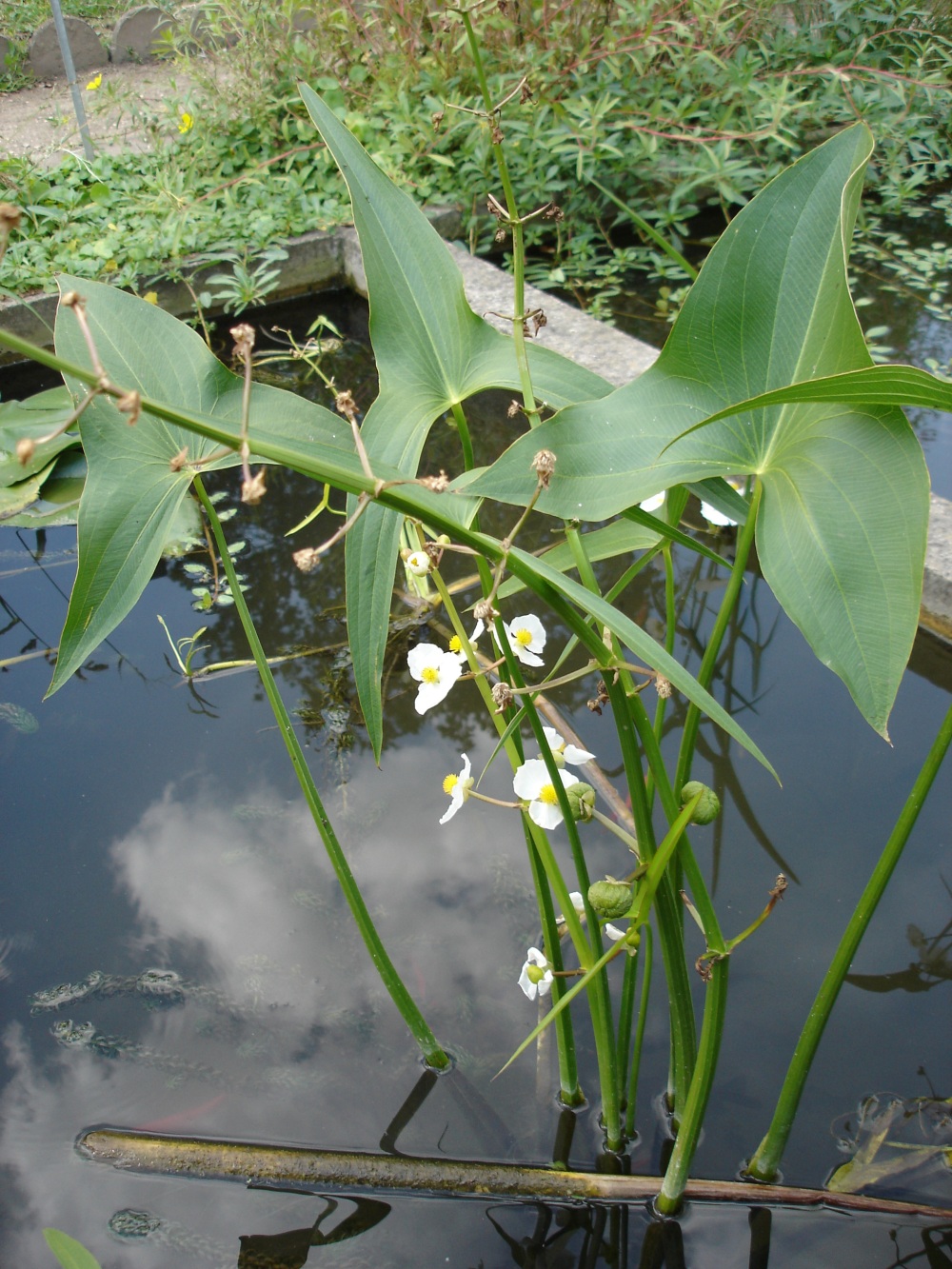
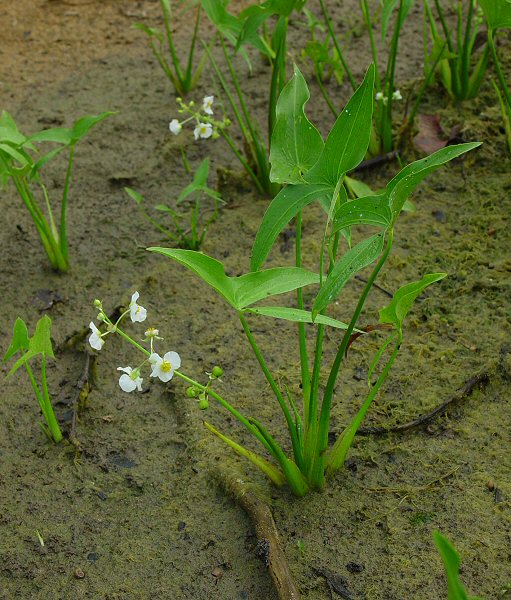
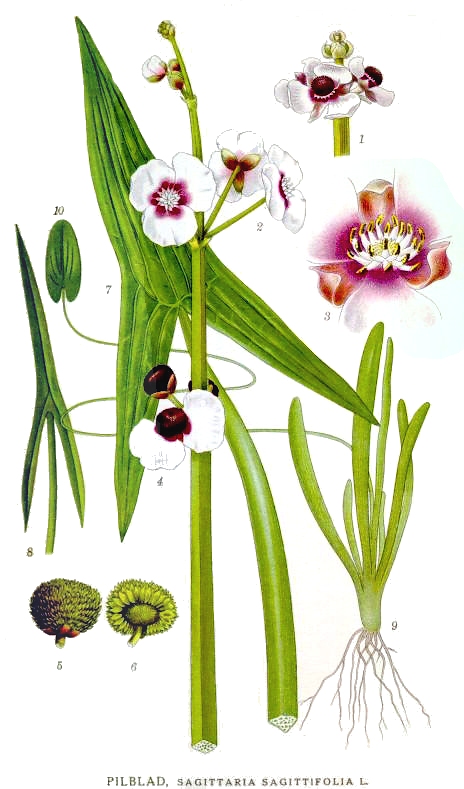
Subterranean tubers often form on the stolons of the arrowhead. Arrowhead is characterized by heterophylly: leaves have different shapes. Submerged leaves are simple and elongated in shape, often resembling thin threads up to 1.2 m long. Floating leaves are elliptical. Aerial leaves resemble an arrow in shape and usually reach 25—30 cm in length.
The flowers are arranged in racemes of three, unisexual, 1.2 to 5 cm in diameter, with a green three-part calyx and three white petals with a pink base. The lower two whorls consist of pistillate (female) flowers, the others of staminate (male) flowers; the peduncles of the pistillate flowers are shorter. They bloom from mid-June to the end of August. Pollinated by insects.
The fruit is an achene with a beak, floating on the surface of the water. Arrowheads, like other genera of the water-plantain family, exhibit hydrochory — dispersal of seeds and fruits by water currents.
Habitat: prefers bodies of water with slow-moving or standing water. The plant is extremely plastic and can grow even without submersion, but the substrate must be well moistened. Prefers open sunny sites.
Planting: planting depth - from 8–12 to 30 cm below the water level. Cultivated on any soil, but prefers silty soil.
Propagation: by seeds or by dividing the tubers formed at the ends of the shoots in most species. The double-flowered form reproduces only vegetatively.