
Deciduous shrubs
Common raspberry «Heritage»
Rubus idaeus Heritage
Obtained from: Durham x Milton x Katberg.
Common raspberry «Heritage»– the legendary remontant variety of common raspberry. It was developed in 1969 at the Cornell University experimental station in New York (USA). The variety became the standard for autumn fruiting.
Shrub compact, vigorous, not tall. Cane-forming ability is low. Canes erect, with strong, slightly elevated fruiting laterals. Thorniness medium. Self-fertile. Fruit stalks long.
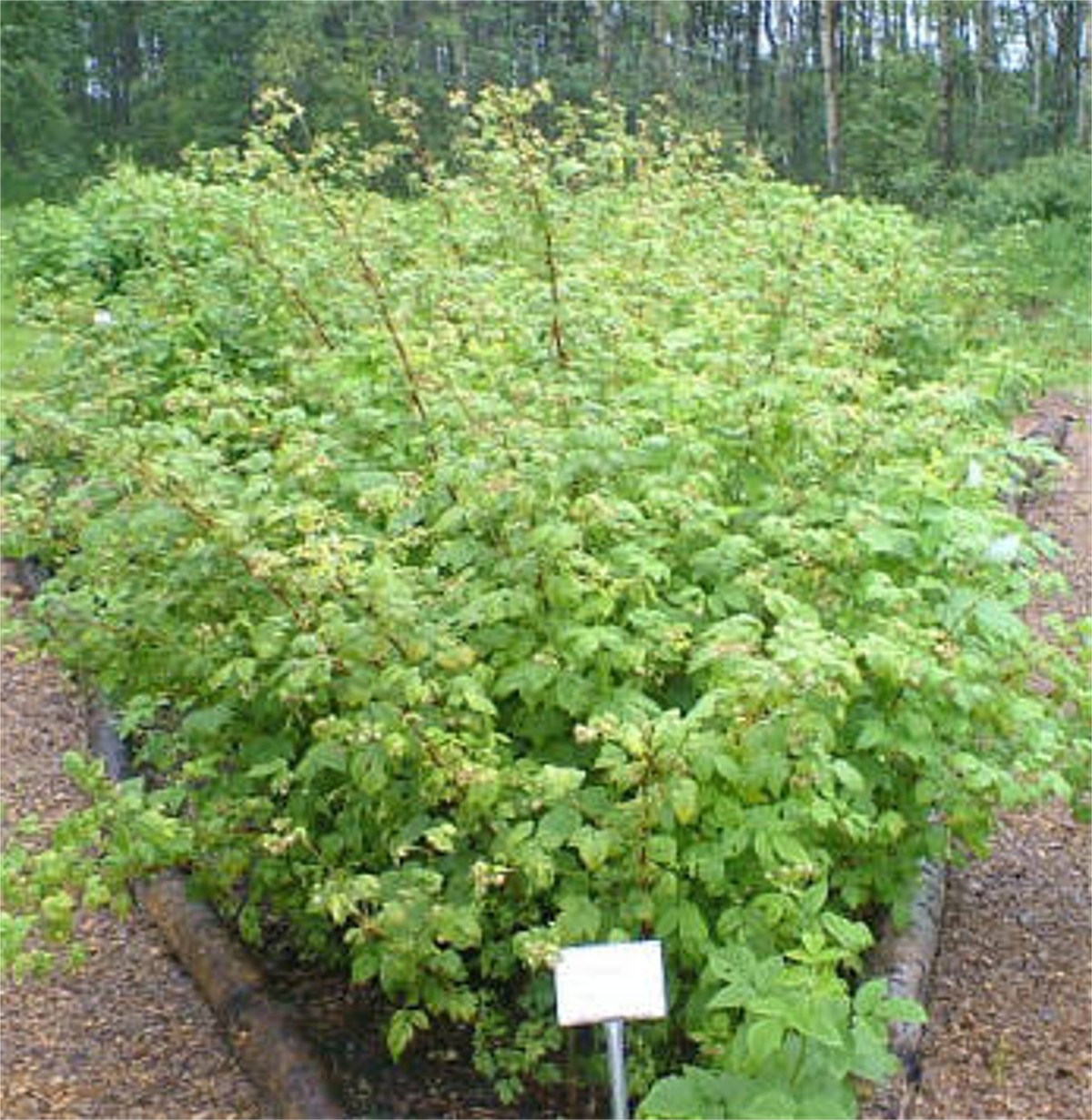
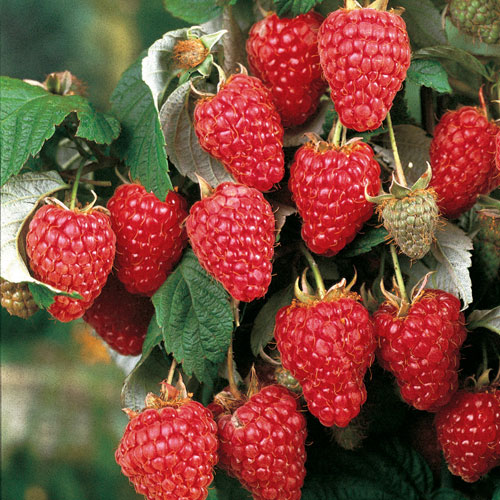
Berries medium-sized, 3.0-3.7 g, uniform in size, dome-shaped, attractive, firm, dark red in color, with a pleasant taste and aroma, small-seeded, detach easily. Good shelf life and transportability. The first harvest can be obtained in June. On overwintered canes a crop can be obtained in the third decade of August and until the end of September. Yield is high. Berries do not fall off and remain on the bushes for a long time. Fruiting laterals are located on the upper 1/3 of the cane. Prone to overloading with fruit.
Hardiness zone: 4-8
Location: prefers open, well-warmed sites protected from cold winds. Grows well on fertile, neutral, well-drained light loamy soils.
Planting: raspberries are planted in spring before budbreak (with spring planting raspberries require regular watering for 2 weeks). In autumn seedlings are planted from mid-September to mid-October. Planting scheme 2x0.5 m. Planting holes are dug 0.4x0.4x0.5 m. Seedlings should not be planted deep; after planting it is necessary to cut the shoots back to 30 cm above the ground.
Diseases and pests: anthracnose, gray mold and other fungal diseases. Resistant to powdery mildew.
Care: requires regular weeding, mulching of the soil. Responds well to potassium and nitrogen fertilizers. In the second year after planting it is necessary to add organic fertilizer – 1 bucket of compost or humus per 1 cubic meter, 25 g of double superphosphate, 20 g of potassium sulfate. In early June with weak growth a feeding with manure tea (5:1) or poultry manure infusion (12:1) is carried out at a rate of 1 bucket per 5 plants. In autumn it needs a moisture-replenishing (deep) watering. Does not require staking. For winter protection in autumn the pruned stubs can be insulated with sawdust, peat or agrofabric. Heat tolerance is low, requires watering during hot periods.
Pruning: pruning is carried out in October-November or early spring. One-year-old shoots are not retained, cutting them back to 3-cm stubs. Autumn pruning of remontant raspberries positively affects yields and protects bushes from diseases and pests that overwinter on the canes. For southern regions spring pruning is recommended, as a warm winter may shift the onset of vegetation. In April a sanitary pruning can be applied, since at this time from swollen buds it is easy to determine healthy shoots. If overwintered canes are retained, a crop can be obtained that ripens from mid-August until the first frosts.
Propagation: propagated by root cuttings, rooted tip cuttings, green and lignified root suckers.
Use: the variety can be used in fruit and berry gardens as well as on commercial plantations. Berries are eaten fresh and also used for making jams, preserves and compotes.