
Deciduous shrubs
Pink cotoneaster
С. roseus Edgew.
Synonyms: Cotoneaster speciosa Hort., Cotoneaster osmastonii G. klotz
Pink cotoneaster (Cotoneaster conspicuus) – a species of spineless shrubs of the genus Cotoneaster in the rose family (Rosaceae). It was first described in 1846 by the Irish botanist Michael Pakenham Edgeworth in the journal «Transactions of the Linnean Society of London».
In the wild it occurs in Iran, northern and eastern Pakistan, in the northeastern part of India and Kashmir. It is found on mountain slopes.
It is a small shrub up to 1.5 m in height (in the wild it can reach 2.5-3 m). Shoots are thin, purple, initially pubescent, later glabrous. Growth rate is medium.
Leaves are elliptical or ovate, up to 2-6.5 cm long and 1-3.5 cm wide, thin, glabrous, green above, gray-green below, with a blunt or acute apex. In autumn the leaves take on yellow tones.
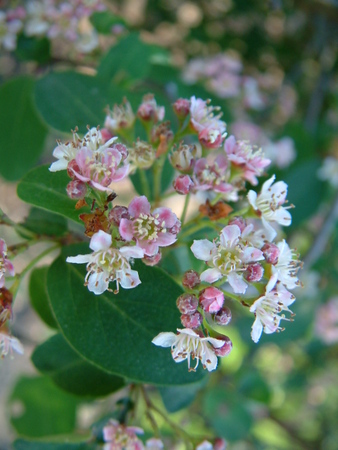
Flowers are small, 9-10 mm in diameter, pink, borne in inflorescences of 3-9 flowers. Blooms abundantly and for a prolonged period, 3-4 weeks, in June. Begins to flower at about 8 years of age.
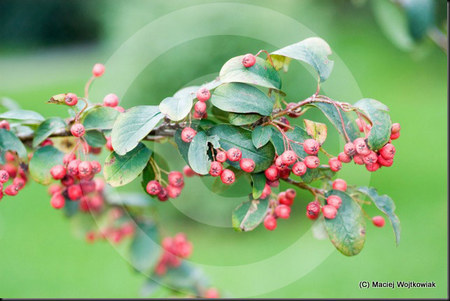
Fruits are rounded, up to 6 mm in diameter, pink-red in color, with 2-3 seeds inside. Does not fruit every year. Fruits ripen in October and remain on the plants until the frosts.
Forms: 'Rothschildianus'
Hardiness zone: zone 6-8 (-23°С). In severe frosts the shoot tips may freeze.
Site: Mesoxerophyte, mesotroph, micromesotherm.
Propagation: Propagated by seed and green cuttings. Seeds require scarification and stratification for 12-15 months at 1–5 °C. Rooting of cuttings without treatment – 20%.
Soil: prefers moderately moist soil. Grows on sandy, loam-sandy, sandy-clay or loamy soils with a pH of around 6.5-7.5.
Planting: planting mix – compost consisting of turf soil, peat and sand in proportions 2:1:2.
Care: in hot, dry summers, to maintain ornamental value it is recommended to water the plant 1-2 times a month at a rate of 1-2 buckets per plant.
Pruning: tolerates trimming and pruning well. Regenerates well after pruning while retaining its growth form. When shaped it forms dense hedges and sculptural groups. Recommended pruning – reduce by 1/3 of the length of the annual shoot, in areas where a dense and compact habit is desired.
Diseases: Fusarium (remove and burn affected parts)
Pests: apple aphid, plum sawfly, cotoneaster mite.
Uses: a rather rare species in cultivation. Looks attractive in ornamental groups and solitary plantings.