
Flowers for the garden
Rodgersia
Rodgersia
Named after American Navy Admiral John Rogers, who led an expedition to China where Rodgersia podophylla was discovered.
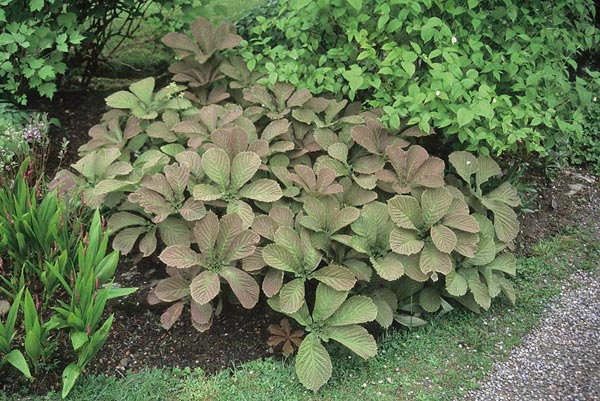
The genus comprises 8 species, distributed in the mountains of China and Japan. These are perennial ornamental foliage, rhizomatous plants. Leaves are large, palmately lobed or palmately divided. Flowers are numerous, white, gathered in large panicles. Rodgersia – a very large, strikingly beautiful, one might even say exotic plant that will always dominate your flowerbed and attract attention.
Rodgersia elder-leaved — Rodgersia sambucifolia
Originates from the Chinese provinces of Yunnan and Sichuan, where it grows in mountain pine forests at elevations of 2900-3200 m.
Plant height during flowering 120 cm, before and after flowering – 70 cm. Leaves pinnately divided, shaped like elder leaves – green with a bronze sheen. Inflorescences – small creamy-white, fragrant panicles. Flowering in July.
Rodgersia horse-chestnut-leaved — Rodgersia aesculofolia Batal.
In the wild it is found in mountainous areas of China at altitudes up to 2900 m.
Plant height during flowering – 140 cm, before and after flowering – 90–100 cm. Basal leaves on long petioles up to 50 cm, resembling chestnut leaves in shape – palmately divided, of 5-7 leaflets, each up to 25 cm long, with the whole leaf up to 50 cm in diameter. Leaves emerge beetroot-bronze, later become fresh green with attractive, pronounced venation. Small white or slightly pink fragrant flowers are gathered in large branched panicles up to 30 cm long on sturdy flowering stems rising above the leaves. Leaf petioles and stems are covered with brown hairs. Flowering lasts from late June to late July. In cultivation since 1902. Has the subspecies Rodgersia aesculifolia var. henrici (Rodgersia henrici).
Rodgersia pinnate — Rodgersia pinnata
Originates from the Chinese province of Yunnan, where it grows in mountain pine forests at elevations of 3000-3900 m.
Plant height during flowering 100-120 cm, before and after flowering – 50-60 cm. Leaves pinnately divided, 50 cm long, 30 cm wide on strong, sturdy petioles 40 to 100 cm long. When emerging they are purple, later dark green, with pronounced venation. Stem heavily branched. Inflorescence — a complex panicle 25—30 cm long with small white or pink fragrant flowers. Flowers for 20—25 days from the first decade of July. Garden forms are known: Alba – with white flowers, and Superba – more compact plants with dense panicles.
Rodgersia podophyllous, or umbrella-leaved — Rodgersia podophylla A. Gray
In the wild it grows in northern Korea, China and Japan.
Plants reach 120 cm in height during flowering and 100 cm before and after it. Rhizome creeping. Leaves palmately divided up to 40 cm in diameter, with numerous pronounced veins, bronze when unfolding, later medium green. Flowers fragrant, creamy-white, gathered in loose, branched, numerous panicles. Flowers from mid-June for 20 — 28 days. In cultivation since 1870.
Location: tolerate shading well; planting in open sunny sites is not recommended. Protection from strong winds is also necessary.
Soil: require soil rich in nutrients and humus, deeply cultivated, cool, fresh and moist.
Care: consists of cleaning the clump in spring from dead leaves and stems, regular watering and feeding with organic fertilizers. Flowering stems with spent inflorescences are cut back to the first fresh leaf. In autumn add humus and dry leaves around the clump – in case of snowless frosts. All Rodgersia species overwinter well in Ukraine, but Rodgersia pinnata needs slight winter protection. Plants can remain in one place for decades without transplanting if the location suits them.
Propagation: by seeds and by division of the clump, in spring or autumn. Divisions should be planted in well-prepared soil into holes or furrows at a depth of 3 — 5 cm, with spacing between divisions of 15—30 cm. Quite quickly after transplanting (within 2—3 years) plants reach normal size. If rapid leaf closure is desired, plant at minimum spacing.
They are also propagated by pieces of rhizome harvested in late autumn. Pieces 7-10 cm long are planted in boxes with soil and stored over winter in a cold but frost-free place. In spring, when shoots appear, they are transplanted into peat pots, and in summer the pots are planted out into the bed, where they remain until the following spring.