
Deciduous shrubs
Common gooseberry Nesluhovsky
Ribes uva-crispa Nesluhovsky)
Common gooseberry Nesluhovsky – a new popular cultivar of Ukrainian breeding, one of the most flavorful varieties. It was obtained in 1970 at the Lviv branch of the Institute of Horticulture of UAAN by breeders V.P. Kopan, K.N. Kopan, Z.A. Shestopal from a cross between the varieties Slivovyi and Mliivskyi Red. In 1990 it was registered in all regions of commercial fruit production.
It is a slightly spreading, vigorous shrub of medium density with straight shoots. Young shoots are brownish and glabrous. Thorns are strong, dark-colored, growing singly or in pairs perpendicular to the shoot, less often obliquely downward.
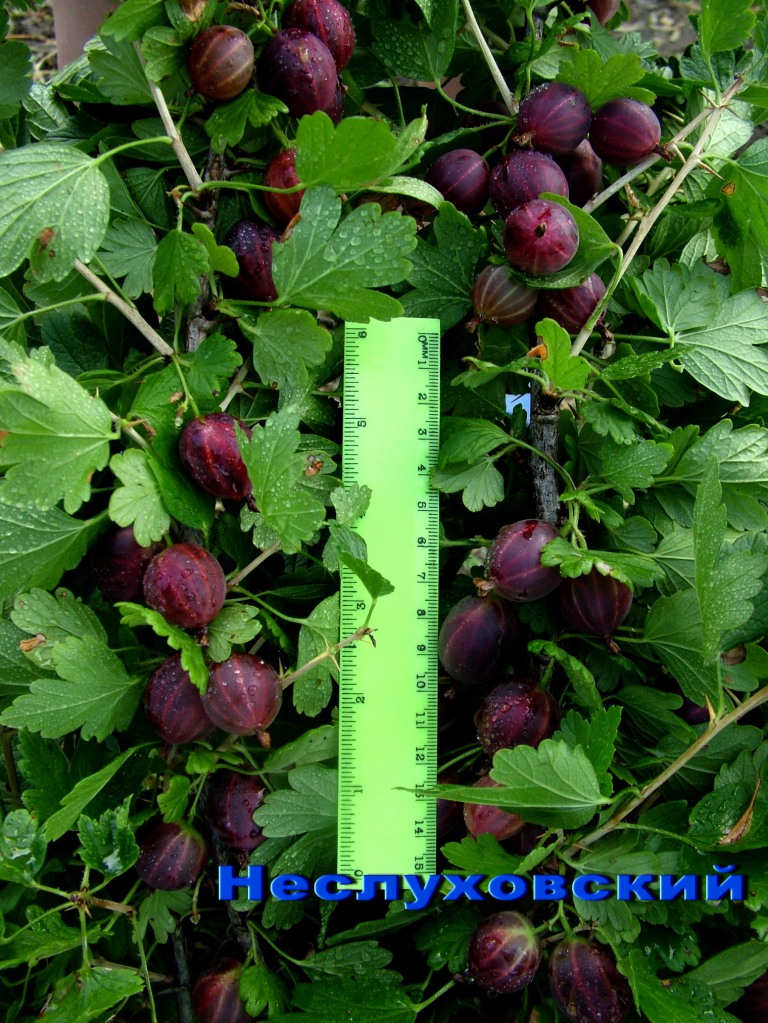
Berries are convex-oval in shape, large, weighing 6–8 g on young bushes and 3.5–4.0 g on more mature ones, average size 1.8x1.8 cm, dark red, borne 1–3 per cluster. The skin is firm, of medium thickness, slightly pubescent. The flesh is juicy, fragrant, with a pleasant dessert sweet-and-sour taste; tasting score 4.5–5.0 points. Yield is high, 4.5–8 kg per bush. Berries remain on the shoots for a long time while retaining their flavor, they do not drop. Ripens early, in the first ten days of June. Fruit set density (number of berries per 1 m) is high.
Chemical composition of the berries: dry matter 14.2%, organic acids 2.2%, sugar 6.8–7.0%, vitamin C 29.0–35.0 mg per 100 g of fresh mass.
Hardiness zone: 4–6.
Location: prefers sunny sites, but can also grow in shade. Prefers light, fertile, moist, medium-loamy soil. Does not tolerate a high groundwater table. Drought-tolerant.
Planting and care: same as for common gooseberry.
Propagation: readily propagated by hardwood cuttings
Diseases and pests: only slightly affected by powdery mildew. Attacked by clearwing moths.
Use: Berries are consumed fresh and frozen. Performs well in standard (stem) culture on golden currant and in bush form.