
Deciduous shrubs
Common gooseberry 'Malachite'
Ribes uva crispa Malahit
Common gooseberry 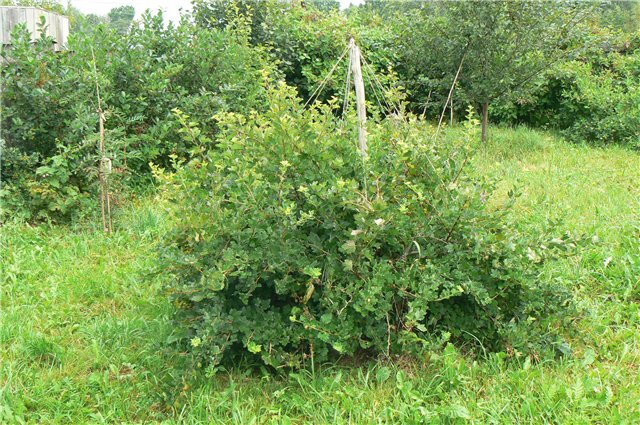
Leaves large, five-lobed, matte, smooth, pubescent, concave, grayish-green in color with medium-sized, unrolled obtuse teeth. Main veins are not colored. Lobes have deep lateral sinuses; the central lobe is larger than the lateral ones, with straight lateral margins. Lateral lobes are medium-sized, with apices pointing upward, acute, with a sharp angle between the veins of the lateral lobes. Basal lobes are weakly developed. The leaf blade base is straight, less often with a small notch; the angle between the petiole and the blade base is straight. Petiole is medium-thick, long, with sparse glandular pubescence, growing at an angle of 45° to the shoot.
Flowers brightly colored, medium-sized, with brightly colored sepals, freely arranged and bent downwards. Raceme 1-2-flowered. Ovary glabrous.
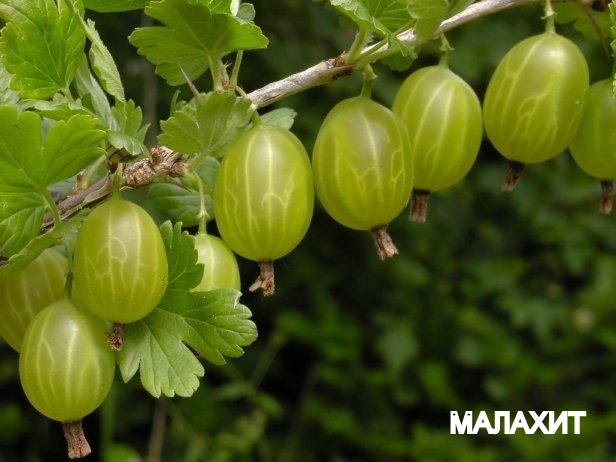
Berries rounded, large (4.5-6 g), green, rarely with a «tan» on the sunny side, with a waxy bloom, glabrous, with numerous seeds inside. The skin has numerous internal veining and strongly branched veins, thin, lighter than the main color. Calyx semi-open or closed, not always complete. Pedicel thin, medium-sized, dark green. Taste rating of the berry 3.7 points. Chemical composition: sugar 8.6%, ascorbic acid 23.0-40.8 mg/100 g, titratable acidity 2.0%. Self-fertility good.
Yield medium, reaches 12.6 t/ha (3.8-4 kg per bush).
Hardiness zone: 4-6.
Location: prefers sunny sites but can grow in shade. Prefers light, fertile, moist medium-loam soil. Does not like shallow groundwater. Drought-tolerant.
Planting: recommended spacing between bushes 1.5x1.5 m. Planting is the same as for common gooseberry.
Care: responds well to watering during dry periods and to nitrogen fertilizers.
Propagation: propagates well by layering and division of the bush.
Diseases and pests: Resistance to American powdery mildew is high.
Uses: Berries are versatile, but mainly for processing.