
Deciduous trees
Staghorn Sumac 'Dissecta'
Rhus typhina Dissecta
Synonyms: Rhus typhina 'Laciniata', Rhus typhina `Dessecta`
Staghorn Sumac 'Dissecta' – a cultivar of staghorn sumac. The cultivar has been awarded the Award of Garden Merit (AGM) by the Royal Horticultural Society (RHS).
It is a small tree with a reclining trunk or a multi-stemmed shrub up to 4 m in height and 6 m in width. The crown is umbrella-shaped and spreading. Shoots are hairy, thick, brownish, with the species' characteristic forked branching reminiscent of antlers. The bark is fissured, dark brown. The root system is powerful, well branched, and produces suckers vigorously.
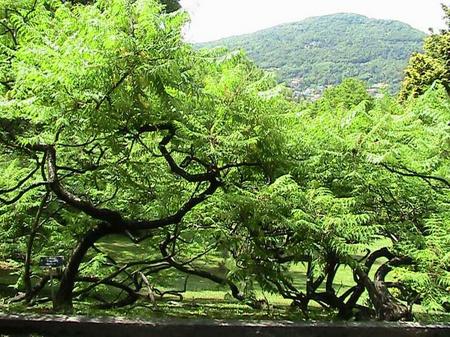
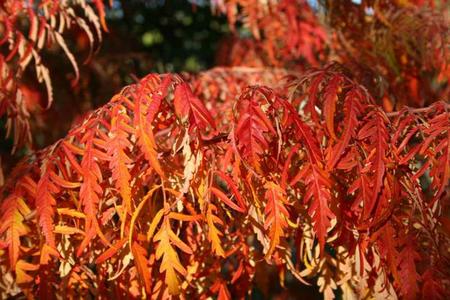
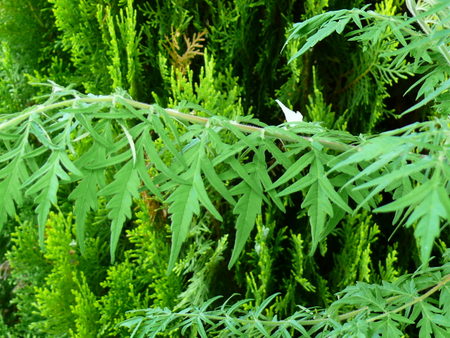
Leaves are imparipinnate, reaching 60-80 cm in length, composed of 29-33 leaflets, covered with velvety pubescence, bright green above and glaucous beneath. Leaflets are large, up to 15 cm long, of complex shape, pinnately dissected, with drooping tips, light green. In autumn they turn yellow-orange.
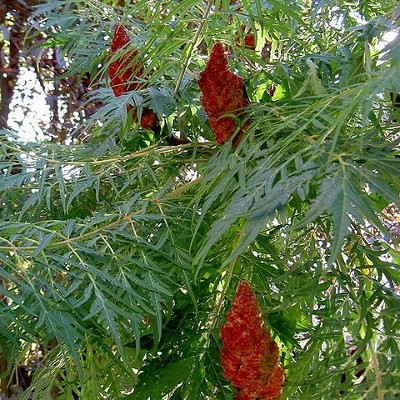
The plant is dioecious. It flowers from May to June. Male flowers are inconspicuous, forming small pyramidal clusters of green staminate flowers. Female flowers are striking bright-red 'candles'. Fruits are collected in narrow pyramidal clusters of carmine-red, pubescent drupes, very decorative, and persist throughout the winter.
Hardiness zone: 4b-8a. Shoots may be damaged by frost but recover quickly due to a strong tendency to produce new shoots.
Location: grows in sun and shade. Not demanding about soil type, but grows faster and better in fertile soils. Drought-tolerant. Tolerates urban conditions well, including smoke and air pollution.
Planting: recommended spacing between plants – 2 m. When planting, the root collar should be buried 3-5 cm. The optimal planting period is from March to November. After planting, water the tree abundantly and mulch with peat.
Pruning: in Ukrainian conditions the tree can be damaged by severe winters. However, the first frosts can act as a natural "gardener", forcing lateral buds to break dormancy. As a result of sanitary pruning, a beautiful branched crown forms. Without pruning, branches grow upward and the tree is less ornamental.
Care: practically requires no care. Fertilization is recommended at least once a year, using a balanced mineral fertilizer in the amount of 30-50 g per 1 m². In winter it is necessary to provide snow retention to protect the roots from freezing.
Propagation: propagates by root suckers and by seed. Seed viability 35%, germination – 2%. Produces abundant root suckers.
Pests and diseases: resistant to pests, but may be affected by the sac fungus Taphrina purpurascens, which causes deformation and reddening of leaves.
Uses: used in single and group plantings, to create thickets and screen objects, in complex compositions and for edging woodland margins, to stabilize slopes and banks. The cultivar is low-growing, but should be used with caution in small gardens.