
Flowering shrubs
Flat rhododendron
Rhododendron repens
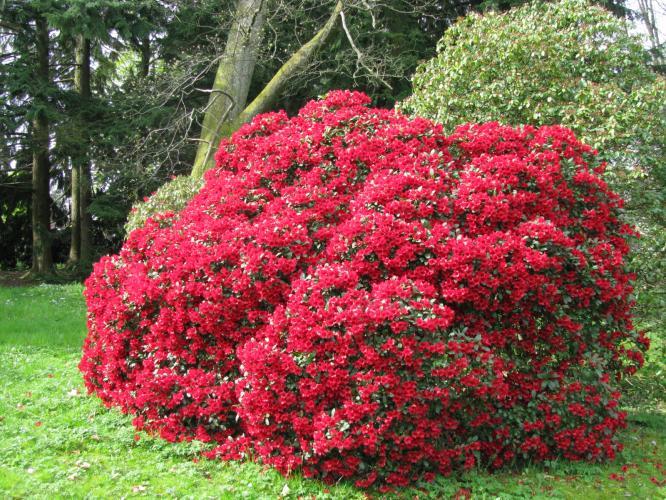
Flat rhododendron (Rhododendron repens) – a group of rhododendrons that were obtained by hybridization of Rhododendron forrestii and red large-flowered rhododendron hybrids. The first hybrid was described in 1914 by Dr. Friedrich Ludwig Emil Diels. In 1930 the first cultivars from this group appeared in the large private rhododendron park Hobbie (Westerstede, Germany), which was founded by the farmer-gardener Dietrich G. Hobbie. Most likely these were the cultivars Scarlet Wonder, Baden Baden, Bad Eilsen.
The hybrids are evergreen shrubs with a more or less weak or creeping habit. The bark is rough.
Leaves large, oblong-elliptic to obovate-lanceolate, thick, medium-green, arranged in whorls at the ends of branches, with entire margins.
Flowers are arranged in inflorescences of 5–30 flowers. The corolla is funnel-shaped to campanulate or open-campanulate, 5–7-lobed, white, light pink or purple, with 10–16 stamens.
Fruits are black, with a bluish bloom, five-valved many-seeded capsules that open from top to bottom.
Hybrids: `Baden-Baden`, `Dr. Ernst Schale`, `Dr. Fruhlingszauber`, `Mannheim`, `Scarlet Wonder`, `Bad Eilsen`.
Hardiness zone: 6a (-23°C). Overwinters under snow.
Location: needs some shading from trees or shrubs.
Soil: prefers slightly acidic to acidic, loose and moist peat soil.
Planting: it is recommended to plant in early spring (April - early May) and autumn (September – November). Planting is possible at other times except during flowering and immediately after flowering. In the dug hole with drainage of crushed stone, add peat, semi-rotted manure, leaf soil, ericaceous soil, pine needles or other organic materials, filling half the volume of the hole. Fill the rest of the hole with soil. You can also add mineral fertilizer at a rate of 2—3 kg per 1 m3 of substrate. Mix all components thoroughly and backfill the hole with the plant's rootball.
Pruning: the plant forms an attractive crown by itself. To increase bushiness, the central vegetative buds can be pinched out.
Care: in hot weather they need watering and foliar spraying. It is recommended to apply organic or mineral fertilizers. Well-rotted manure is diluted with water at a ratio of 1:15—20 and left for several days until active microbiological processes begin. The manure liquid is diluted until light brown in color. 3—4 kg of superphosphate can be added to 100 L of the liquid manure. Feedings are carried out in early spring and until the end of July. A potassium-phosphorus buffered solution is effective; it is prepared from 10 L of water and 8 g of potassium nitrate KNO3 and 8 g of monopotassium phosphate KH2PO4. During secondary shoot growth in autumn they can be sprayed with a 1% solution of potassium sulfate K2SO4 or a 1% solution of monopotassium phosphate KH2PO4. In greenhouse conditions the optimal winter temperature is 6—8 °C; at the end of February – beginning of March the temperature is raised to 10—12 °C.
Pests: grooved weevil, common spider mite, acacia false scale, tobacco thrips, rhododendron mite or bug, greenhouse whitefly, rhododendron whitefly, gastropod mollusks (slugs and snails), crows.
Diseases: tracheomycotic wilting, Phytophthora root rot, bacterial root canker, gray mold, damping-off of seedlings and young plants, bud rot, shoot dieback, root rot, dry white rot of the root collar, waxy disease (leaf blistering), Pestalotia/Pestalotiopsis leaf spot, anthracnose leaf spot, Septoria leaf spot (azalea septoria, or small-spot leaf spot), Phyllosticta leaf spot, cercosporosis, rust, mosaic.
Propagation: propagated by root suckers and by seed. Seeds are germinated at +16—20 °C. Seeds can also be stratified in a refrigerator at +4 °C for 24 hours. Seeds can be treated with "Epin." The soil mixture for seeds consists of lowland peat and sand in a ratio of 3:1 and a complex mineral fertilizer at a rate of 10 g per box sized 30 × 45 cm. For cuttings use terminal and semi-woody parts of the shoot. Cutting size 3—5 cm long with 3—4 internodes. Substrate: peat or ericaceous soil with sand (2:1). Cuttings root at 18—20 °C.
Uses: widely used in hybridization. In landscape design used in groups and singly. Looks effective against a background of conifers and deciduous trees.