
Flowering shrubs
Pontic rhododendron
Rhododendron ponticum
Synonyms: Anthodendron ponticum (L.) Rchb (1831), Azalea arborea L. (1753), Azalea baetica (Boiss. & Reut.) Kuntze (1891), Azalea lancifolia (Moench) Kuntze (1891), Hymenanthes pontica (L.) H.F.Copel. (1943), Rhododendron adansonii Pépin (1859), Rhododendron algarvense Page (1817), Rhododendron baeticum Boiss. & Reut. (1856), Rhododendron lancifolium Moench (1794), Rhododendron speciosum Salisb. (1796), Rhododendron parviflorum Dum.Cours. (1811).
Pontic rhododendron (Rhododendron ponticum L.) – an evergreen shrub of the genus Rhododendron (Rhododendron) of the family Ericaceae (Ericaceae).
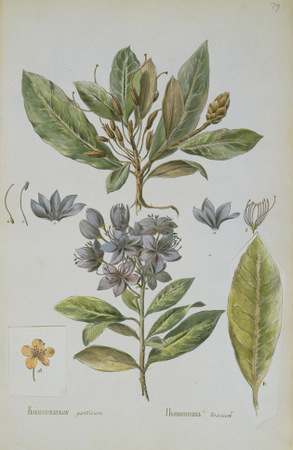
Artist K. F. Knappe from P. S. Pallas' book «Flora Rossica»
Excavations show that the species occurred in the southern and western parts of Europe already in the Late Glacial period or before it, approximately 20,000 years ago.
The species was first discovered by Joseph Pitton de Tournefort, professor of botany at the Royal Garden of Medicinal Plants in Paris, in 1700-1702 during his travels to the Near East. The species received its name from the place where the first specimen was found – Pontus (the northeastern part of Asia Minor). In cultivation since 1763. Lives for more than 100 years.
In the wild it occurs in Europe (northern Spain, Portugal, the United Kingdom, Ireland, southeastern Bulgaria), Asia (Turkey, Lebanon, Georgia, Krasnodar Krai (Russia), the Himalayas, Afghanistan, Tajikistan, northern Pakistan, Indian Kashmir (northern part of the Republic of India)). Grows on heathlands, uplands, in shady forests, in shaded places or on acidic soils.
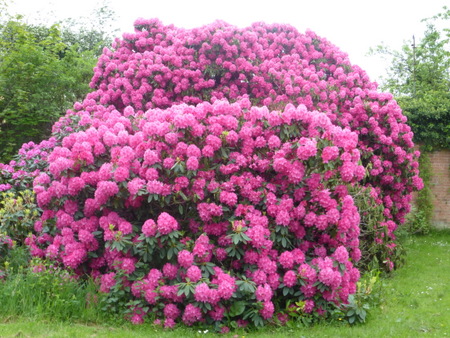
It is a branching evergreen shrub, less often a small tree up to 5 m, rarely up to 8 m tall. Crown 4-5 m in diameter, broadly spreading. Grows quickly, annual increase 10-15 cm. Shoots are pubescent at first, later becoming glabrous. Branches glabrous, covered with brown or cherry-brown bark.
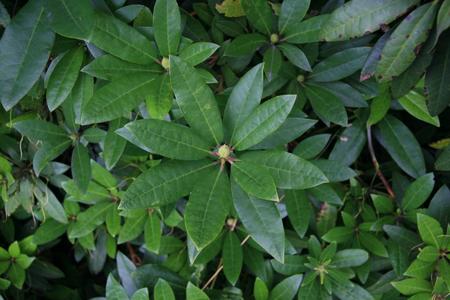
Leaves oblong-lanceolate, acute and narrowed toward the base, entire-margined, margins slightly turned, large, 6-20 cm long and 2-9 cm wide, pubescent at first, later glabrous, wintering, leathery, bluish-dark green above, paler below, shiny. Petioles short, 1.3-3 cm long.
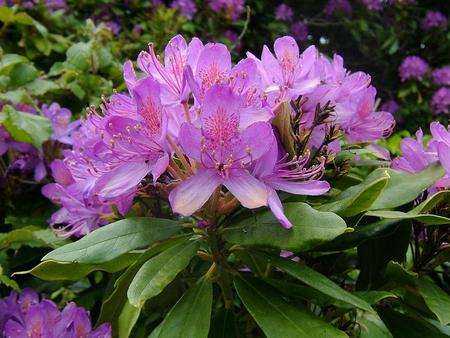
Flowers numerous, borne at branch tips, in dense racemose clusters, 10-15 cm in diameter, lilac or pale pink, less often purple or violet-purple, with greenish-yellow or brownish spots. Flowers form corymb-like umbels on a short axis. Pedicels glabrous or weakly glandular, with teeth 0.5 mm long and 1.5-2 mm wide, triangular or slightly twisted, in flower 2-4.5 cm long, in fruit 4-6 cm. Corolla violet-pink, less often white-pink, 3.8-5 cm long and 4.5-6 cm in diameter, bell- to funnel-shaped. Lobes oblong, spreading, slightly tomentose inside below. Filaments slightly curved, sparsely hairy up to 1/3. Anthers 2.5-3 mm long. Ovary with short glandular pubescence. Stamens in number 10. Flowers in June-August.
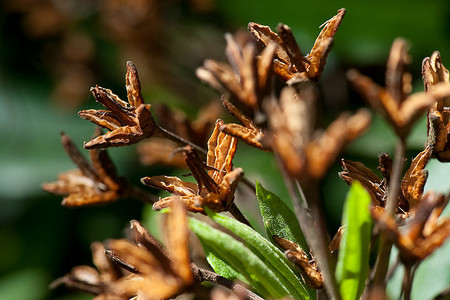
Fruits – glabrous capsules, cylindrical in shape, 1.5-18 cm long.
Subspecies:
- Rhododendron ponticum subsp. baeticum (Boiss. & Reut.) Hand.-Mazz.
Natural hybrids:
- Rhododendron ×filidactylis R.I.Milne, 2001 (Rh. ponticum × Rh. Ungernii)
- Rhododendron ×sochadzeae Kharadze & Davlian., 1969 (Rh. ponticum × Rh. Caucasicum)
Obtained hybrids: Rhododendron 'Cunningham’s White', Rhododendron 'Chionoides', 'A. Bedford', 'Anah Kruschke', 'Blue Ensign' and 'Blue Peter'.
Hardiness zone: 5b-8 (-23°C). Overwinters with protection.
Location: tolerant of shade. Requires protection from strong winds and direct sunlight.
Soil: prefers slightly acidic, loose and moist soil.
Planting: it is recommended to plant in early spring (April - early May) and autumn (September – November). Can be planted in other periods except during flowering and immediately after flowering. In the dug hole with drainage of crushed stone add peat, semi-decomposed manure, leaf mold, ericaceous soil, pine needles or other organic materials to fill half of the hole volume. Fill the remaining part of the hole with soil. Mineral fertilizer can also be added at a rate of 2—3 kg per 1 m3 of substrate. Mix all components thoroughly and fill the hole with the plant root ball.
Pruning: the plant forms a beautiful crown by itself. To increase bushiness, central vegetative buds can be pinched out.
Care: in hot weather it needs watering and foliar spraying. It is recommended to apply organic or mineral fertilizers. Well-rotted manure is diluted with water at a ratio of 1:15—20 and left for several days until active microbiological processes begin. Manure slurry is diluted to a light brown color. 3—4 kg of superphosphate can be added to 100 l of manure slurry. Fertilization is carried out in early spring and until the end of July. Effective is fertilization with a potassium-phosphate buffer solution prepared from 10 l of water and 8 g of potassium nitrate KNO3 and 8 g of monobasic potassium phosphate KH2PO4. During secondary shoot growth in autumn, shoots can be sprayed with 1% potassium sulfate K2SO4 solution or 1% monobasic potassium phosphate KH2PO4 solution.
Pests: grooved weevil, common spider mite, acacia false scale, tobacco thrips, rhododendron mite or bug, greenhouse (glasshouse) whitefly, rhododendron whitefly, gastropod mollusks (slugs and snails), crows.
Diseases: tracheomycosis wilt, Phytophthora root rot, bacterial root canker, gray mold, damping-off of seedlings, bud rot, shoot dieback, root rot, dry white rot of the root collar, wax disease (leaf blistering), Pestalotia leaf spot, anthracnose leaf spot, Septoria leaf spot (azalea eptoriose, or small-spot leaf disease), Phyllosticta leaf spot, Cercospora leaf spot, rust, mosaic.
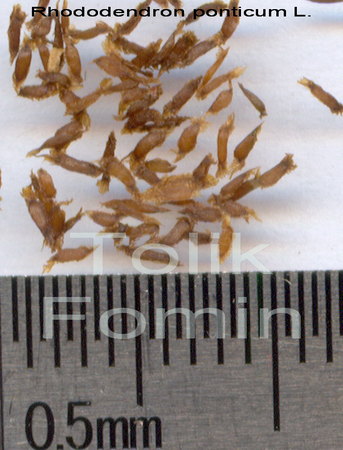
Propagation: propagates by root suckers and seeds. Seeds are stored in paper bags or in tightly closed glass containers. Laboratory germination of seeds - 82%, in soil — 85%. Seeds do not require stratification. Sow them in December-February in greenhouse conditions at 18 — 20 °C without covering with soil.
Conservation status: Russia (Karachay-Cherkess Republic)
Uses: widely used in hybridization. In landscape design used in groups and singly. Shows effectively against the background of coniferous and deciduous species.