
Flowering shrubs
Dense rhododendron
Rhododendron impeditum Balf. f. & W.W. Sm
Synonyms: Rhododendron litangense Balf. f. ex Hutch. (1930), Rhododendron semanteum Balf. f. ex Hutch., Spec. Rhododendron (J.B.Stevenson) 411. (1930), confused rhododendron.
Dense rhododendron (Rhododendron impeditum Balf. f. & W.W. Sm.) – an evergreen shrub of the genus (family Ericaceae).
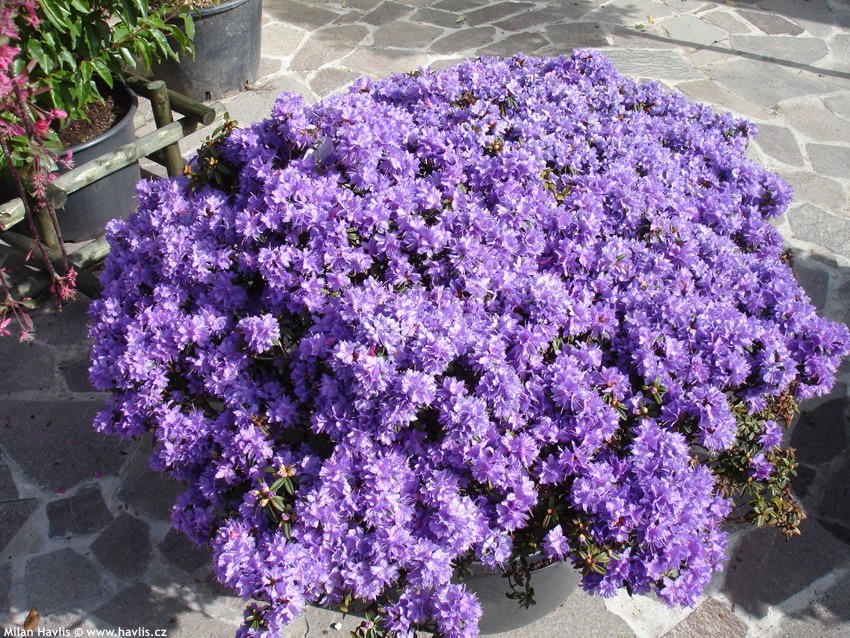
Rhododendron impeditum "LUISELLA"
The species was first described in 1916 by British and Swiss botanists Isaac Bayley Balfour and William Wright Smith in their work «Notes from the Royal Botanic Garden, Edinburgh». It was introduced into cultivation in 1916.
In the wild it occurs in China (northwest Yunnan, west Sichuan). It grows on open slopes where it forms whole thickets, as well as on alpine meadows. It ascends mountains to an altitude of 2500—4600 meters above sea level.
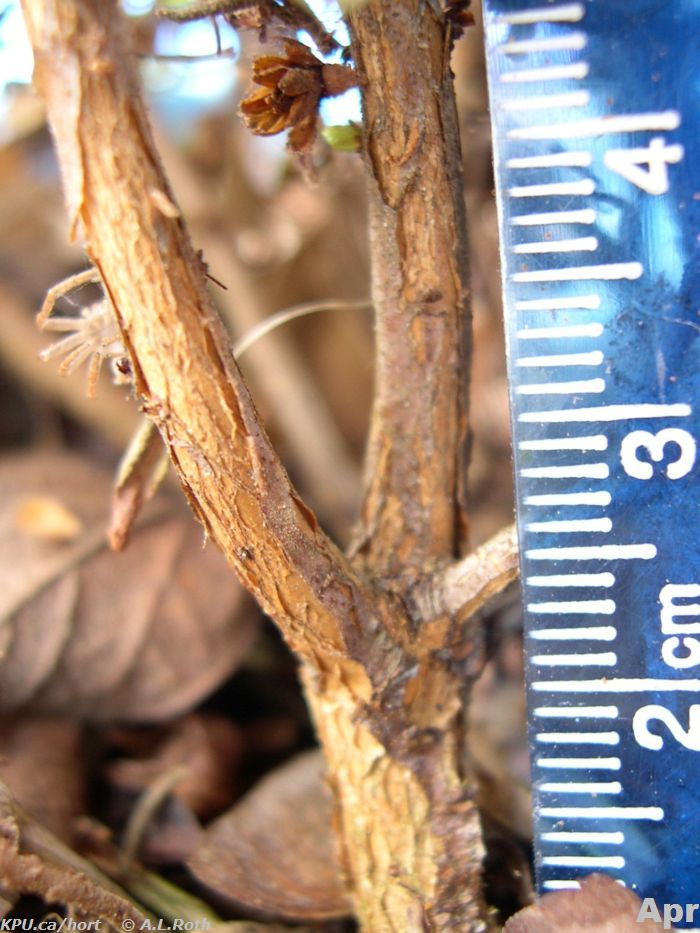
It is an evergreen shrub 0.3-1.2 m high and 0.5 m in diameter. It grows slowly, with an annual increment of 1-3 cm. The crown is cushion-shaped, compact, densely branched. Branches spreading or erect. Bark peeling, brown. Young shoots thin, densely covered with small black scales.
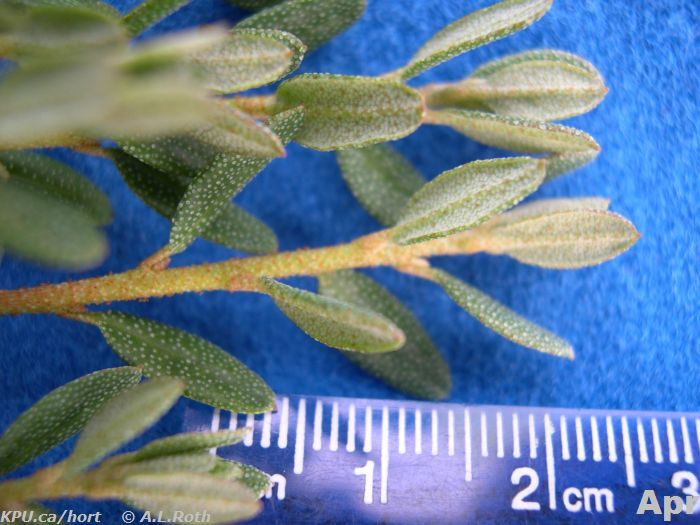
Petiole 1-3 mm long, scaly. Leaf blade ovate, elliptic or broadly elliptic to oblong, (0.4-) 0.5-1.4 (-1.6) cm long and (0.25-) 0.3-0.6 (-0.8) cm wide, above dark or light greenish-gray or bluish-gray, below pale gray-green, on both sides (especially on the underside) densely covered with scales and with brown spots from the indumentum or uniformly brownish. Leaf base cuneate, apex acute or obtuse.
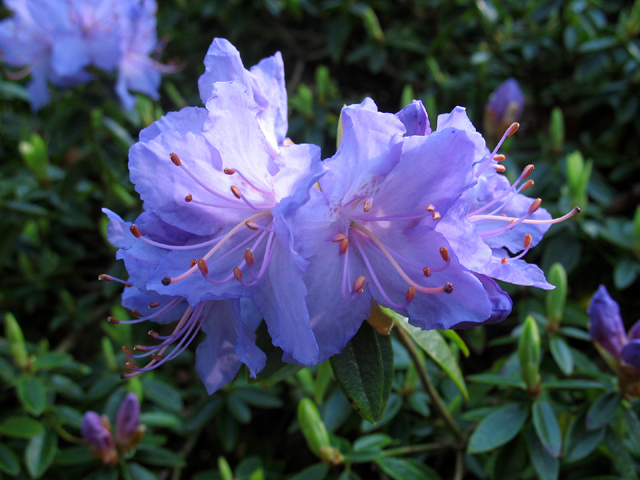
Inflorescence (2) 3- or 4-flowered, located at the tips of shoots. Peduncle scaly, 1-3 cm long. Sepal lobes 2.5-4 mm long, oblong, ciliate, persistent in fruit, forming a sparse ring. Corolla widely funnel-shaped, purple, violet or lavender, more rarely white, (0.7-) 0.8-1.5 cm long. Tube (2) 3-6 mm long, slightly scaly, less often pubescent on the outside, inner surface pubescent. Stamens (5) 10 or 11, filaments pubescent to the base. Ovary 1.5-2.5 mm long, scaly. Styles longer and shorter than the stamens, glabrous or slightly pubescent at the base. Flowers abundantly and for a long time, for 25 days, in May-June.
Fruits – small scaly capsules. Seeds light brown. Fruits ripen in September-October.
Hybrids:
- Rhododendron × lysolepis Hutch.
Cultivars: Moerheimii, Blue Tit, Blue Tit Magor, Gristede, Azurica, Luisella.
Hardiness zone: 4b-8 (-34°C). Overwinters with protection.
Location: light-loving. Requires a site protected from strong winds and also from direct sunlight.
Soil: prefers weakly acidic or acidic, loose and moist peat soil.
Planting: planting is recommended in early spring (April - early May) and autumn (September – November). It can be planted at other times, except during flowering and immediately after flowering. In the dug hole with drainage of crushed stone add peat, semi-rotted manure, leaf mould, ericaceous soil, pine needles or other organic materials, which fill half of the hole volume. The remaining part of the hole is filled with soil. You can also add mineral fertilizer at a rate of 2—3 kg per 1 m3 of substrate. All components are thoroughly mixed and the hole is filled with the plant rootball.
Pruning: the plant forms a beautiful crown by itself. To increase bushiness, central vegetative buds can be pinched out.
Care: in hot weather requires watering and spraying of the leaves. It is recommended to apply organic or mineral fertilizers. Well-rotted manure is diluted with water in a ratio of 1:15—20 and left for several days until active microbiological processes begin. Manure slurry is diluted to a light brown color. To the manure slurry you can add 3—4 kg of superphosphate per 100 l of liquid. Feeding is carried out in early spring and until the end of July. Potassium-phosphorus buffer solution is effective, which is prepared from 10 l of water and 8 g of potassium nitrate KNO3 and 8 g of monobasic potassium phosphate KН2РО4. During secondary shoot growth in autumn they can be sprayed with a 1% solution of potassium sulfate K2SO4 or a 1% solution of monobasic potassium phosphate KН2РО4.
Pests: Grooved weevil, common spider mite, acacia soft scale, tobacco thrips, rhododendron mite or bug, greenhouse (or glasshouse) whitefly, rhododendron whitefly, gastropod mollusks (slugs), crows.
Diseases: tracheomycotic wilt, Phytophthora root rot, bacterial root cancer, gray mold, damping-off of seedlings, bud rot, shoot dieback, root rot, dry white rot of the root collar, waxy disease (leaf blistering), Pestalotiopsis leaf spot, anthracnose leaf spot, Septoria leaf spot (azalea Septoria, or small leaf-spot), Phyllosticta leaf spot, Cercospora leaf spot, rust, mosaic.
Propagation: propagates by root suckers and seeds. Seeds are stored in paper bags or in tightly closed glass containers. Seed germination – 95%. Plants grown from seed flower in the 2nd year.
Conservation status: Russia (Karachay-Cherkess Republic)
Uses: widely used in hybridization. In landscape design used in groups and individually. Looks striking against a background of coniferous and deciduous species.