
Flowering shrubs
Rusty Rhododendron
Rhododendron ferrugineum
Synonyms: Rhododendron small-leaved, Rhododendron rust-red, alpine rose, Rhododendron rust-leaved, Rhododendron rust-colored, Rhododendron ferruginous, alpine rhododendron, Azalea ferruginea (L.) Kuntze (1891), Chamaerhododendron ferrugineum (L.) Bubani (1899), Plinthochroma ferruginea (L.) Dulac (1867), Rhododendron germanicum var. ferrugineum (L.) Hoppe (1837), Rhododendron myrtifolium Schott, Bot. Zeitung (Berlin) (1851).
Rusty Rhododendron (Rhododendron ferrugineum L.) – a species of the genus Rhododendron in the family Ericaceae. The species was first described by Carl Linnaeus in 1753 in "Species Plantarum." Cultivated as an ornamental plant since 1739.
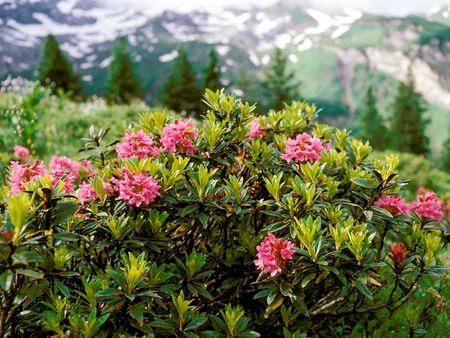
Occurs naturally in Central Europe, in the Pyrenees, Alps, Apennines, Dinaric Alps and Jura. Cultivated on Kralicky Sneznik. Grows in mountain forests, often together with Siberian juniper (Juniperus sibirica) and pine (Pinus). Found at elevations from 500 to 2840 m above sea level. The oldest known specimen is about 300 years old (growing in France).
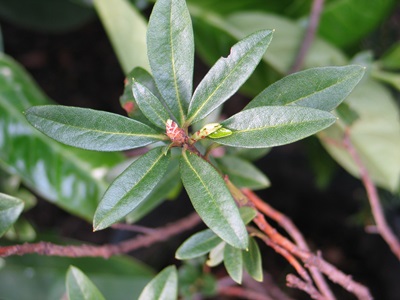
An evergreen shrub 0.5–0.9 m tall, in the wild up to 1.5–2 m. Grows slowly, annual increment 1–3 cm. Crown very dense, broadly spreading, much-branched. Branches erect, ascending, spreading and prostrate. Young shoots slightly rust-scaly. Bark gray-brown.
Leaves elliptic, narrowly elliptic, narrowly ovate to ovate, 2.5–4.5 cm long and 1–1.5 cm wide, with a revolute entire margin. Upper leaf surface glabrous, dark green, glossy; lower surface densely covered with imbricate glandular scales of golden-yellow color, which later become rust-red to brown.
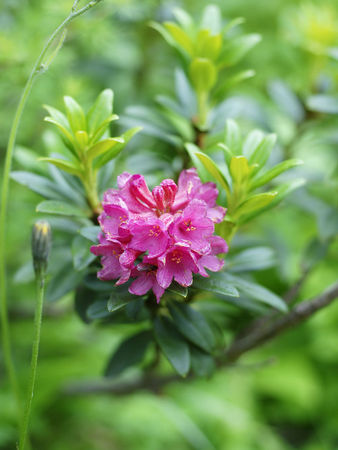
Flowers are grouped in dense umbellate inflorescences of 6–10 (12) flowers, up to 5 cm in diameter, borne at shoot tips, densely raspberry-pink, bright pink-scarlet, less often pink-lilac to almost white. Corolla 1–1.2 cm in diameter and 1.5 cm long, bright pink, less often white, tubular-funnel-shaped with 5 rounded lobes; petals up to 1.5 cm long, usually pubescent and slightly hairy on the outside. Calyx small, with conspicuous veins, scaly-ciliate. Stamens 10, shorter than the corolla, hairy. Filaments white-hairy at the base. Ovary 5-loculed, densely scaly. Style glabrous. Flowers in May–June (in the Alps in July–August), profuse and abundant, lasting about a month. Begins flowering and fruiting at 5 years.
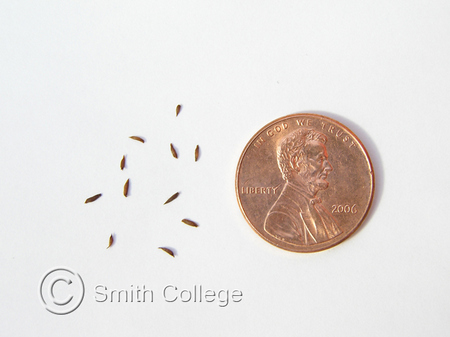
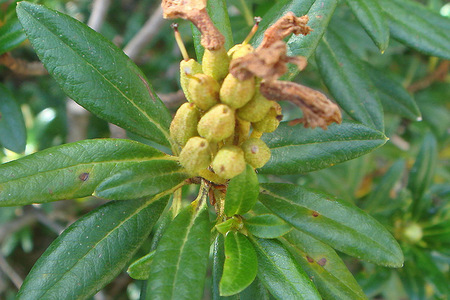
Fruits – small scaly capsules with 5 ribs, up to 6 mm long, containing numerous fleshy seeds.
Chromosome number: 2n = 26
Hybrids: R. × arbutifolium – R. × halense – R. × hamondii – R. × laeteviren
Hardiness zone: 4b–8 (−34°C). Overwinters under snow cover.
Location: Prefers light but dislikes hot direct sunlight.
Soil: prefers slightly acidic to acidic (pH ~4.5), loose and moist peaty soil. Tolerates calcareous soil if covered with a humus layer.
Planting: planting is recommended in early spring (April – early May) and autumn (September – November). Can be planted at other times except during flowering and immediately after flowering. Into the dug hole with drainage made of gravel add peat, semi-decomposed manure, leaf mold, ericaceous soil, pine needles or other organic materials to fill half the hole. Fill the remaining part of the hole with soil. Mineral fertilizer can also be added at a rate of 2–3 kg per 1 m3 of substrate. Mix all components thoroughly and fill the hole with the plant root ball.
Pruning: the plant forms an attractive crown on its own. To increase bushiness, pinch out the central vegetative buds.
Care: in hot weather requires watering and foliar spraying. It is recommended to apply organic or mineral fertilizers. Well-rotted manure is diluted with water at a ratio of 1:15–20 and left for several days until active microbiological processes begin. Manure tea is diluted to a light brown color. To the manure tea 3–4 kg of superphosphate can be added per 100 liters of liquid. Fertilization is carried out in early spring and until the end of July. A potassium-phosphate buffer solution is effective, prepared from 10 l of water and 8 g of potassium nitrate KNO3 and 8 g of monopotassium phosphate KH2PO4. During secondary shoot growth in autumn they can be sprayed with a 1% solution of potassium sulfate K2SO4 or a 1% solution of monopotassium phosphate KH2PO4. In greenhouse conditions the optimal winter temperature is 6–8 °C; in late February – early March the temperature is raised to 10–12 °C.
Pests: grooved weevil, common spider mite, acacia scale insect, tobacco thrips, rhododendron mite or bug, greenhouse (or conservatory) whitefly, rhododendron whitefly, gastropod molluscs (slugs and snails), crows.
Diseases: tracheomycotic wilting, Phytophthora root rot, bacterial root gall, gray mold, damping-off and young seedling rot, bud rot, dieback of shoots, root rot, dry white rot of the root collar, wax disease (leaf blistering), Pestalotiopsis leaf spot, anthracnose leaf spot, Septoria leaf spot (azalea eptoriose, or small leaf-spotting), Phyllosticta leaf spot, cercospora leaf spot, rust, mosaic.
Propagation: reproduces in nature by self-pollination. Can propagate vegetatively – branches pressed to the ground by snow root fairly easily. Can also be propagated by division and by seed. Seed germination 76%. Cutting rooting 22% when treated with an IMK solution (0.1%) for 16 h.
Uses: well suited for rock gardens, solitary and group plantings, and on lawns.