
Flowering shrubs
Rhododendron
Rhododendron
Rhododendron (Rhododendron L) – the largest genus of plants in the family Ericaceae. The genus was first distinguished by Carl Linnaeus in 1753 in «Species Plantarum», although a rhododendron species (Rhododendron hirsutum) had been described already in the sixteenth century by Carolus Clusius. Linnaeus placed 5 species in the genus – R. Ferrugineum, R. dauricum, R. hirsutum, R. Chamaecistus, R. Maximum. At that time Linnaeus believed that six previously described species of Azalea (Azalea indica, A. pontica, A. lutea, A. viscosa, A. lapponica and A. Procumbens) in his work «Systema Naturae» belonged to a separate genus Azalea because they have 5 stamens, not 10. After new species were discovered, it turned out they differed significantly from the type species of the genus Rhododendron. In 1836 botanists Salisbury and Tate included Azalea in the genus Rhododendron and divided them into 8 subgenera.
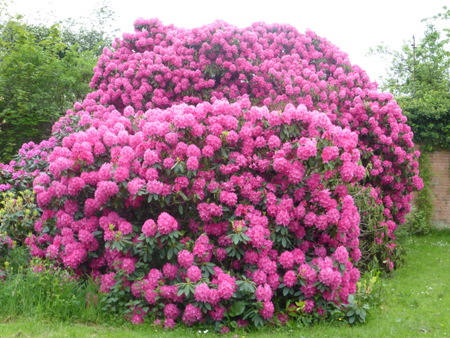
Plants are mainly distributed in the temperate climate of the Northern Hemisphere. Some species diversity is also observed in southern China, Japan, the Himalayas, Southeast Asia, and North America. A few species occur in the Southern Hemisphere – in New Guinea and the northeastern part of Australia. In Ukraine, the Carpathian rhododendron (Rhododendron myrtifolium), called «Chervona ruta», grows in the subalpine meadows and is listed in the Red Book. The yellow rhododendron (Rhododendron luteum) can also be found in Polissya.
They grow singly and in groups, often in the understory, rising up mountain slopes to the alpine belt. They are also found in tundra, swamps, and bogs.
Members of the genus are evergreen, semi-evergreen and deciduous shrubs and subshrubs, more rarely small trees. Dwarf species reach 10–100 cm in height; some trees grow up to 30 m.
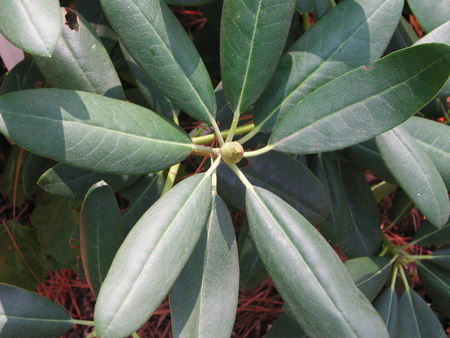
Leaves vary in shape and size, arranged spirally, annual, biennial or perennial, sessile or petiolate, alternate, with an entire, less often serrate margin, ovate or obovate in shape, often pubescent.
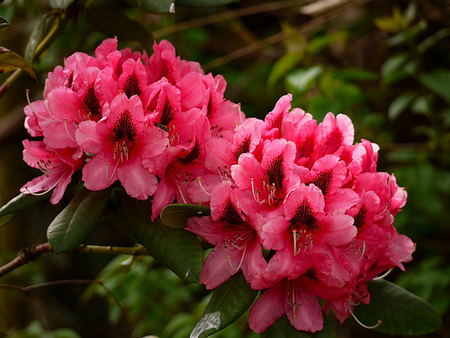
Flowers are bisexual, gathered in racemose or corymbose inflorescences, less often solitary or in pairs. The corolla is slightly irregular, in shades of yellow, pink or purplish-violet.
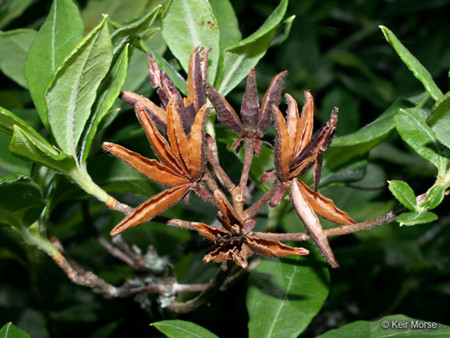
Fruits are five-valved many-seeded capsules that open from top to bottom.
Subgenera:
- Azaleastrum
- Candidastrum
- Hymenanthes
- Mumeazalea
- Pentanthera
- Rhododendron
- Therorhodion
- Tsutsusi
- Vireya
Species: the genus includes about 1,024 species. The most popular of them (based on Wikipedia):
- Golden rhododendron (Rhododendron aureum Georgi)
- Hypopitys rhododendron (Rhododendron hypopitys Pojark.)
- Short-fruited rhododendron (Rhododendron brachycarpum D.Don)
- Small-leaved rhododendron (Rhododendron parvifolium Adams)
- Adams' rhododendron (Rhododendron adamsii Rehd.)
- Pointed rhododendron (Rhododendron mucronulatum Turcz.)
- Daurian rhododendron (Rhododendron dauricum L.)
- Sichote-Alin rhododendron (Rhododendron sichotense Pojark.)
- Tschonoski's rhododendron (Rhododendron tschonoskii Maxim.)
- Schlippenbach's rhododendron (Rhododendron schlippenbachii Maxim.)
- Kamchatka rhododendron (Rhododendron camtschaticum Pall.)
- Redowsky's rhododendron (Rhododendron redowskianum Maxim.)
- Faurie's rhododendron, pink (Rhododendron fauriae Franch. [syn. Rhododendron brachycarpum auct.])
- Yellow rhododendron (Rhododendron luteum Sweet)
- Caucasian rhododendron (Rhododendron caucasicum Pall.)
- Pontic rhododendron (Rhododendron ponticum L.)
- Carpathian rhododendron (Rhododendron myrtifolium Schott & Kotschy)
- Compact rhododendron (Rhododendron impeditum)
- Rusty rhododendron (type species) (Rhododendron ferrugineum L.)
Garden classification: gardeners divide rhododendrons into 2 groups:
- Lepidote (cultivars with scales on small leaves)
- Elepidote (cultivars without scales on the leaves and with large leaves)
Deciduous rhododendrons (azaleas) are divided into groups:
- Ghent Hybrids
- Mollis Hybrids
- Fraseri Group
- Occidentale Hybrids
- Knap Hill Hybrids
- Exbury Hybrids
- Girard Hybrids
- Ilam Hybrids
- Slonecker Hybrids
- Windsor Hybrids
- Rustica Flore Pleno Hybrids
- Eastern American Hybrids
- Feliz and Dijkhuis Viscosum Hybrids
- Northern Lights Hybrids
Hardiness zone: 4b-8 (−34°C). Overwinters with protection.
Location: requires partial shading from trees or shrubs.
Soil: prefers slightly acidic to acidic, loose and moist peat soil.
Planting: it is recommended to plant in early spring (April – early May) and autumn (September – November). Planting at other times is possible, except during flowering and immediately after flowering. In the dug hole with drainage made of crushed stone, add peat, semi-decomposed manure, leaf mold, ericaceous soil, pine needles or other organic materials to fill half the volume of the hole. Fill the rest of the hole with soil. You can also add mineral fertilizer at a rate of 2—3 kg per 1 m3 of substrate. Mix all components thoroughly and fill the hole with the plant rootball.
Pruning: the plant forms a nice crown by itself. To increase bushiness, you can pinch out central vegetative buds.
Care: in hot weather they need watering and foliar spraying. It is recommended to apply organic or mineral fertilizers. Well-rotted manure should be diluted with water at a ratio of 1:15—20 and left for several days until active microbiological processes begin. Manure tea should be diluted to a light brown color. You can add 3—4 kg of superphosphate per 100 L of manure tea. Fertilization is carried out in early spring and until the end of July. A potassium-phosphorus buffer solution is effective, prepared from 10 L of water and 8 g of potassium nitrate (KNO3) and 8 g of monopotassium phosphate (KH2PO4). During secondary shoot growth in autumn, new shoots can be sprayed with a 1% solution of potassium sulfate (K2SO4) or a 1% solution of monopotassium phosphate (KH2PO4). In greenhouse conditions the optimal winter temperature is 6—8 °C; in late February – early March raise the temperature to 10—12 °C.
Pests: grooved weevil, common spider mite, acacia false scale, tobacco thrips, rhododendron mite or bug, greenhouse (or glasshouse) whitefly, rhododendron whitefly, gastropod molluscs (slugs and snails), crows.
Diseases: tracheomycotic wilting, Phytophthora root rot, bacterial root canker, gray mold, damping-off of seedlings, bud rot, shoot dieback, root rot, dry white rot of the root collar, waxy disease (leaf blistering), Pestalotia leaf spot, anthracnose leaf spot, Septoria leaf spot (azalea Septoria, or small leaf spot), Phyllosticta leaf spot, Cercospora leaf spot, rust, mosaic.
Propagation: propagates by root suckers and seeds. Seeds are germinated at +16—20 °C. Seeds can also be stratified in a refrigerator at +4 °C for 24 hours. Seeds can be treated with "Epin". The soil mix for seeds consists of lowland peat and sand in a 3:1 ratio and a complex mineral fertilizer at a rate of 10 g for a box sized 30 × 45 cm. For cuttings use terminal and semi-hardwood parts of the shoot. Cutting size: 3—5 cm long with 3—4 internodes. Substrate: peat or ericaceous soil with sand (2:1). Cuttings root at 18—20 °C.
Uses: widely used in hybridization. In landscape design used in groups and as solitary specimens. Looks effective against a background of coniferous and deciduous species.