
Climbing plants
Rhodochiton
Rhodochiton
Rhodochiton (lat. Rhodochiton) - a genus of perennial herbaceous flowering plants of the family Plantaginaceae (Plantaginaceae).
The genus includes only three species native to Mexico and Central America.
A perennial that in temperate regions can be grown outdoors as an annual. An evergreen, fast-growing climbing plant up to 3–4 m high with reddish stems that become woody at the base. Leaves dark green, sometimes with a red margin, pointed, toothed, heart-shaped.
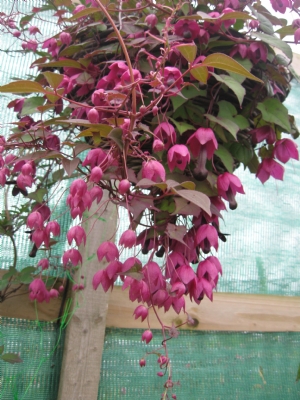
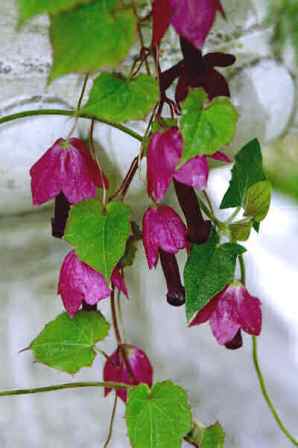
The dark, unusual tubular flowers emit a faint fragrance. Rhodochiton blooms abundantly from mid-summer to late autumn with five-lobed bell-shaped flowers with a wine-red perianth and a long, up to 2.5 cm, narrow central corolla tube widened at the base. The perianth petals remain on the plant after flowering. Fruit – a pod.
In cultivation:
Dark-blood or climbing Rhodochiton - Rhodochiton atrosanguineus
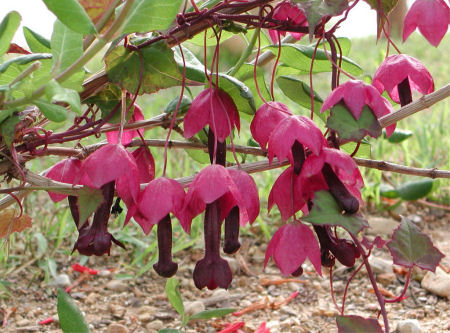
Herbaceous, creeping plant reaching 2–3 m, perennial, but in temperate climates grown as an annual. Stems thin, herbaceous, slightly woody. Leaves large, heart-shaped, dark green or reddish.
The flowers are very decorative and unusual. They consist of a bell-shaped, cup-like perianth of pink and light purple color and a long tubular corolla of wine or blood color. They have a light fragrance. Blooms abundantly from mid-summer to late autumn.
Location: prefers a very bright, warm site.
Soil: moist, loose and fertile, with a neutral reaction. Good drainage is necessary.
Care: requires support. Weekly feedings with organic or complete mineral fertilizer are necessary in spring and summer. The plant can be kept over winter. It should be kept with moderate watering in a cool, bright room. The plant responds well to pruning by one-third of the shoot length, which is done after flowering or in early spring. All elongated weak shoots are also cut out in spring. After 3–4 years the plants become overgrown, so it is recommended to replace them with young ones.
Propagation: by seeds and cuttings.