
Indoor plants
Rhapis
Rhapis
The genus Rhapis (Rhapis L. f. ex Aiton.) comprises from 9 to 15 species of the palm family. They are distributed in China and Japan. Rhapis are clumping palms with thin bamboo-like tubular stems covered with felted, net-like fibers. Leaves are fan-shaped, small, deeply divided into 5—10 segments with finely serrated margins.
Rhapis was brought to Europe about 240 years ago. The botanical name comes from the Greek word rhapis — a rod, a stick. Therefore, in common speech this palm is sometimes called "whip-like." The reed-like stems are used to make canes and umbrellas — which is why in England Rhapis is called the Lady palm. Under sufficiently favorable conditions Rhapis humilis may reward you with white or ivory-colored flowers.
Rhapis species are ornamental. They are used to decorate cool, spacious interiors and stair landings, and to green conservatories, but they can also be suitable for ordinary apartment conditions. Rhapis species produce many offshoots and can thus form multi-stemmed, shrub-like groups. A single thin stem looks less attractive.
Rhapis humilis (Rhapis humilis Blume.)
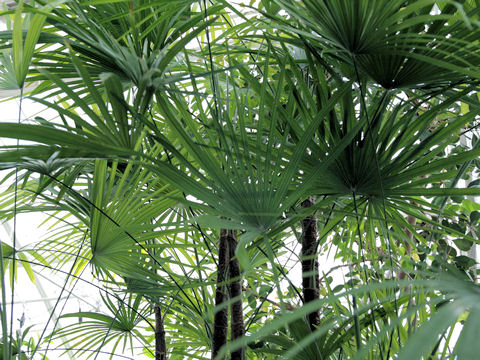
A clumping, low-growing plant (up to 1–1.5 m tall). Stems no more than 3–4 cm in diameter, densely fibrous. Leaves fan-shaped, deeply divided (almost to the base) into 7–10 segments, stiff, dark green, glossy. Petiole short, covered with fibers. Inflorescence axillary, branched. Native to southern China. Grows in subtropical forests.
Rhapis excelsa (Rhapis excelsa)
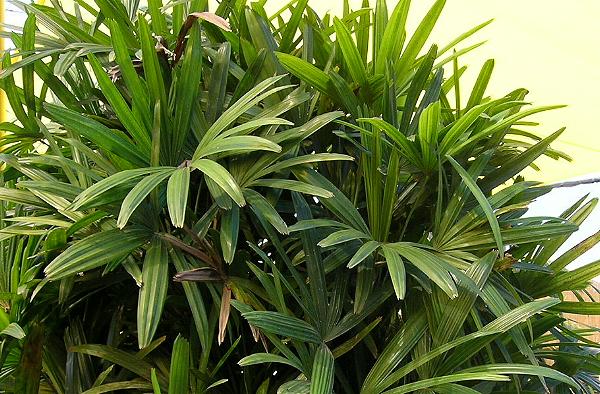
A reed-like fan palm up to 3 m tall. Trunks are jointed, resembling bamboo stems, covered with netted-fibrous leaf bases. Leaves are small, divided into 5–10 segments. Leaf margins are finely serrated.
Location: well-lit and ventilated, but not in direct sun. In winter — bright with temperatures of 5°C to 10°C. In summer it is recommended to take the plant outdoors.
Light: bright light
Watering: in summer water very abundantly, but avoid excess water in the pot. In winter reduce watering depending on the temperature.
Humidity: moderate
Propagation: readily propagated by division and by seed.