
Fruit trees
Pear 'Striyska'
Pyrus communis
Pear 'Striyska' – a popular late-winter cultivar of the common pear. Bred in 1964 at the Lviv experimental station by crossing the varieties Bere Hardi and Parizhanka. Authors of the cultivar: V. P. Kopan, K. N. Kopan. The first station trial was conducted at the Ukrainian Research Institute of Horticulture, involving researchers from the Lviv experimental horticultural station Yu. I. Leshchuk and N. I. Shevchuk. Entered into the State Register of plant varieties suitable for cultivation in Ukraine in 1999. Suitable for Polissya and the Forest-Steppe.
It is a fast-growing tree. At 10 years it reaches 4—4.5 m in height and 3—3.5 m in diameter. The crown is strong, tall-pyramidal. Shoots are knotted, thick, greenish-gray.
Leaves are medium, oblong-elliptic or oblong-ovate, long-acuminate, apex twisted in a helical manner. Petioles long, rather thick.
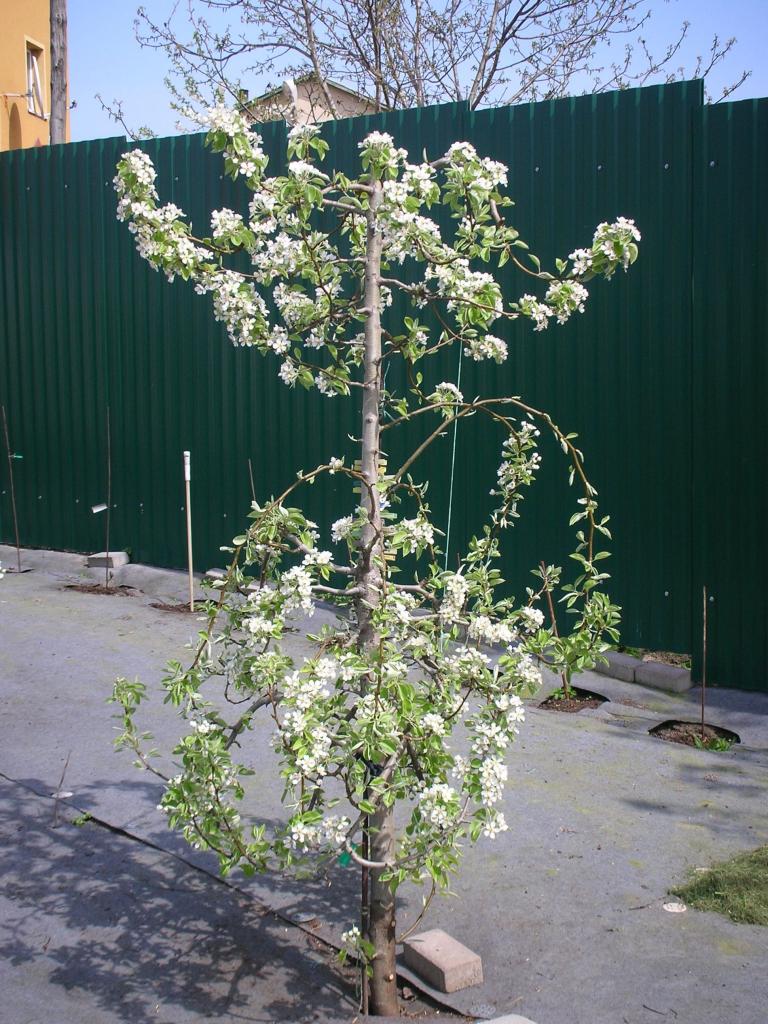
Photo by V. Koval
Best pollinators: Conference, Malivchanka, Nikolai Kryuger, Devo, Bere Krasnokutska.
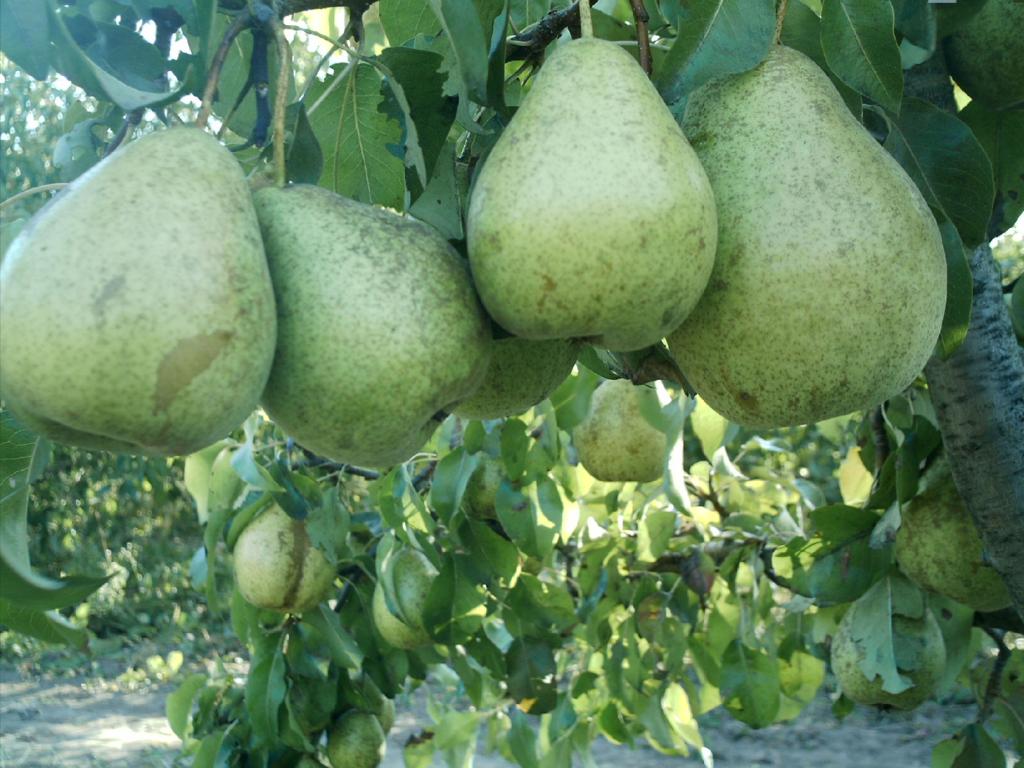
Fruits on short fruiting spurs and spurs, intensively setting fruit buds on one-year shoots. Begins bearing at 4–5 years, yield high (36.7 t/ha). Fruits are large, uniform, reaching 270–300 g, elongated-pyriform, grayish-green with a slight pink blush, becoming greenish-yellow at ripening. Skin is fairly thick, dry, russeted. Flesh creamy, juicy, semi-buttery, with a light almond aroma, very sweet (8.0–8.2 points). Tasting score – 4.3 points. Chemical composition of the flesh: dry matter – 14.0%, sugar – 11.4%, acids – 0.15%, pectins – 1.0%, vitamin C – 2.7 mg per 100 g fresh weight. Harvest maturity occurs in October, consumer maturity in January–March.
Hardiness zone: 4a
Location: demanding with respect to environmental conditions. Less winter-hardy and more thermophilic than apple. Poorly tolerates early autumn frosts, alternating thaws and frosts, and spring frosts (buds die at -4 °C). Prefers loose, moist soil with a small clay content. Prefers sunny but not scorching, wind-protected sites.
Planting: plant seedlings preferably in spring, but autumn planting is also possible. Pear seedlings generally have a poorly developed root system, so for the first 2 years the pear practically does not grow. Soil from the planting hole should be mixed with organic and mineral-potassium fertilizers. Fill the mixture to the edge of the hole. Leave the root collar 3 cm above ground level.
Pruning: requires regulation of shoots, since with crop overload fruits become smaller.
Propagation: readily grafts onto quince rootstocks (VA-29).
Diseases and pests: the most common diseases are fruit rot, sooty mold, rust, powdery mildew, pear gall mite. Resistant to scab.
Use: advantages of the cultivar – precocity, high yield, compatibility with quince rootstocks, suitable for intensive cultivation. Fruits transport well and store for a long time while retaining their taste and commercial qualities; they have high flavor ratings.