
Fruit trees
Callery Pear
Pyrus calleryana
Synonyms: kelleri, urban, Chinese pear, Callery pear
Callery Pear (Pyrus calleryana) – a species of the genus Pear (Pyrus) of the family Rosaceae. Native to Vietnam and China. The species is named after the Italian-French sinologist Joseph-Marie Callery (1810-1862), who sent the first specimens to Europe. It was introduced to the USA in 1909. Since 1950 it has been used as an ornamental plant.
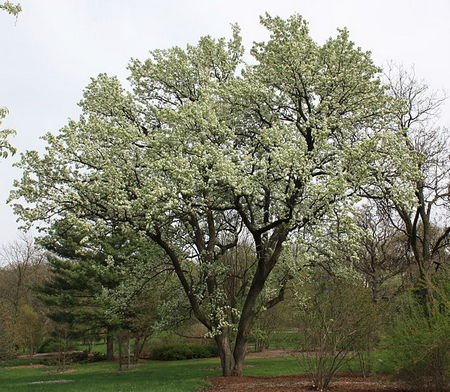
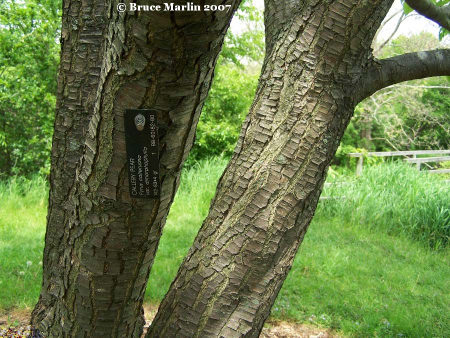
It is a deciduous tree 15-20 m in height. The crown ranges from narrow-columnar to rounded or oval. The bark is grayish-brown, fissured, with shallow grooves. Scaffold branches grow straight, lateral branches curve upward. Shoots are thorny.
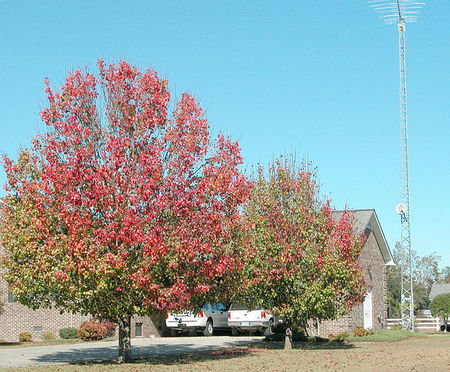
Leaves are oval, 4-7 cm long, glossy, dark green above, slightly paler below, remain on the tree until late autumn (November, December) and then turn yellow, orange, red-crimson and bronze.
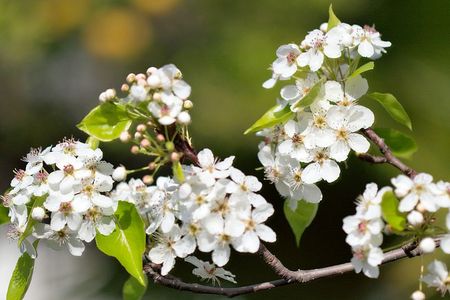
Flowers are white, with five petals, 2-3 cm in diameter, very ornamental, arranged in corymb-like inflorescences, appearing in spring before the leaves unfold, starting from mid or late April, lasting about 1 week.
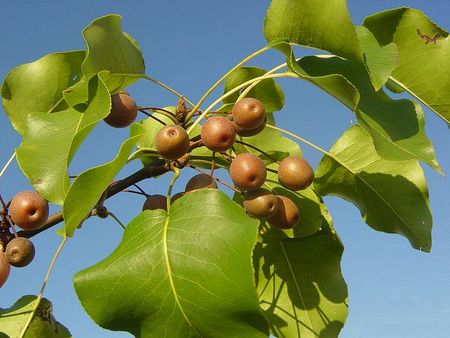
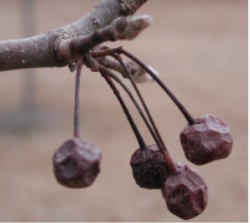
Fruits are small, up to 1 cm in diameter, light brown in color, inedible, remain very hard until the first frosts. After frosts the fruits become softer and are pecked by birds, which disperse the seeds.
Cultivars: 'Bradford', 'Chanticleer' ('Cleveland Select'), 'Aristocrat', 'Autumn Blaze', 'Capital', 'New Bradford', 'Redspire', 'Whitehouse'.
Hardiness zone 6a. Mature trees are fairly cold-hardy, while young trees may be slightly frost-damaged.
Location: grows well in sunny sites but can also tolerate partial shade. Prefers moist, well-drained fertile soil. However, it can grow on any soil, including acidic or alkaline. Resistant to urban conditions and drought, not affected by limited space. Prone to windthrow, and can also be damaged during heavy snowfalls. Can tolerate short-term flooding.
Pruning: pruning is similar to that for the common pear.
Planting: planting is best carried out in autumn.
Pests and diseases: resistance to pests and diseases is very high. Also resistant to fire blight.
Propagation: propagated by cuttings
Uses: used as a rootstock for pears Comice, Bosc, Seckel and Nashi. Also widely used as a pollen donor in pollenizer plantings and in breeding programs to develop pears resistant to fire blight. The wood has a very beautiful grain. It is used to make woodwind instruments and veneer for furniture. Grown as an ornamental plant for solitary and group plantings, and for creating avenues.