
Deciduous shrubs
Narrow-leaved pyracantha
Pyracantha angustifolia C.K.Schneid.
Synonym: firethorn
Pyracantha angustifolia (Pyracantha angustifolia C.K.Schneid.) – a species of evergreen plants of the Rose family (Rosaceae). The species was first described by the Austrian botanist Camillo Karl Schneider in 1906 in his book «Illustriertes Handbuch der Laubholzkunde».
In the wild it occurs in the southeastern part of China - Guizhou, Hubei, Sichuan, the Tibet Autonomous Region, the provinces of Yunnan and Zhejiang. It grows in thickets on slopes and along roadsides. In the mountains it rises to an altitude of 1600-3000 m above sea level. Widely cultivated in North America.
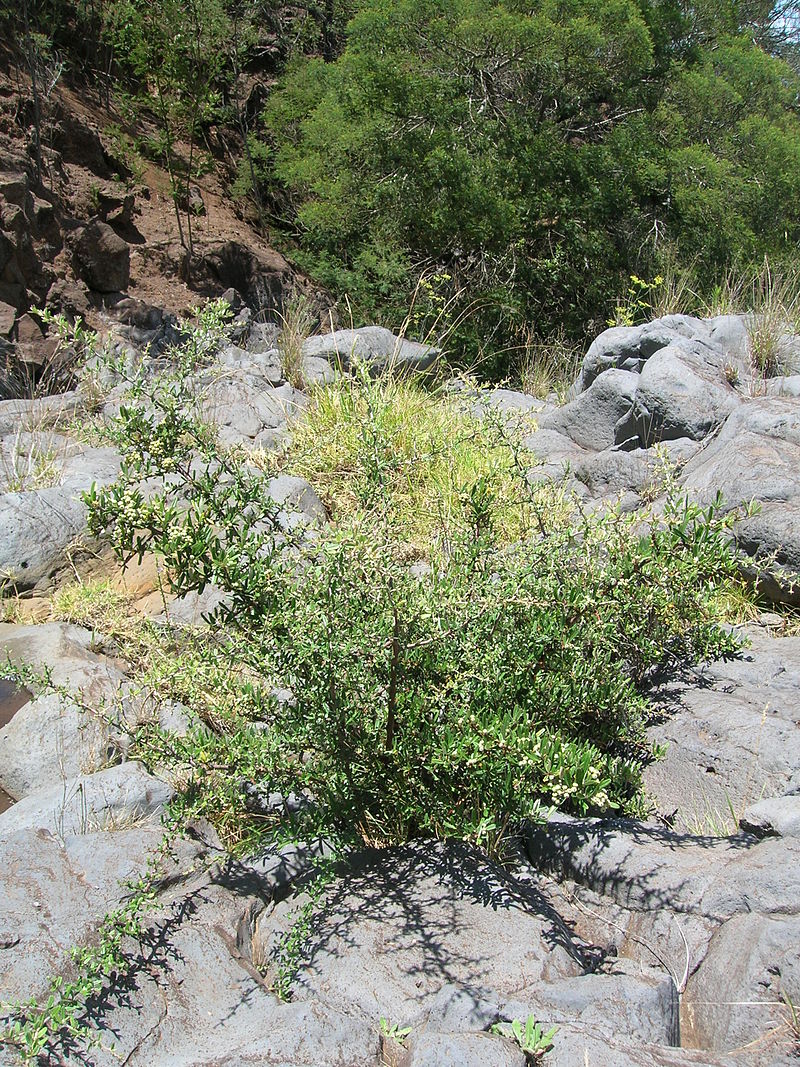
This is an evergreen, upright, spreading shrub up to 4 m in height. Shoots are purple-brown, covered with sparse thorns up to 2.5 cm long. Young shoots are densely pubescent, gray-yellow.
Leaves alternate, narrowly oblong or oblong-lanceolate, 1.5-5 cm long and 4-8 mm wide, emarginate or obtuse, less often acuminate, with a cuneate base and an entire or rarely toothed margin in the upper part of the blade, on a long petiole (1.5-2 cm long) or sessile. The upper surface of the blade is pubescent at first, later glabrous; the underside is grayish-pubescent.
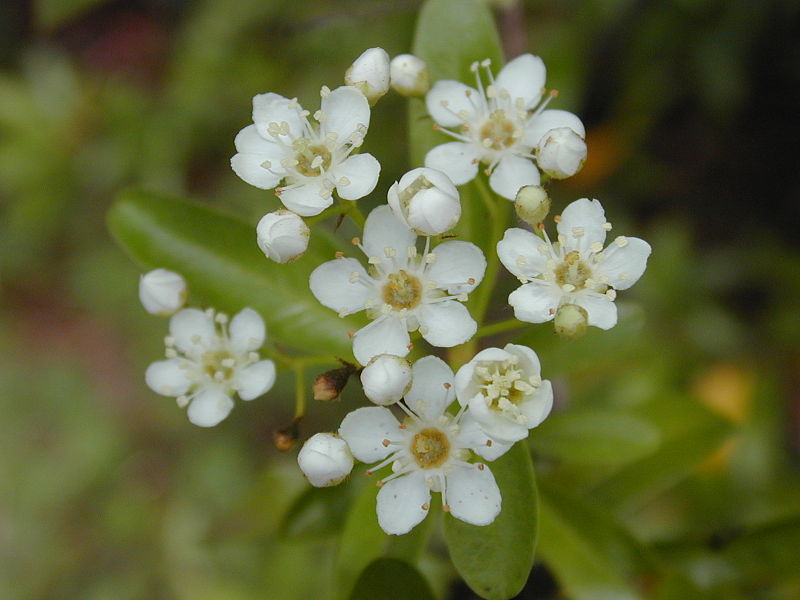
Flowers white, 0.25-0.8 cm in diameter, arranged in corymb-like inflorescences 2-4 cm in diameter. Fruit stalk densely gray-woolly. Bracts deciduous, lanceolate. Pedicel 1-2 mm long, densely pubescent, gray. Hypanthium bell-shaped, gray, densely pubescent. Sepals triangular, 1-1.1 mm long, densely gray-woolly, with an acute apex. Petals rounded, about 4 mm long, apex rounded or emarginate. Stamens 20; filaments 1.5-2 mm. Ovary woolly-white; styles almost the same length as the stamens. Flowering is sporadic, in May-June.
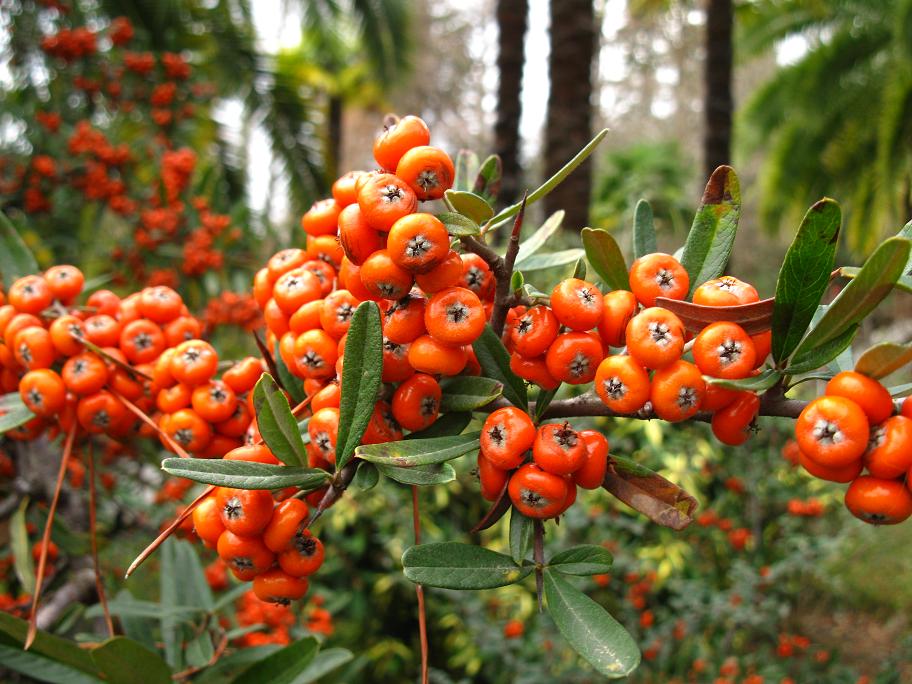
Fruits spherical, slightly compressed, 0.6-0.8 cm in diameter, bright orange, persist on the shrub throughout the winter. Ripens in September-October.
Varieties: ‘Orange glow’, ‘Orange charmer’, ‘Orange giant’, ‘Red Column’ (‘Red Firethorn’), 'Red cushion','Gnome', 'Monon', 'Yukon Belle'.
Hardiness zone: zone 5-8 (-25°C).
Location: a sun-loving plant, but also grows well in light partial shade. Performs well on sun-warmed sites sheltered from cold desiccating winds. Preferably grown near a south-facing wall.
Propagation: propagated by seeds, root suckers, layering, cuttings. Cultivars are propagated by grafting and cuttings. Pyracantha is used as rootstock.
Soil: a drought-tolerant plant, can grow on dry and moderately moist soils. Poorly tolerates waterlogged and flooded sites. On heavy soils it requires drainage of crushed brick or gravel with sand, 10-20 cm thick. Not demanding in fertility, can grow on ordinary garden soils. Grows best on loose, deep, fairly fertile and slightly alkaline loams.
Planting: planting is preferably done in early spring. For this, dig a hole twice the size of the root ball. Mix the excavated soil with a bucket of compost and plant the specimen.
Care: does not require fertilization. Young plants need winter protection with conifer branches or a layer of dry leaves.
Pruning: tolerates trimming well, which is done in mid-summer after flowering. Regrows quickly after radical rejuvenation pruning (to 20 cm above ground). Crown shaping is necessary for shrubs trained against walls. Freely growing shrubs do not require regular pruning. The more severe the pruning, the fewer berries set. When grown as a houseplant it requires heavy pruning.
Temperature: when grown as a houseplant requires a cool wintering at -2 to +7 °C.
Transplanting: in indoor culture transplanting is done very rarely, no more often than once every 3-4 years. Careless transplanting may provoke a halt in the plant's growth.
Diseases: bacterial blight, Phytophthora, pyracantha scab (Spilocaea pyracanthae).
Pests: aphids, caterpillars, chafer beetles.
Uses: used for plantings in parks and park-forests, in solitary and group plantings, for creating free-growing and clipped hedges.