
Deciduous shrubs
Pyracantha
Pyracantha
Synonym: firethorn
Pyracantha (Pyracantha M.Roem.) – a genus of evergreen or semi-evergreen plants in the family Rosaceae. The genus name comes from the Greek words 'pyr' – fire and 'akanthos' – thorn. The genus was first described by M.J. Roemer in 1847 in his work «Fam. Nat. Syn. Monogr.».
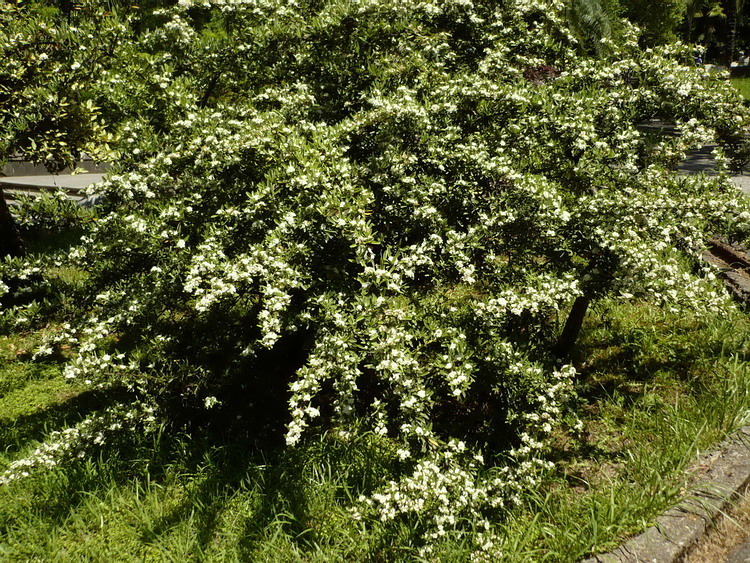
Pyracantha angustifolia (photo N. Golubev)
In nature it occurs in Southeast Asia (the Himalayas and central China) and in southern Europe. Plants grow on rocky slopes, at forest edges, in glades, in shrub thickets, and also under the canopy of open forests.

It is an erect and spreading evergreen or semi-evergreen shrub up to 6 m tall with a dense, spreading crown. It grows quickly. Shoots are covered with sparse spines up to 2.5 cm long. Buds are small, pubescent.
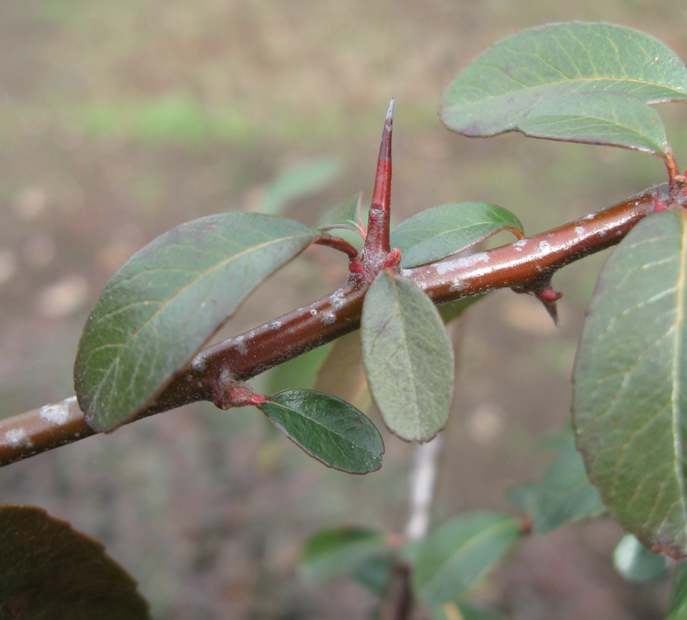
Pyracantha rogersiana (photo V. Grigorenko)
Leaves alternate, petiolate or sessile, simple, entire, oblong-elliptic or obovate in shape, up to 5 cm long; apex rounded, emarginate, less often acute; base cuneate; margins entire or with a small number of teeth in the upper part. The upper surface of the blade is at first pubescent, later glabrous, leathery, glossy; the underside is more or less pubescent, paler.
The plant is monoecious. Flowers 0.5-1 cm in diameter, white or pink-cream, fragrant, gathered in corymb-like many-flowered inflorescences that appear on shortened last year’s shoots. Sepals, petals and stamens are fused at the base into a fleshy floral tube. There are 5 sepals, which remain on the fruits. Petals rounded, 5 in number. Stamens 20, anthers red or yellow. Carpels 2-5. Ovary inferior. Flowers in May-June.
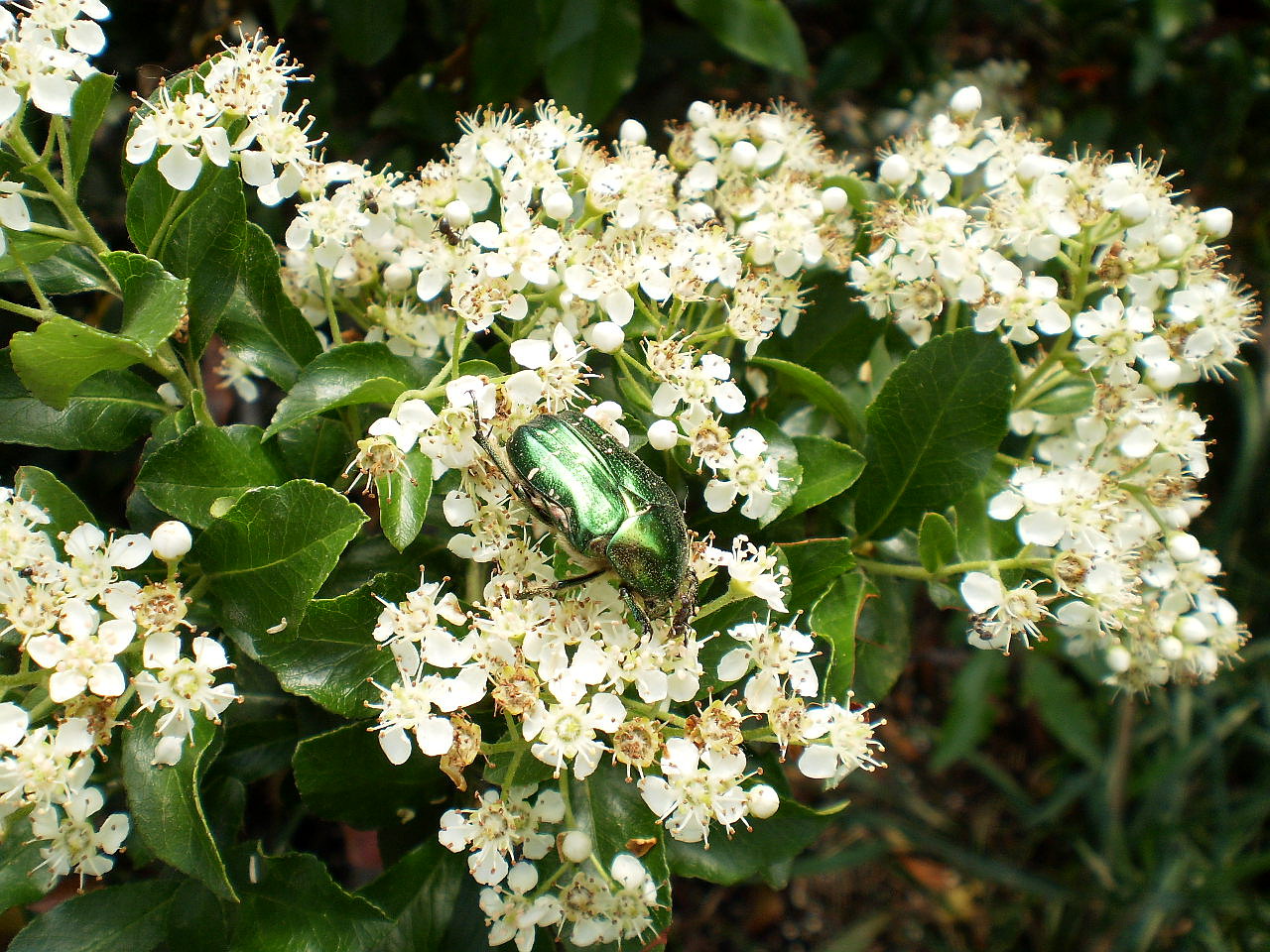
Pyracantha coccinea (photo M. Shevchenko)
Fruits globular, slightly compressed, small pomes, 0.6-0.8 cm in diameter, with a long-persistent calyx, scarlet-red, orange or yellow. Fruits are bitter, not poisonous, inedible. They ripen in late August – early September and persist on the branches for a long time.
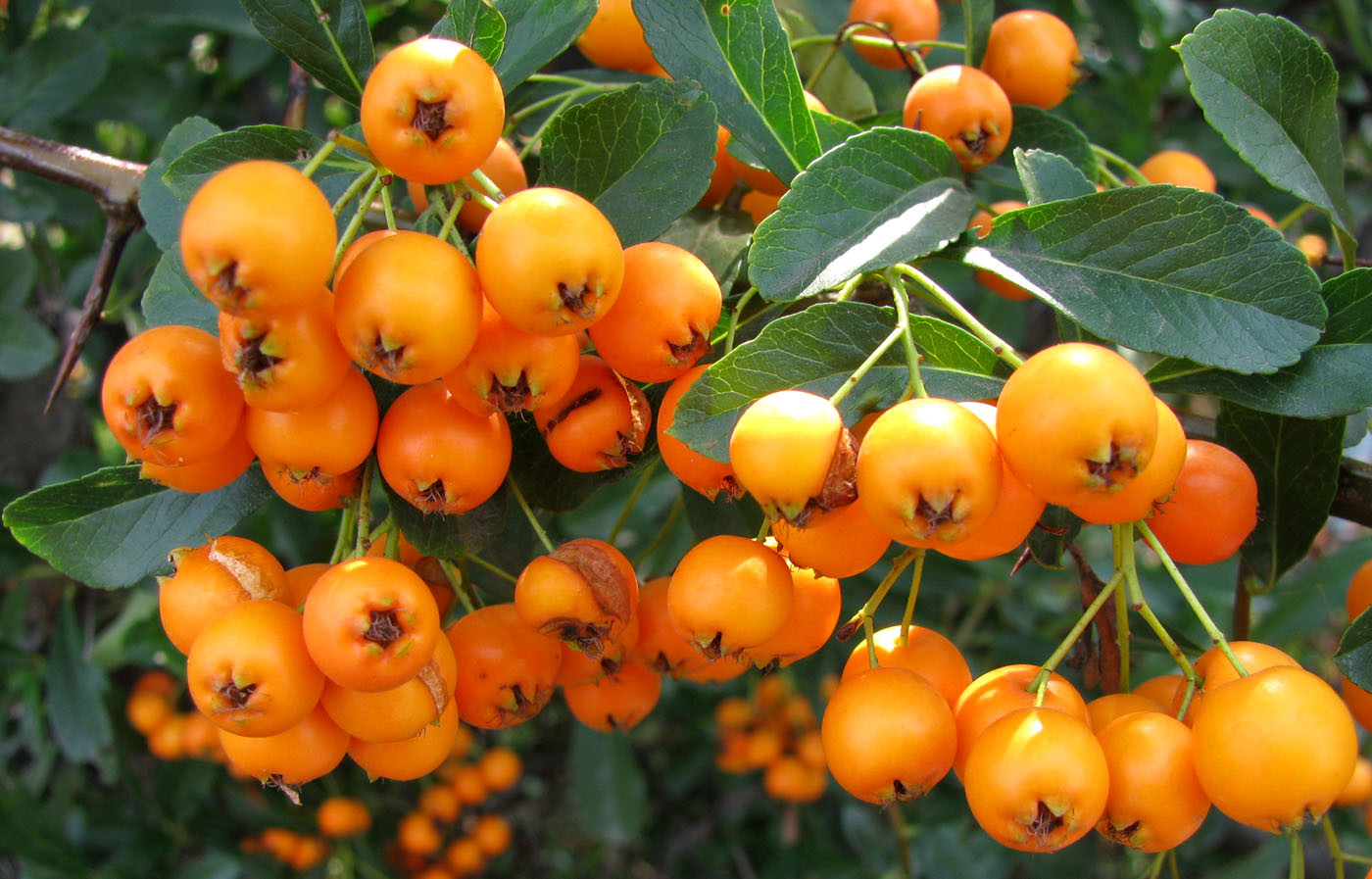
Pyracantha coccinea (photo V. Papchenkov)
Species: the genus includes at least 6 species:
- Pyracantha angustifolia – narrow-leaved pyracantha (Southwest China).
- Pyracantha atalantioides – Pyracantha atalantioides (Southern China).
- Pyracantha coccinea (Scarlet firethorn) – bright-red pyracantha (Northeast Spain and east to northern Iran).
- Pyracantha crenatoserrata – Pyracantha crenatoserrata (Central China).
- Pyracantha crenulata – Pyracantha crenulata (Himalayas).
- Pyracantha koidzumii – Pyracantha koidzumii (Taiwan).
- Pyracantha rogersiana – Pyracantha rogersiana (Yunnan, China).
- Pyracantha fortuneana – Pyracantha fortuneana (Central China)
Hybrids: Osteomeles Lindl. × Pyracantha M.Roem. = Pyracomeles
Cultivars: 'America', 'Firelight', 'Golden Charmer', 'Golden Dome', 'Lalandei', 'Mohave', 'Navajo', 'Orange Glow', 'Rosy Mantle', 'Santa Cruz', 'Soleil d'Or', 'Teton', 'Watereri'
Hardiness zone: zone 5-8 (-25°C).
Location: a sun-loving plant, but it also grows well in light partial shade. Does well on sun-warmed sites sheltered from cold, drying winds. Preferably grown near a south-facing wall.
Propagation: species are propagated by seeds, root suckers, layers, and cuttings. Cultivars are propagated by grafting and cuttings. Pyracantha is used as a rootstock.
Soil: a drought-tolerant plant; can grow on dry and moderately moist soils. Poorly tolerates waterlogged and flooded sites. On heavy soils it needs drainage of crushed brick or gravel with sand, layer 10-20 cm. Not demanding in fertility, can grow on ordinary garden soils. Best grown on loose, deep, reasonably fertile and slightly alkaline loams.
Planting: planting is preferably carried out in early spring. For this, dig a hole twice the size of the root ball. Mix the excavated soil with a bucket of compost and plant.
Care: does not require fertilization. Young plants need winter protection with conifer boughs or a layer of dry leaves.
Pruning: tolerates clipping well; pruning is carried out in mid-summer after flowering. Regenerates quickly after radical rejuvenation pruning (to 20 cm from the ground). Crown shaping is necessary for shrubs trained over walls. Freely growing shrubs do not require regular pruning. The harder the pruning, the fewer berries set. When grown as a houseplant it requires heavy pruning.
Temperature: when grown as a houseplant requires a cool wintering at -2 to +7 °C.
Transplanting: in indoor culture, transplant very rarely, no more often than once every 3-4 years. Rough transplanting may cause cessation of growth.
Diseases: bacterial scorch, Phytophthora, pyracantha leaf spot (Spilocaea pyracanthae).
Pests: aphids, caterpillars, chafer beetles.
Uses: ornamental for abundant flowering with corymbose inflorescences, a densely branched thorny crown, evergreen or semi-evergreen foliage and long-lasting brightly colored berries on the shrubs. A good nectar plant. Can be grown in large containers. Used to create dense, tall, freely growing or clipped hedges, shrub borders, to decorate walls of outbuildings, to make espaliers, in rock gardens. Cultivated as a houseplant, bonsai and topiary.