
Flowers for the garden
Puschkinia
Puschkinia
Puschkinia (lat. Puschkinia) — a genus of perennial bulbous plants of the family Hyacinthaceae (Hyacinthaceae). Some sources place the genus in the family Asparagaceae (Asparagaceae) or Liliaceae (Liliaceae). The genus includes only two species. In the wild they are found on damp rocky slopes, on mountain meadows and among shrubs in Asia Minor and the Near East and in the Caucasus. Both species are very ornamental.
The genus is named after Apollos Apollosovich Musin-Pushkin (1760—1805), a Russian chemist and mineralogist, vice-chairman of the Mining Board, a member of the Royal Society of London, who first collected these plants on Mount Ararat in 1802.
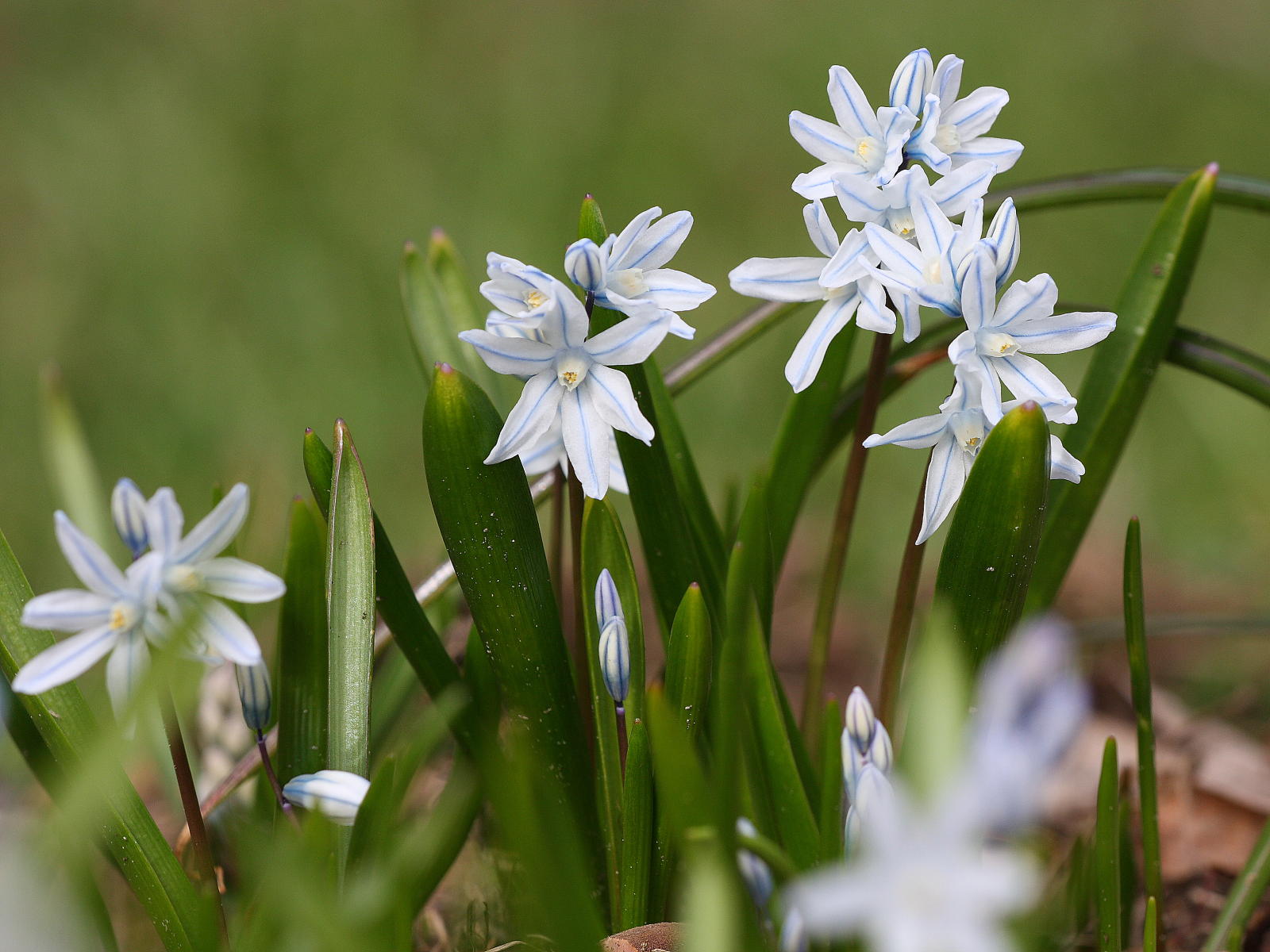
Herbaceous bulbous plants, early-spring ephemeroids. Bulbs ovoid in shape with brownish thin outer scales.
Leaves dark green, linear strap-shaped, numbering 2—3 and located at the base of the stem. Flowers in racemose inflorescences at the tips of scapes 15—18 cm tall. The perianth is pale blue or white, bell-shaped, consisting of 6 segments fused at the base into a short tube. The scent of Puschkinia flowers is not very pleasant. Fruit — a fleshy capsule with rounded, light-brown seeds.
In cultivation:
Puschkinia hyacinthoides — Puschkinia hyacinthoides
Grows on dry grassy and rocky slopes of the upper-mountain belt of the Eastern Transcaucasus and northern Iran. A charming small plant with pale blue or nearly white flowers. Bulbs up to 2 cm in diameter. Leaves linear, fleshy, about 15 cm long and up to 1 cm wide. Sturdy scapes about 15 cm tall terminate in compact, oval-shaped inflorescences. A mature bulb produces 2—4 scapes. Inflorescences consist of 12—15, sometimes up to 30, nodding flowers. Flowers about 1.5 cm in diameter, white or pale blue, with a bright blue stripe along the midrib (back) of the perianth segments.
Puschkinia scilloides — Puschkinia scilloides
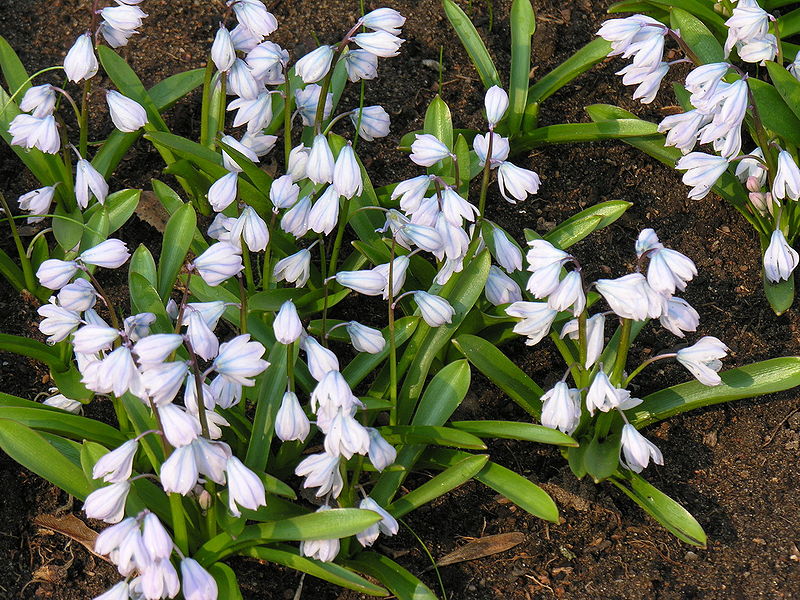
Occurs on forest edges, meadows and among shrubs from the mid-mountain to alpine belt of the Caucasus, northern Iran, Turkey and Lebanon.
A low perennial bulbous plant with two basal leaves that appear simultaneously with the scapes. Leaves narrowly linear, 12-15 cm long, dark green, rather fleshy. Scape up to 20 cm tall. Flowers bell-shaped, pale blue with a blue stripe down the middle of each perianth segment, 2 cm in diameter, pleasantly scented, gathered in a compact, racemose, few-flowered inflorescence up to 12 cm long. Fruit — a fleshy capsule. Seeds light brown. Flowers in May for 20—25 days. Bulbs ovoid or nearly rounded up to 3 cm long, 2—2.5 cm in diameter with brownish outer scales.
Location: sunny sites, but can tolerate slight shade.
Soil: prefers fertile, well-drained soils.
Care: consists of timely removal of weeds that suppress growth of Puschkinia; in spring loosen the soil for better air exchange; if the spring is dry, plants need watering. In autumn, at the end of September—October, mulch the plantings with peat or humus to protect them over winter.
Propagation: by bulbs and seeds, sowing of which is carried out in autumn. Young plants flower in the 3rd—4th year. A mature bulb within 4—5 years after planting forms a “nest” of 5—7 bulbs of different ages. Therefore, after 5—7 years Puschkinia should be dug up and the “nests” divided.