
Fruit trees
Pomegranate
Punica
Synonyms: Pomegranate shrub, Pomegranate tree
Pomegranate – a genus of small trees or shrubs of the family Lythraceae (Punica). Widely distributed worldwide in tropical and subtropical climates from 41° S to 41° N. Cultivated in Afghanistan. Found in the Middle East, Spain, Iran, Greece, Italy, Armenia, Azerbaijan, Georgia, Portugal, Crimea, Uzbekistan, Tajikistan, France, countries of the former Yugoslavia. In Russia it is cultivated in Sochi and Southern Dagestan. Also occurs on Socotra Island (Arabian Sea). The botanical name for the genus «Punica» was given by Carl Linnaeus in 1758; it comes from the Latin punicus - Punic, Carthaginian, since this plant was widespread in that country (modern Tunisia).
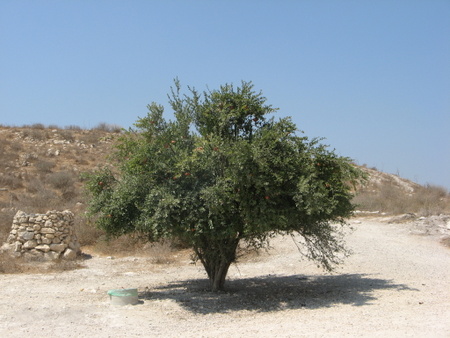
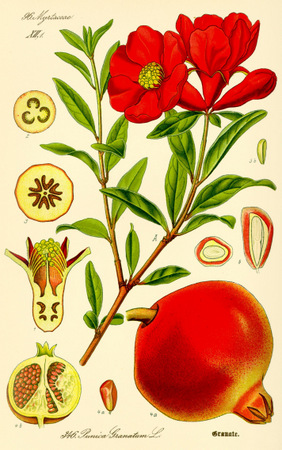
Members of the genus are low deciduous fruit trees or shrubs, reaching a height of 5-6 m. Branches are thorny and slender. Crown spreading, umbrella-shaped. In indoor conditions it appears as a small shrub or tree 1.5-2 m high. Bark grayish-brown. Lives up to 20 years.
Leaves opposite, glossy, up to 7 cm long, elongated-elliptic in shape, light- or dark-green in color.
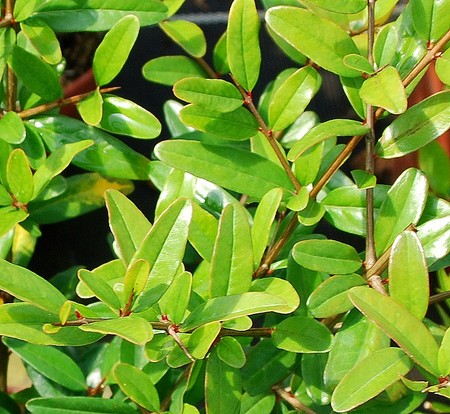
Punica granatum Nana
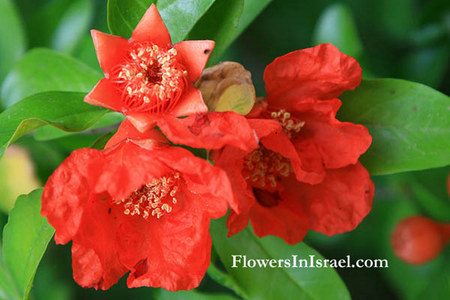
Flowers from May to August. There are two kinds of flowers: large, bright-orange, up to 3 cm in diameter, bell-shaped (these do not set fruit) and bisexual, urn-shaped (these set fruit), without scent. Intermediate forms also occur. The calyx of the flower is leathery, colored, with 5-7 triangular fleshy lobes. Stamens and petals are attached to the throat of the calyx. Flowers occur singly or in groups of 2-3 in the leaf axils. The pistil is single, with a slightly lobed, thickened stigma. Flowers are very decorative.
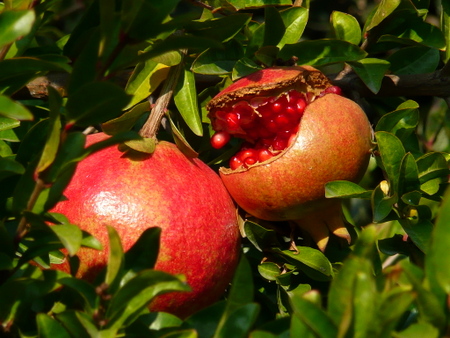
Fruits are globose "pomegranates" – large berries with a persistent calyx and a leathery pericarp, 5-12 cm in diameter. Skin color ranges from orange-yellow to brownish-red. Some fruits can reach 15-18 cm in diameter. Seeds are numerous; one fruit contains 100-1200 seeds, which are located in 6-12 locules or chambers arranged in two tiers. Around each seed is a juicy edible aril, which makes up more than 50% of the fruit's total weight. Yield is high, averaging 50-60 kg per tree. Fruits ripen in September-October.
Species: common pomegranate (Punica granatum L.) and Socotran pomegranate or protopunica (Punica protopunica Balf.).
Hardiness zone: zone 11a (+5°C)
Site: prefers well-lit, warm and wind-protected locations that are in sun throughout the day (especially in temperate zones). Well-draining soil with good drainage. Grows well on dry and rocky soils. On clay soil with water stagnation the roots may rot, and the fruits can have a sour taste. Not demanding to soil, but grows well on slightly acidic to moderately alkaline soils.
Planting: planting is best done in autumn in October-November. Can also be planted in spring. Soil mix: fertile topsoil should be mixed with sand and peat in equal proportions. The plant should be planted leaning to the south for easier winter covering.
Pruning: shaped by spring pruning, which stimulates branching. Young shoots are recommended to be trimmed, leaving 2-5 pairs of leaves. Pruning should be done to an outward-facing bud.
Care: in the first year after planting you can fertilize with ammonium sulfate 3 times at 1/3 cup each. It is recommended to do this in February, May and September.
Diseases: susceptible to fungal diseases.
Pests: mealybug and spider mite, aphids and caterpillars of the pomegranate moth.
Propagation: by seeds, cuttings (less often by layering), and also by grafting. When propagating by seed one can use
Uses: very decorative during flowering and fruiting. In landscape design used as a specimen on the lawn. Fruits are eaten fresh and used for making juices