
Flowers for the garden
Hoary Veronica
Pseudolysimachion incana
Synonyms: Pseudolysimachion incanum (L.) Holub., Veronica bellidifolia Juz., Veronica spicata subsp. incana (L.) Walters, veronica with white-felt, Veronica margaritifolia, silver veronica, grey veronica, Veronica incana (vernacular), Veronica incana (grey) [note: Russian common names translated literally].
Hoary Veronica (Veronica incana L.) – a species of plant in the genus Veronica of the Plantaginaceae family. The species was first described by Carl Linnaeus in 1753 in "Species Plantarum 1: 10". In cultivation since 1759.
In nature it grows in Western Europe – in Romania, Serbia, Bulgaria, Ukraine (Chernivtsi region); in Asia – in Mongolia, China. It is found on rocky and steppe slopes, on cliffs, in dry pine and deciduous forests, less often on saline meadows, in the subalpine and alpine belts, on slopes with limestone and marl, and also in dry riverbeds.
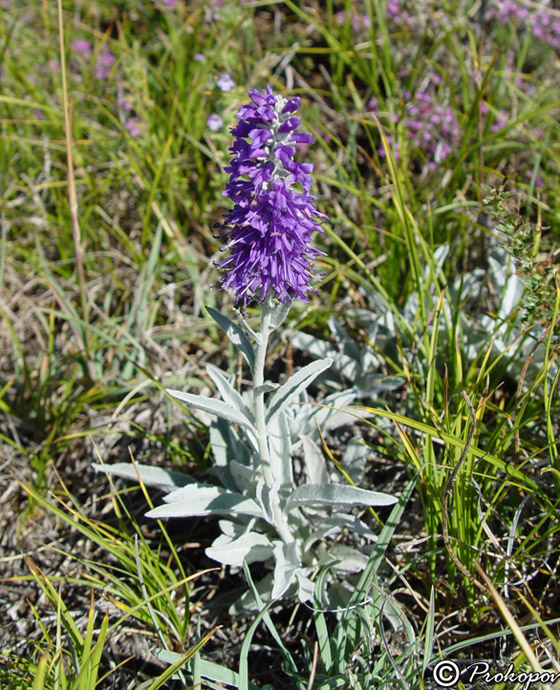
It is a perennial herbaceous plant 10-45 (60) cm tall. Stems erect, robust, sparsely branched or simple, ascending, grayish or white, less often greenish, woolly-pubescent; hairs curly and fine. Roots woody, ascending, branched, thin.
Василий Гелюта
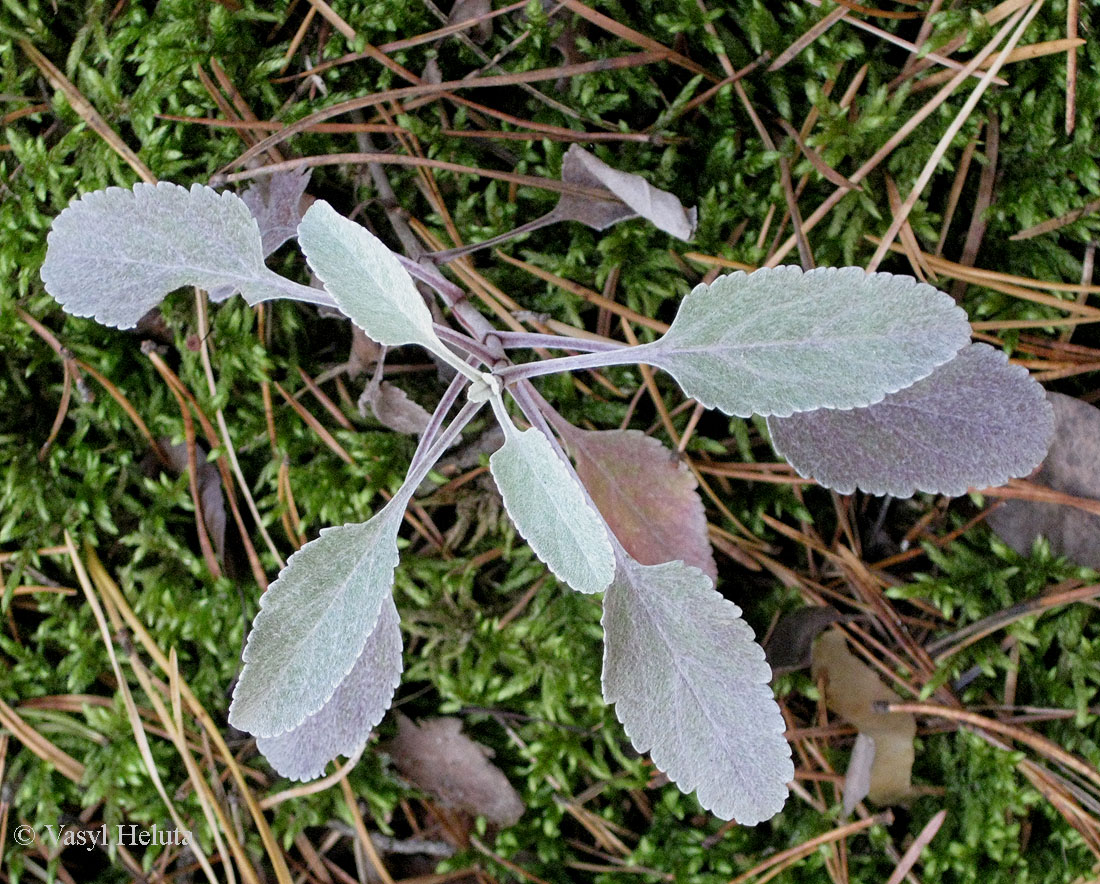
Leaves opposite, slightly appressed to the stem, directed upward at an acute angle, ovate, oblong or lance-oblong in shape, 1.5-10 cm long and 0.5-2 cm wide, entire at the apex, indistinctly finely crenate or bluntly toothed at the margin, base cuneate. Lower leaves form a rosette, often overwintering, ovate to oblong in shape, finely crenate-toothed at the margin, obtuse or rounded at the apex; petiole up to 2.5 cm long. Upper leaves lance-oblong to lanceolate, petiole up to 1 cm long, entire or almost entire. Leaves at the top reduced, sessile.
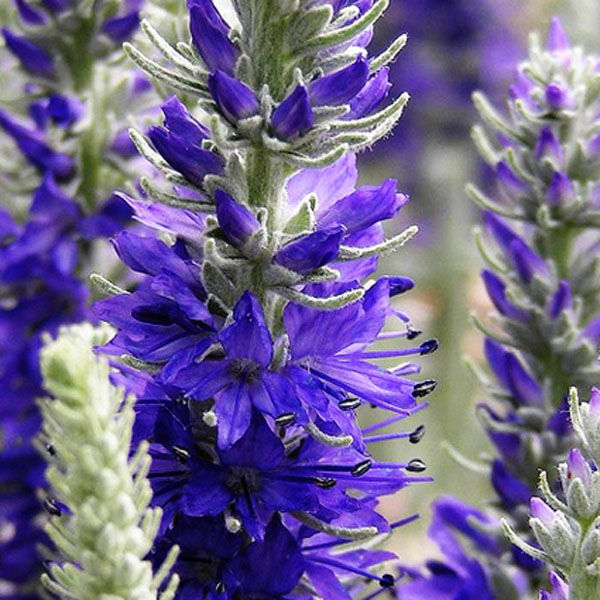
Flowers are gathered in a terminal dense solitary raceme, less often with 2 lateral branches, spike-like in form, 3-10 (30) cm long, 1.2-1.5 cm in diameter, sometimes interrupted below. Bracts lance-linear in shape, upper ones awl-shaped, twice as long as the pedicels, equal to the calyx or slightly exceeding it, white-woolly, without glandular pubescence. Flowers on short pedicels or almost sessile, shorter than the calyces, bright blue or vivid light blue. Calyx 3-4 mm long, deeply divided into 4 unequal lobes, ovate-oblong or lanceolate in shape, obtuse. Corolla tubular-bell-shaped. Corolla lobes acute or obtuse, irregular, from oblong-ovate to ovate (2 lateral) in shape and broadly ovate lobes. Stamens straight, exserted from the corolla. Anthers ovate, 1-2 mm long. Flowers in June-August.
Capsules rounded, ovate or rounded-reniform in shape, 3-5 mm long and wide, base rounded or shortly cuneate, dehiscing at the apex with a narrow notch. Seeds 0.75 mm long and 0.5 mm wide, ovate, plano-convex or flat.
Chromosome number: 2n = 32
Subspecies:
- Veronica incana ssp. Hololeuca
- Veronica incana subsp. incana
Cultivars: 'Pure Silver', 'Silver Carpet', 'Silbersee'.
Hardiness zone: 3a (-40°C).
Exposure: Prefers full sun, but tolerates shade.
Soil: prefers dry, rocky, light, calcareous soil. Drought-tolerant.
Care: practically requires no care. When flowering is finished the shoots are pruned. Does not require winter shelter.
Pests: Dasyneura veronicae (gall midge), mites Anceria anceps.
Diseases: raspberry ring spot, mycorrhiza.
Propagation: propagated vegetatively (cuttings), by division or by seeds. Seeds are sown in autumn or spring. Plants grown from seed flower in the 2nd year. Take cuttings in May or June.
Uses: used in rock gardens, mixed borders,