
Indoor plants
Pseuderanthemum
Pseuderanthemum
The genus includes about 60 species of evergreen perennials and shrubs from forests in tropical regions worldwide. As the genus name indicates, Pseuderanthemum resemble Eranthemum in appearance (Latin: pseudo - «false»). Pseuderanthemum are grown for their attractive decorative foliage, which somewhat resembles fig leaves. Flowering is rare under indoor conditions. Decorative forms of the dark-purple Pseuderanthemum are popular in cultivation. Its native range is Polynesia. The key to successful indoor cultivation is high air humidity.
Pseuderanthemum tuberculatum – (Pseuderanthemum tuberculatum)
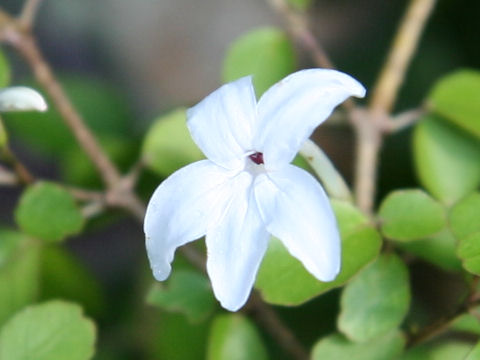
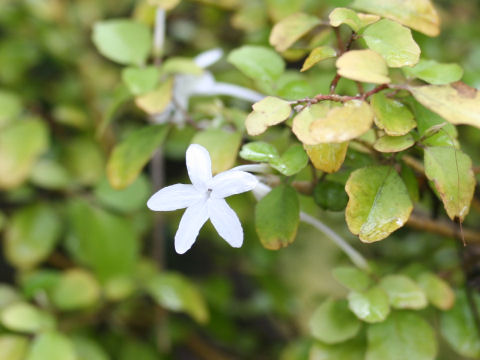
A low-growing, freely branching shrub with horizontally spreading shoots. Stems thin, tuberculate. Leaves opposite, unequal in a pair, oval to rounded, with a wavy margin, 1-3 cm long, glossy. Flowers numerous, pure white, solitary in the leaf axils, with a long (up to 4 cm), thin, almost filiform tube slightly widening at the top and a spreading 5-lobed limb 3-3.5 cm in diameter. Flowers almost year-round. Native to New Caledonia.
Pseuderanthemum atropurpureum – (Pseuderanthemum atropurpureum Bailey = Eranthemum atropurpureum hort.)
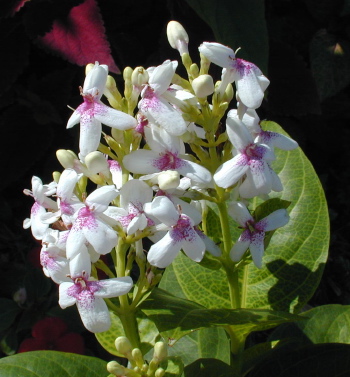
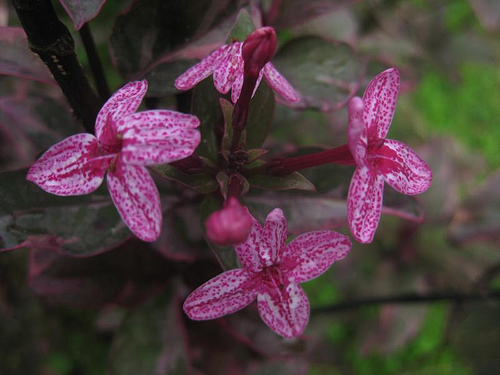
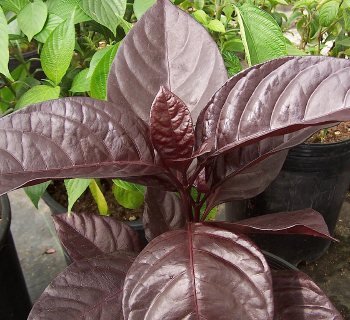
An evergreen shrub up to 120 cm tall. Stems glabrous, branching, quadrangular. Leaves up to 15 cm long, opposite, shortly petiolate, oval or ovate, acute, entire, reddish-lilac above, less often green, green beneath, tinged with red. Flowers are gathered in a terminal many-flowered compound racemose inflorescence up to 15 cm tall. The calyx, like the corolla, is five-parted, yellowish or reddish. The corolla is funnel-shaped or wheel-shaped, about 3 cm long, white with a reddish throat. The limb is shorter than the tube; its lobes are ciliate on the margin. In cultivation since the second half of the 19th century. A more popular form, `Tricolor`, has leaves adorned with irregular dark-green, yellow, and pink spots.
Location: sheltered from direct sunlight, semi-shade at a temperature of 20 °C. Plants are kept in winter at 16-18 °C. Light-loving. General care.
Lighting: good, but not direct sunlight.
Watering: requires frequent watering with soft water at room temperature.
Air humidity: cultivation of this plant is possible at an air humidity of at least 60%.
Care: apply a complete mineral fertilizer in spring and summer.
Propagation: by terminal cuttings, rooting them at 20-25 °C in water or in a light loose substrate made of a mixture of peat with sand or sphagnum.
Repotting: as needed, in spring, into a light nutritious substrate.