Deciduous shrubs
Three-lobed almond
Prunus triloba (Louiseania triloba)
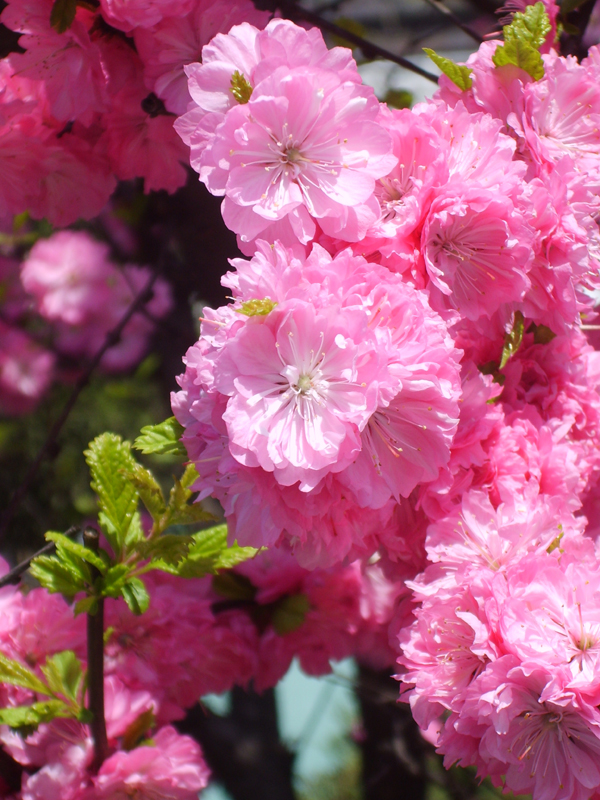
A very beautiful deciduous shrub. It was discovered in northern China in 1831. This plant, under the name Chinese double-flowered plum, was introduced to England from China in the middle of the last century. It reached our country (meaning the territory of the former Soviet Union) apparently by three routes: from England via other European countries, directly from China via Manchuria and Primorye, and from China via Central Asia. In Western Europe the plant became known as the three-lobed plum (Prunus triloba). In our country it was also known as the three-lobed almond (Amygdalus triloba), although already in 1959 botanists finally assigned it to the genus Louiseania (Louiseania triloba). In everyday speech the plant is very often called Japanese cherry or sakura, although this is completely incorrect.
Within the territory of the former USSR the double-flowered form of Louiseania is widespread. It can be seen in an amateur gardener's plot as well as in a botanical garden's collection or display. However, in landscaping the plant is encountered quite rarely, and paradoxically this is mainly because of its extreme decorative value during flowering (it is stolen, cut for bouquets, etc.), and, of course, because of the lack of planting material and the unawareness of landscape workers.
Appearance: a medium-sized shrub or a very small tree with radiately arranged shoots, medium- or fast-growing.
Flowers: borne in pairs on the shoots, of various colors — dark pink, light red, raspberry, single, up to 1.5 cm in diameter, flowering before the leaves open in the first half of May, for about 2.5 weeks.
Fruits: a rounded drupe, up to 1 cm, with a dry, velvety mesocarp that dries before falling, with a slightly sculptured, poorly separable stone.
Leaves: borne in clusters on fruiting shoots, coarsely toothed at the margin, indistinctly three-lobed, densely hairy underneath when unfolding, later glabrous; leaves of the growing shoots are sharply finely toothed at the margin, with more clearly defined lobes; in autumn pale yellow or brown.
Requirements: sun/partial shade, prefers warmth, winter-hardy, suitable for urban conditions, needs protection from wind, early-opening flowers can be damaged by late frosts.
Soils: from fresh to moist, from neutral to slightly alkaline, well-drained, sandy-loam or loamy substrates; does not grow on heavy, compacted soils.
Note: branches should be pruned back by 2/3 after flowering, since the flowers form on last year’s shoots.
Zone: 5a