
Deciduous shrubs
Cherry laurel Rotundifolia
Prunus laurocerasus "Rotundifolia"
Cherry laurel Rotundifolia (Prunus laurocerasus "Rotundifolia") – a cultivar of cherry laurel (Prunus laurocerasus L.) from the genus Prunus, family Rosales. The cultivar was obtained in 1865 in France at the nursery L.C.B. BILLARD & BARRE.
It is an evergreen broadleaf, vertically growing shrub with a compact crown, becoming broader and more open with age. It reaches 2-
Leaves are alternate, broadly elliptic to obovate, (10) 13-17 cm long, 6-8 cm wide, margins rounded, leathery, paler green than those of laurocerasus “Caucasica”, but equally glossy and toothed on the edges.
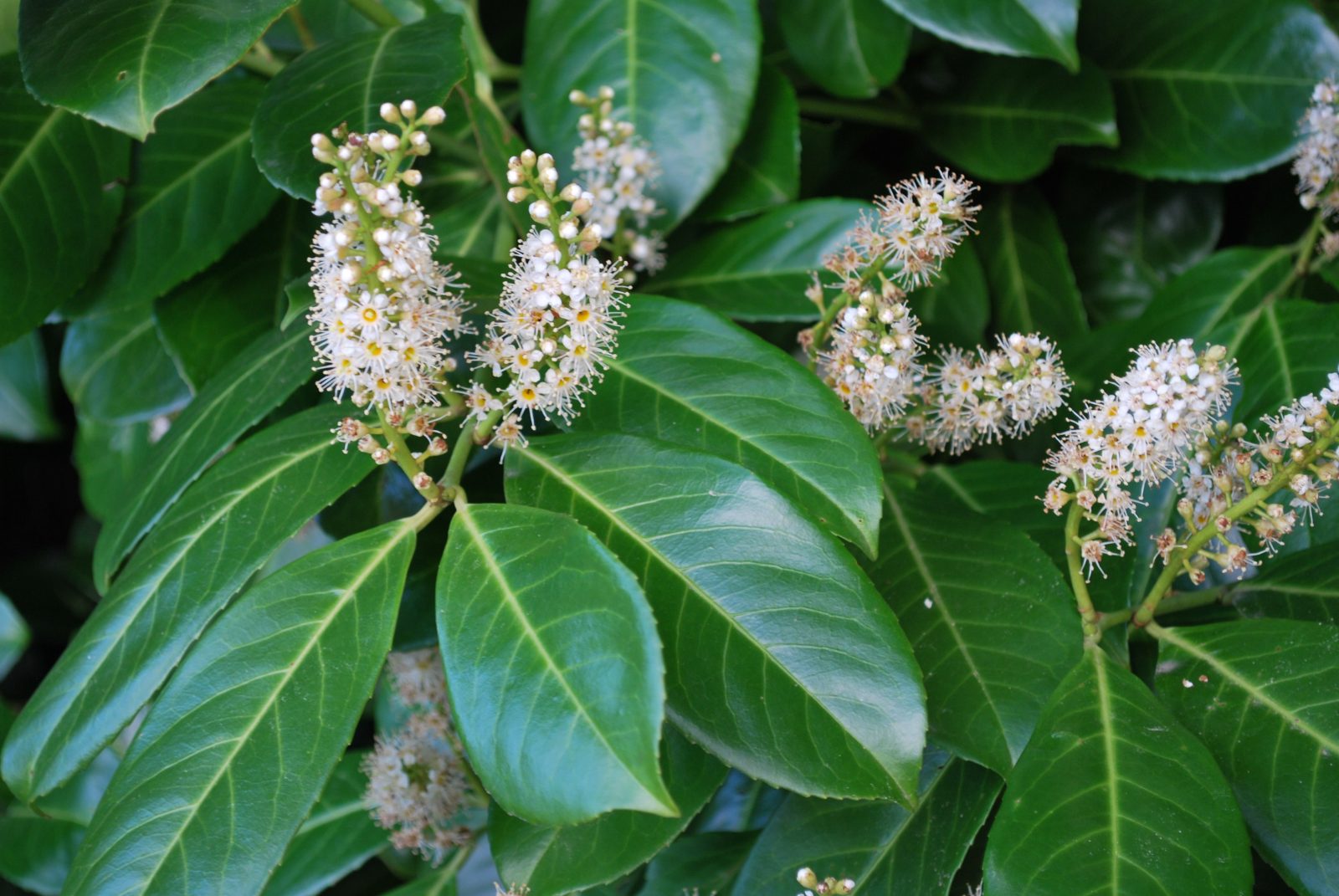
Flowers white, arranged in erect racemes 20 cm long. Flowers in May.
Fruits sharply ovoid or conical, about
Hardiness zone: 6a-7a (-23°C).

Site: tolerant of urban conditions. Prefers light but tolerates shade. The plant is fairly tolerant of temperature fluctuations.
Soil: Grows well on dry, moist, humus-rich, fertile garden soils, from slightly acidic to alkaline. Overall undemanding and also grows well on light sandy soils. For container cultivation a substrate composed of equal parts peat and fertile soil is used. An advantage of container growing is the ability to avoid complex procedures such as transplanting; it is usually sufficient to replace the spent top layer of soil with a new, more fertile one. A positive effect is achieved by adding a complete fertilizer to the watering water at a rate of
Care: responds well to the application of organic fertilizers; dosages are small – 5-7 kg/ sq.m.
Pruning: pruning should be carried out at the end of winter, and when grown as a hedge also in August to maintain a neat and tidy appearance.
Watering: watering is recommended during hot periods.
Propagation: by seeds, green cuttings and layering. When propagating by seeds, it should be taken into account that seeds must be sown immediately after the fruits mature, since their germination rapidly declines during storage; it can even be said that the seeds do not store at all. The life of the seeds can be slightly extended by placing them in a moist environment. Seeds sown in autumn into moist soil germinate uniformly in spring; young plants are best transplanted immediately to a permanent place, as the root system of cherry laurel suffers greatly during transplantation. As for propagation by layering, the yield of planting material here is somewhat lower than when sowing seeds. This method is subdivided into three different variants: arching layers, vertical and horizontal. As for propagation by arching layers, everything is done the same as with currants; this method is very widespread and does not need detailed description. A different matter is propagation by vertical layers, a method known to few, so it is worth describing in more detail. It is as follows: early in spring or late in autumn the cherry laurel bush is cut back completely, leaving only stumps not exceeding three centimeters in height. Then green shoots grow from these stumps, which should be thinned, leaving only the strongest. When the length of the shoots reaches twenty centimeters they should be earthened up, leaving only the tip and watered abundantly. During the entire growing season the plants should be mounded and watered, and in autumn, when the shoots have formed roots, they should be unmounded and, separated from the parent plant, planted in a new place. Propagation by green cuttings is the most difficult method, but if done correctly standard planting material can be obtained in the current year. The essence is as follows: still non-woody shoots are cut in June and divided into cuttings 10-
Pests: thrushes
Diseases: powdery mildew of grapevine, which manifests as powdery spots on the leaves. Getting rid of this disease is quite simple; carry out standard treatments with sulfur-based or similar fungicides.
Uses: Used for hedges, planted singly or in groups.