
Fruit trees
Domestic plum
Prúnus doméstica
Domestic plum (lat. Prunus) — a species of fruit trees of the genus Plum (Prunus), subfamily Plums (Amygdaloídeae or Prunoídeae, Spiraeoídeae) of the rose family (Rosácea). Widely distributed in the temperate zone of the Northern Hemisphere.
A tree reaching up to 15 m in height, the crown is broadly or narrowly ovoid. Lifespan depends on the cultivar; on average it lives up to 25 years, of which the productive period is 10–15 years.
Г.А.Курсаков
The root system is of the taproot type; the main part of the roots lies at a depth of 20–40 cm.
Leaves alternate, shortly petiolate, simple, elliptic or obovate in shape, with a serrated or crenate margin, pubescent beneath. They reach 4–10 cm in length and 2–5 cm in width.
Flowers are white, 1.5–2 cm in diameter, borne singly or in groups of 1–3. Self-fertility depends on the cultivar. Yield increases when several cultivars are planted. Fruiting in early-bearing cultivars begins in the 2nd–3rd year after planting; late-bearing cultivars begin in the 6th–7th year. It bears fruit for 10–15 years or more.
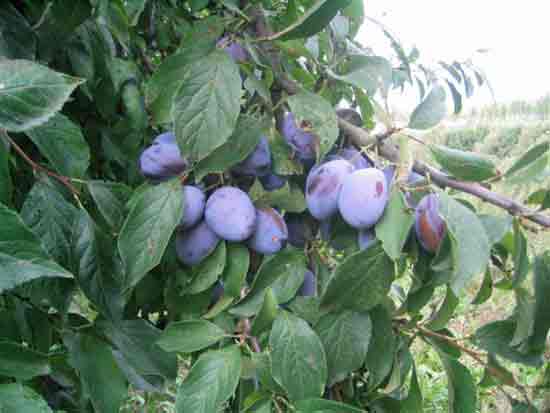
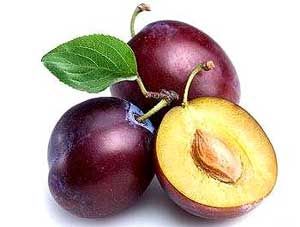
Fruits are fleshy drupes, purple, pale green, red, or black-blue in color with a glaucous waxy bloom. The stone is oblong-oval, flattened, pointed at both ends.
Hardiness zone: 5
Cultivars: divided into pomological groups – venherka (Hungarian), renclods, egg plums, mirabelles and others. Popular cultivars include: Стенли, Ренклод Альтана, Комета, Красная ранняя, Память Тимирязева, Искра, Ксения, Венгерка Московская, Президент, Рекорд, Тульская, Сизый голубок, Чачакская.
Site: prefers moist, loamy, well-drained, warm and nutrient-rich soils. Of all fruit trees it is the most demanding of moisture, so regular irrigation is recommended during active vegetation. Does not tolerate waterlogging; groundwater should be no closer than 1.5 m to the soil surface. When planting plums in rows, it is best to orient rows north–south; spacing between seedlings should be no less than 2–3 m.
Pollination: some plum cultivars are self-sterile. Cross-pollination significantly increases yield. Therefore it is recommended to plant several trees nearby or in a row. Even self-fertile cultivars show a significant yield increase with such planting. Cherry-plums (alycha) can also be interplanted for pollination.
Planting: It is preferable to plant plums in spring, because many seedlings die when planted in autumn. In autumn seedlings should be heeled in so that they are covered by snow during winter. The soil at the planting site should be cultivated to a depth of at least 35–40 cm. Planting scheme – 4 x 6 m. Dimensions of the planting hole – 50 x 50 cm. Add 10–16 kg of manure or compost, 100–150 g of double superphosphate, 80–120 g of potassium sulfate or 60–80 g of potassium chloride, 400–500 g of ash into the hole, mix with the topsoil and fill up to the root collar.
Pruning: the most convenient training is a fan on a low trunk (10–20 cm high). This training increases resistance to adverse winter conditions. Well-lit and ventilated flattened low crowns also make tree care more comfortable while providing high-quality yields. Young trees require annual correction of growth, as they often form acute branch angles that need to be widened using props. Since plum has a weak ability to self-regulate the growth of shoots and trunk and can quickly produce new vigorous branches from dormant buds on the trunk, such water sprouts should not be cut flush. It is recommended to use them to form fruitful scaffolding branches. Crown height is limited to 2 m. To increase the number of fruiting buds, strong shoots of all branching orders should be only slightly shortened. Dense crowns are thinned by removing crossing branches, as well as branches growing inward and those too close to needed branches. Remember that it is better to cut one large branch than many small ones. To prevent infection by silver leaf (milk gloss), pruning is recommended during leaf bud break.
Care: to obtain stable and high yields, application of organic and mineral fertilizers is necessary. In September it is recommended to apply half a bucket of compost with 30–40 g of double superphosphate and potassium sulfate or potassium chloride per 1 sq.m. In spring apply urea at 20–25 g per 1 sq.m. Under the crown the soil is recommended to be loosened while burying fertilizers, and outside the crown – shallowly dug without damaging roots. Acidic-prone soils should be limed once every three years at 300–500 g/sq.m.
Diseases: brown spot, witch’s broom, red spot (Polystigma), gummosis of stone fruits, dwarfing, plum pockets, clasterosporiosis (shot hole disease), milk gloss (silvering), mosaic disease, moniliosis (gray rot), plum pox, branch dieback, fruit rot, plum rust, coccomycosis.
Pests: plum fruit moth, brown fruit mite, pear borer, yellow plum sawfly, cambium borer, western bark beetle, winter inchworm, tussock moth (казарка), ringed silk moth, red apple mite, gypsy moth, fruit moth, bark leafroller, spongy silk moth, leafroller (пяденица обдирало), gall mite, striped fruit moth, black sawfly, apple clearwing moth, plum-pollinated aphid.
Propagation: pomological plums are propagated vegetatively – by cuttings, root suckers, grafting. Seed propagation is used only for producing rootstocks. For seed propagation take the healthiest seeds, clean them of pulp and soak in water for 4 days, stirring and changing the water daily. After that, remove the seeds, dry them and store them in a jar. Before sowing they must be stratified – placed in a moist but not wet medium (sawdust or sand) and kept for 180 days at +1+10°C. Seeds are sown in autumn or in spring at the end of April, after frosts. Seed germination is 70–100%. Spacing between seedlings – 10 cm, between rows – 70 cm, depth 70 cm. For grafting it is necessary to grow a frost-hardy seedling rootstock. Grafting can begin a year later. Grafting is done during active sap movement, in April–May or in July–August. Cuttings are usually grafted in spring, and bud grafting in summer. For propagation by root suckers, in autumn cut the root that connects the sucker to the mother plant and plant it in spring in a permanent place. For propagation by root cuttings, dig up roots at a distance of 1 m from the trunk for a young tree and 1.5 m for a mature tree. Take roots 1.5 cm thick and 15 cm long. If roots are dug in autumn, store them over winter in an excavated trench up to 50 cm deep, covered with coarse river sand and peat in a 1:1 ratio, or in a cellar covered with layers of damp sawdust and moss. At the end of April–early May they should be planted in prepared soil (sand and peat 1:3) inclined or vertically. Row spacing 10 cm, cuttings spacing 5 cm, depth – 5 cm. Top ends are buried by 2 cm and mulched with peat or sawdust. Cuttings are shaded to prevent drying out. Several times per season they can be fed with nitrogen fertilizers.
Uses: the fruits contain vitamins A, B1, B2, C, P, as well as useful elements – phosphorus, potassium, magnesium, calcium, iron. Sugar content (fructose, glucose, sucrose) ranges from 9 to 17% depending on conditions. Organic acids – oxalic, malic, citric, salicylic, as well as nitrogenous, pectic and tannic substances. Fruits are consumed fresh and used to make preserves, jams, juices, wine, pastilles. Dried fruits are called prunes. The tree is a late-spring bloomer; honey productivity – 10 kg of honey per 1 ha of plantings. Seeds and pulp are used in medicine.