Fruit trees
Cherry, or Bird cherry
Prunus avium
Cherry, or Bird cherry (lat. Prunus avium) — a woody plant (up to 10 meters tall) from the family Rosaceae (Rosaceae), occurs wild in the forests of Ukraine, southern Russia, in Crimea, the Caucasus, other regions of Europe, in North Africa and Western Asia, and is also widely cultivated. The bird cherry is the oldest form of cherry. It is believed to have been known as early as 8000 BC in Anatolia and in Europe — in the territories of present-day Denmark and Switzerland.
The small town of Kerasunt between Pharnacia and Trapezus was famous for its cherries. It was there that the Romans first encountered them, giving the name "Kerasunt fruits", cerasi. From this come the Italian ciliegia, French cerise, Spanish cereza, Portuguese cereja, German Kirsche, English cherry, Russian "черешня".
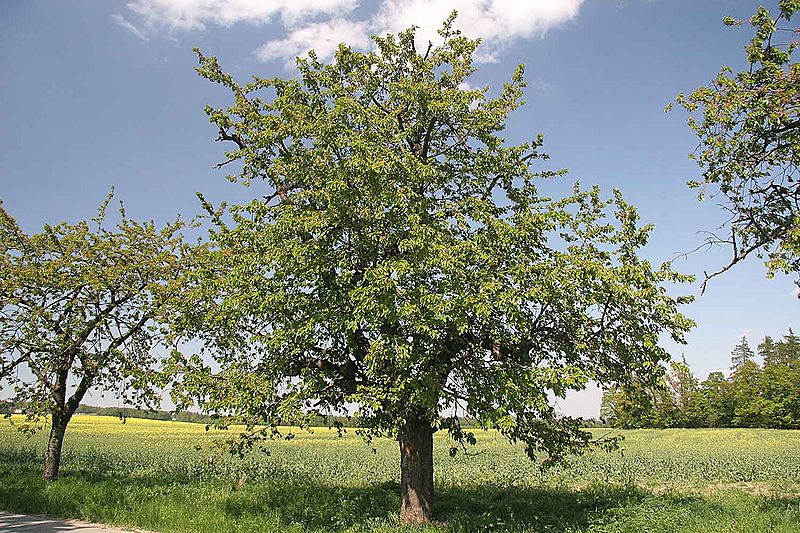
Cherry is a woody plant belonging to trees of the first rank. It is characterized by rapid growth, especially at a young age. The crown is ovate in shape; however, depending on growing conditions, its shape can change from ovate to conical. The bark in youth is brown, reddish or silvery in color, with numerous streaks, for a long time covered with brown lenticels, and sometimes may peel in thin transverse films.
The root system is predominantly horizontal, but under favorable conditions well-branched vertical roots may also form. The taproot forms only during the 1—2nd years of life, and over time it branches.
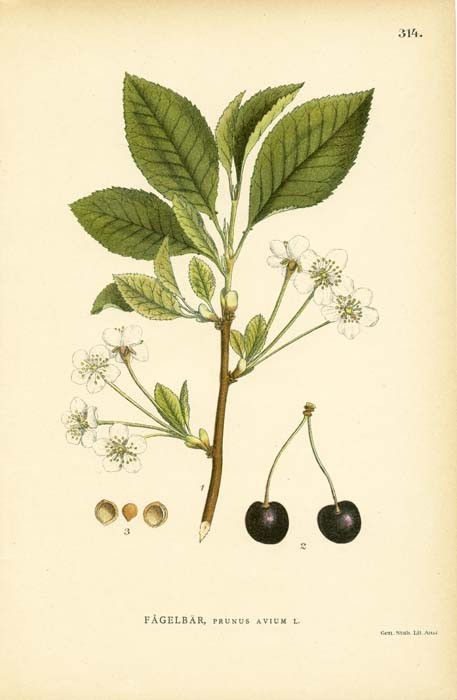
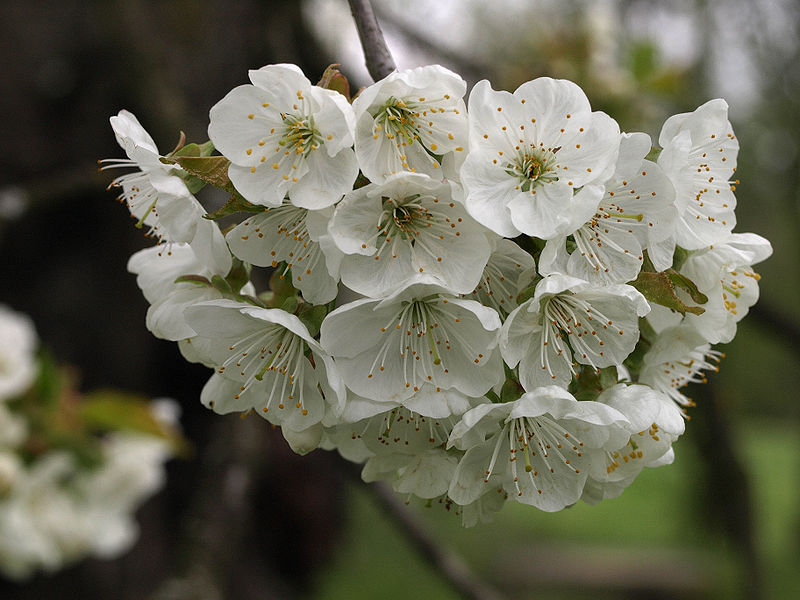
Leaves are shortly acuminate, obovate, oblong-ovate or elliptic in shape, serrated, slightly wrinkled. Petioles with two glands at the base of the blade, up to 16 cm long. Flowers are bisexual, white in color, usually appearing on shoots shortly before leaf budburst, forming few-flowered, almost sessile umbels. There are five sepals and five petals, many stamens, and one pistil.
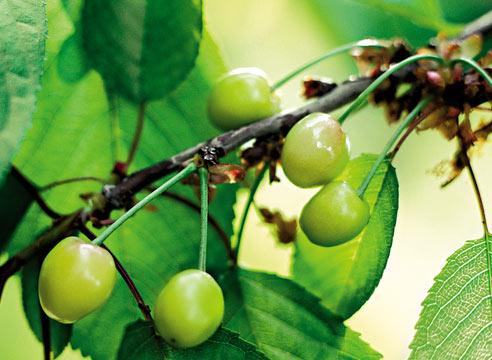
Fruits are true drupes, with a fleshy, juicy mesocarp, shaped oval, spherical or heart-shaped, and in color range from light yellow (almost white) to dark red (almost black); wild fruits are smaller than cultivated ones, up to 2 cm in diameter. The stone is spherical or slightly elongated, with a smooth surface. Seeds consist of a coat, an embryo and endosperm. The seed coat is yellowish-brown, sometimes with a dark red tint.
Several methods of propagation are characteristic for cherry (by seed, stump suckers and root suckers), but in natural conditions seed propagation predominates.
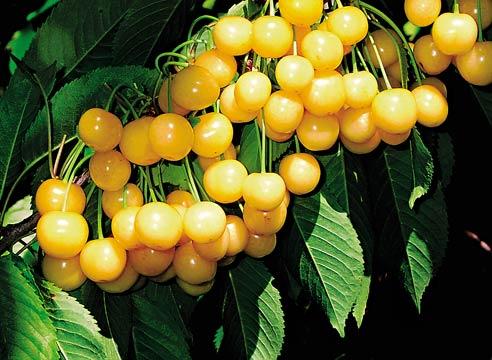
Cherry fruits contain organic acids, sugars (fructose, glucose), vitamins C, A, B1, B2, E, PP, trace elements (iron, iodine), macroelements (potassium, calcium, magnesium and others), pectic substances, as well as anthocyanins — compounds from the flavonoid group. Cherry fruits are highly valued for their pleasant sweet taste. Fruits are consumed fresh; they are also suitable for various kinds of processing: production of juices, compotes, fruit wine, and for making preserves and jam.