
Indoor plants
Primula
Primula
Family Primulaceae. Native to the temperate regions of Europe, Asia, and North America. In nature, over 500 species of these annual and perennial herbaceous plants are known. The following species and their hybrids are common in cultivation:
Примула обратноконическая - Primula obconica - a perennial herbaceous plant forming a fairly large clump - up to about 60 cm tall. Leaves are pubescent, on long petioles, rounded in shape, cordate at the base, wavy at the margin, up to 10 cm long. Flowers up to 4 cm in diameter, fragrant, arranged in umbels, and may be white, pink, red, cherry, blue, or lilac.
Примула кьюская - Primula kewensis - an annual herbaceous plant forming a rosette of leaves up to 35 cm tall. Leaves on long petioles, rounded-cordate in shape, toothed at the margin, with a whitish bloom on the upper surface, about 15-20 cm long. Flowers small, up to 2 cm in corolla diameter with a long tube, fragrant, arranged in umbels. The only species that blooms with yellow flowers.
Примула мягкая - Primula malacoides - an annual herbaceous plant forming a rosette of leaves up to 45 cm tall. Leaves on long petioles, rounded-cordate in shape, toothed at the margin, about 15-20 cm long. Flowers small, up to 1.5 cm in diameter, fragrant, borne in whorled inflorescences in several tiers, and may be white, pink, purple, or red with a yellow eye in the throat.
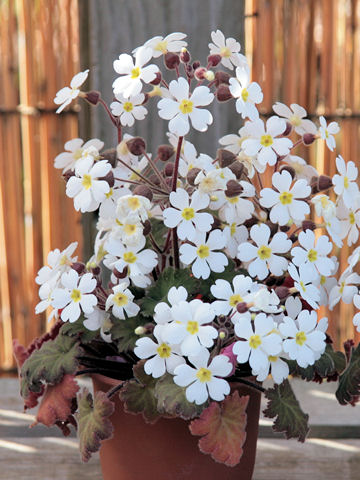
Temperature: Cool in winter; during flowering optimal around 12-15°C, for Primula obconica slightly higher - about 15-18°C. After flowering, Primula obconica and Primula sinensis can be kept for a second year, but they must be kept in very cool conditions - preferably no higher than 15°C. For this they can be planted in the garden, preferably on the north or northwest side.
Light: Bright, diffused light. In summer provide shade during the hottest hours of the day. In winter, during the peak flowering, light should be maximal and direct sun at that time will not harm them.
Watering: Primulas are watered fairly abundantly during flowering - the soil should remain slightly moist. Perennial primulas left after flowering are watered moderately. Primulas do not tolerate watering with hard water.
Fertilizers: Primulas are very sensitive to excess salts, so fertilizers should be applied cautiously, preferably at half the dose recommended by the manufacturer. Feedings begin in late winter in February - when buds have already appeared or are just appearing - and continue until the end of flowering, every two weeks. Use iron-containing fertilizers for feeding primulas.
Air humidity: Primulas are periodically misted with soft water. Pots can be placed on a tray with wet pebbles.
Repotting: After flowering. Soil - a mixture of 1 part peat soil, 1 part leaf mold, 1 part sand. For Primula obconica add 1 part turf soil. Good drainage is essential.
Propagation: By seed and by dividing the clump when repotting. Seeds obtained by artificial pollination are sown in June - July. Seeds are placed in wide shallow trays and covered with a thin layer of moist soil - about 2 mm deep - and covered with glass. The seeds are kept in a cool, shaded place.