
Flowers for the garden
Shrubby cinquefoil
Potentilla fruticosa
Synonyms: shrubby Kuril tea, shrubby cinquefoil, Dasiphora fruticosa, Pentaphylloides fruticosa L., Pentaphylloides floribunda (Pursh) A.Löve, Potentilla floribunda Pursh, Potentilla rigida Wall. ex Lehm., Moguchka, Dasiphora
Shrubby cinquefoil (Potentilla fruticosa (L.) – a species of shrubs in the genus Potentilla (Pentaphylloides) of the rose family (Rosaceae). The species was first described by Carl Linnaeus in «Sp. Pl. 1» 495. 1753. In cultivation
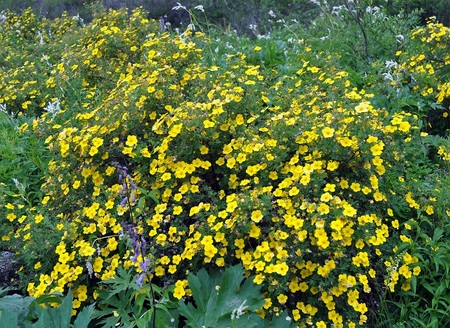
The range covers the entire eastern part of Siberia and the Russian Far East, the mountains of Central Asia, Mongolia, China and Japan. It is also found in North America, Europe and the Caucasus. It grows in meadows, forests, river floodplains, along stream beds, on gravel, scree and in high-mountain tundras. In the mountains it rises to altitudes of up to 3600 m above sea level.
Author M.Skotnikova
It is an erect, less often prostrate, strongly branched shrub 10–150 cm high. Lives up to 30 years. The root system is superficial, dense, sensitive to soil compaction. The crown is erect, compact or more or less widely spreading, densely branched and heavily leaved. Branches are covered with reddish-brown or brownish-gray peeling bark. Shoots are short, often reddish, pubescent with white appressed hairs.
Author T.Rib
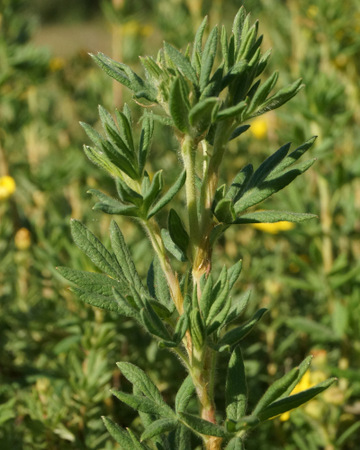
Leaves pinnately compound, with 2 (rarely 3) pairs of leaflets, the upper ones sometimes trifoliate. Leaflets are oblong or oblong-ovate, up to 30 mm long and 1–10 mm wide, appressed-hairy on both sides, less often nearly glabrous, shortly acuminate, light green to fully green, not changing color in autumn.
Author T.Rib
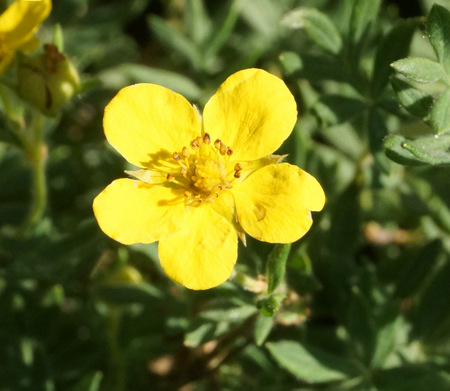
Flowers 2–3 (4) cm in diameter, in all shades of yellow, solitary or 2–7 in racemose or corymbose inflorescences borne at shoot tips. Outer linear-lanceolate sepals entire or two-notched at the tip, almost the same size as the ovate inner ones. Petals rounded, about twice as long as the sepals. They develop on current-year shoots. Each flower has up to 30 stamens, which makes the flower center appear fluffy. Anthers are elongated. The flowering duration of an individual flower ranges from 6 hours to 2 days and depends on temperature and air humidity. Blooms from June to October, very long and quite abundantly.
Author V.Bogdanovich
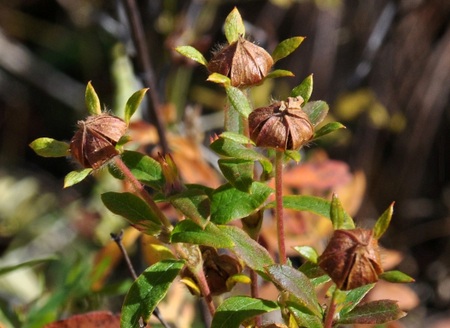
Fruits are brown aggregate achenes, covered with fine hairs. Achenes are very small with a bent apex; less commonly a slightly falcate achene is encountered, 1.5—2 mm long and 0.7—1 mm wide. The first seeds ripen in late August to September.
Varieties:
- Dasiphora fruticosa subsp. fruticosa
- Dasiphora fruticosa subsp. floribunda (Pursh) Kartesz
Cultivars: more than 130 cultivars have been created. Low-growing - ‘Beesii’ (‘Nana Argentea’, foliage silvery-gray), ‘Coronaitin Triumph’, ‘Dart’s Golddigger’ (foliage silvery-gray), ‘Donard Gold", ‘Dakota Sunrise’, ‘Goldfinger’ (foliage silvery-gray), ‘Goldstar‘, ‘Goldteppich‘ (foliage silvery-gray), ‘Jolina‘, ‘Longacre’ (foliage silvery-gray), ‘Reisenberg’ and cultivars ‘Abbotswood’, ‘Beanii’, ‘Farrer’s White’, ‘Rhodocalyx’ with white flowers. Tall-growing - ‘Elizabeth’ (‘Arbuscula’, ‘Sutter’s Gold’) and ‘Kathrine Dykes’ (foliage silvery-gray) with yellow flowers.
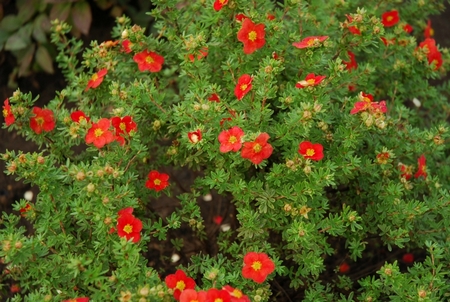
Potentilla fruticosa "Red Ace"
Hardiness zone: 4a (-34°C)
Location: prefers well-drained, moist soils. Mesotrophic, however can also grow on dry poor soils, but in that case grows slowly, has smaller size and flowers poorly. Preferably plant in sunny locations.
Planting: spacing between plants 60–80 cm. Size of planting hole: 50–60 cm. Drainage — a layer of crushed brick or gravel 15–20 cm thick. Soil mix: garden soil, humus and sand (2:2:1). Crown (root collar) at ground level. For poor soil add mineral fertilizer (up to 100 g per hole). Planting or transplanting is carried out in early spring, after snowmelt and soil thaw, but cinquefoil can also be planted in late August — September.
Care: before flowering plants can be fertilized: dissolve 30 g superphosphate and 10 g potassium sulfate in 10 l of warm water.
Pruning: shrubs are trimmed once every three years. In September non-woody shoots are cut back by one third; if pruning in April, shoots are shortened by 10–20 cm. Pruning promotes active growth and improved branching. Tolerates trimming well.
Diseases and pests: resistant to diseases and pests, but may be affected by rust.
Propagation: by seed, sown in spring after 3 months of stratification, or vegetatively - by hardwood and soft cuttings, layering, root suckers, and can also be propagated by dividing bushes.
Uses: a highly ornamental plant. Used in borders, rock gardens, and groups. A good nectar plant.