
Fruit trees
Pontic Hazel
С. pontica KKoch
Synonyms: filbert, Heraclea nut, C. colurna. non L. C. pontica., Byzantine nut.
Pontic common hazel – a variety of the common hazel. In cultivation since ancient times, from the era of Ancient Greece. In the wild it grows as an understorey shrub in the Western Transcaucasus and in Asia Minor.
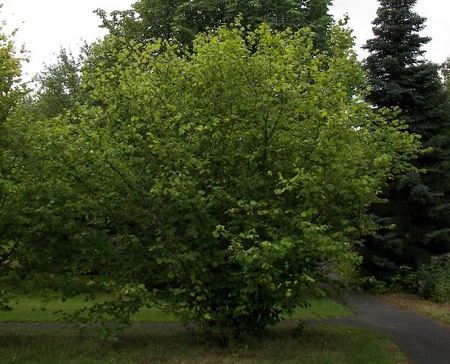
It is a multi-stemmed shrub with a spreading crown up to 6 m high. Petioles and one-year shoots are densely pubescent. Bark brown or dark brown, covered with lenticels.
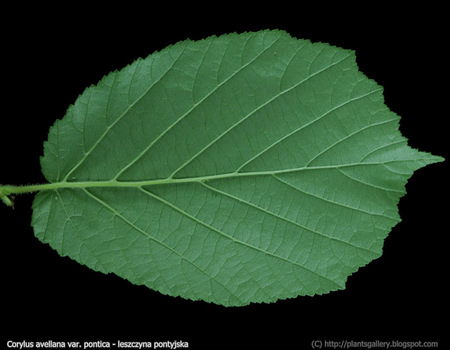
Leaves rounded with a cordate base and a shortly acuminate apex, yellow-green, pubescent beneath, with oblong-lanceolate stipules.
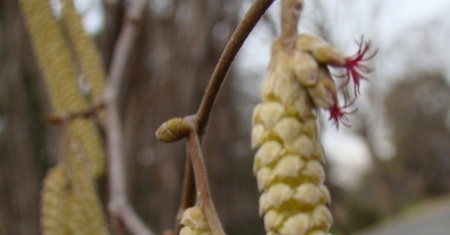
Flowers bloom in April–May. Male flowers – yellow catkins up to 10 cm long; female flowers – located in the buds.
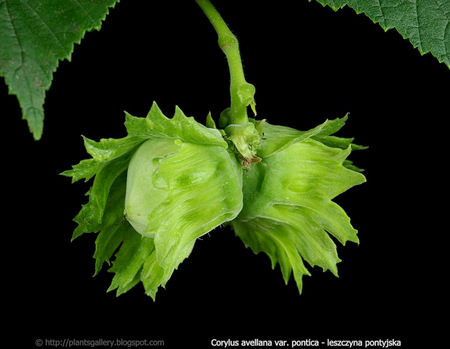
Fruits – large edible nuts of ovoid, slightly flattened shape, occurring 2–3 together. The involucre (husk) is longer than the nut, slightly constricted above its apex and then widely opens in a bell-like shape with toothed, broadly lanceolate lobes, light green in color. Nuts ripen in September–October.
Hardiness zone: 5(-15°). In severe winters the shoot tips may be damaged by frost.
Site: heat-loving. Prefers rich, moist alkaline soil; does not tolerate acidic soil. Grows in sun and in shade. Performs poorly on poor and heavy soils. Wind-resistant.
Planting: Optimal seedling age – 2 years. Planting is best done in autumn. Planting hole size 50x60 cm. Into the hole add 10-15 kg of humus, 200 g of superphosphate, 50 g of potassium salt and mix with the top layer of fertile soil. Before planting seedlings should be pruned to 20-25 cm, and the roots dipped in a clay-and-manure slurry. Spacing between plants 4-5 m from each other, slightly closer in a hedge. For good pollination it needs several pollinator varieties.
Care: care consists of shallow loosening of the soil around the trunk circles, and mulching (for example, with mown grass). Watering is recommended during dry periods.
Pruning: should be carried out in early spring before the start of sap flow. Requires only sanitary pruning.
Propagation: cuttings root poorly. Seeds require stratification. For this they are first soaked in warm water for 48 hours, later kept in warmth for 2 weeks, after that 3-4 months of cold stratification. Germinates in 1-6 months at a temperature of 20 °C.
Pests: hazel leaf beetle, nut weevil, hazel leaf-roller, bud mite, rodents.
Diseases: anthracnose, gray mold and fruit rot.
Uses: used for obtaining valuable nuts. For ornamental purposes planted in groups and, thanks to the attractive foliage coloring and the fanciful shapes formed by the curved shoots, used as specimen plants. Used in breeding and has given rise to many varieties of modern hazelnut.