
Flowers for the garden
Knotweed
Polygonum
The name Polygonum comes from the Greek words 'polys' — many and 'gonos' — knee; given for the knobby, jointed stem. As for their generic Latin name, botanists have still not reached a consensus. In various foreign publications knotweeds appear under the names Polygonum, Persicaria, Fallopia, Reynotria, Tovara.
The genus includes about 300 species of annual and perennial herbaceous plants, less often subshrubs and lianas, widely distributed around the globe. They can be found in many parts of the world - in meadows and along riverbanks, in forests and in high mountains.
About 20 species are cultivated. Stems erect or prostrate, sometimes twining. Leaves simple, alternate. Flowers small, in few-flowered clusters, often gathered into racemose or paniculate inflorescences. Fruit — an achene. Up to 100 seeds per gram.
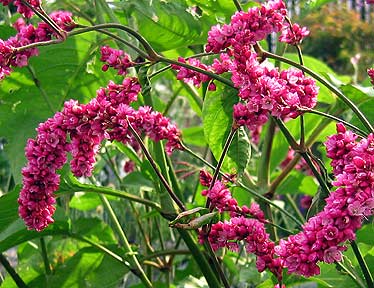
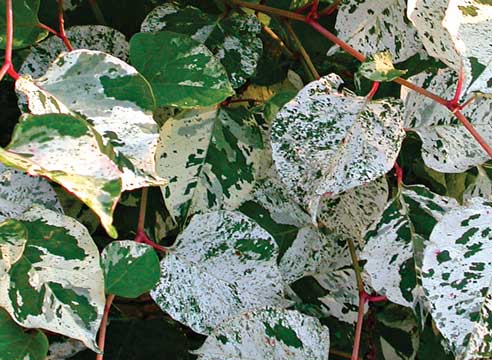
Knotweed is an amazingly diverse and interesting genus. It appears in many forms — from the familiar little herb on a village lane to three-meter thickets of Sakhalin buckwheat, from modest inhabitants of lakes and marshes, such as amphibious knotweed, to the "Baljuan buckwheat" — a fifteen-meter liana that wildly clambers over fences, buildings and neighboring trees.
In our conditions such species as Polygonum affine (knotweed affine), a low groundcover plant native to Nepal, and Polygonum bistorta (bistort), also called snake knotweed, have established themselves well. In recent years they have been joined by new, previously unknown species from Japan, China, the Himalayas and the Far East. They also proved to be quite undemanding and grow successfully in Ukraine. These remarkable plants find a place in any garden - they can be used in compositions or as specimens. Knotweeds tolerate pruning well and remain decorative throughout the season.
Alpine knotweed — Polygonum alpinum
Found in the wild in mixed-grass steppes and mountain meadows of the temperate zone of the Northern Hemisphere.
It forms large spreading bushes up to 150 cm high. Stems numerous, branched in the upper part. Leaves lanceolate-ovate. Rhizome cordlike, strongly creeping. Blooms very abundantly in mid-summer. Flowers numerous, white, gathered in large dense panicles. Hardy, can survive without shelter.
Extremely undemanding, aggressive, but very decorative weed. Good for planting near outbuildings and fences. Interesting for cut flowers.
Polygonum weyrichii — Polygonum weyrichii.
Occurs in the wild on grassy slopes of Sakhalin, the Kurils and Japan. Forms powerful thickets up to 200 cm tall. Stems branched and leafy. Leaves oval-elongated, sessile. Rhizome cordlike, creeping. Blooms in late summer. Inflorescence racemose, flowers very small, white, inconspicuous. Hardy, does not require winter cover.
Extremely undemanding, prefers rich loams. Good for planting near outbuildings and fences.
Viviparous knotweed — Polygonum viviparum L. - Polygonum insulare= Bistorta vivipara (L.) S.F. Grau
Native to Europe, Asia and North America. Found in bogs, marshy meadows and forests; in mountains it rises to alpine zones.
Perennial plant up to 50 cm tall. Stem erect, simple, glabrous. Leaf blades rather stiff, beneath glabrous or hairy, flat or with margins curved downward; basal leaves elliptic, oblong, lanceolate, 2 – 10 cm long and 0.5 – 2.5 cm wide, acute, cuneate or rounded at the base, rarely slightly cordate; petioles usually longer than the blades, stem leaves linear, shortly petiolate. Inflorescence loose, narrow, 3 – 8 cm long and 0.5 – 1 cm wide, with sessile buds in the lower part. Perianth 3 – 3.5 mm long, white, pale pink. Fruit length – 3 mm, three-angled.
Flowers in June-August. Instead of flowers, small bulbils sometimes appear in the inflorescence, which the plant easily uses for propagation.
Capitate knotweed — Polygonum capilatum.
A decorative but little-known annual plant possesses a rare quality among summer annuals - it quickly covers the ground. Knotweed is heat-loving and moisture-loving, growing excellently in sun. When grown in partial shade it develops less decorative leaf coloration. A strongly branching, sprawling plant 10 - 15 cm high, with small leaves bearing reddish stripes and spots on a green background. Small round inflorescences 1 - 1.5 cm in diameter are composed of tiny light-pink flowers and are positioned slightly above the leaves. Decorative from June until the first frosts.
Propagated by seeds and cuttings. Water when the soil begins to dry. Feed during the growth period with complete fertilizers 2-3 times. Not demanding in care. Knotweed can form a beautiful border (it tolerates pruning well), be planted in a mixed border to fill empty spaces, in a garden urn or container where shoots will hang slightly. It is also suitable for pot culture.
Variable knotweed - Polygonum polymorpha Nakai. = Aconogonum polymorpha (Nakai.)Nakai.
Native to East Asia. One of the most interesting species. This is a large perennial whose luxuriant bush can grow almost to 2 m in height. Sturdy, hollow, upright stems, heavily branched in the upper part, more than 2 cm in diameter, are covered from bottom to top with oblong-lanceolate leaves (over 10 cm long). Huge compound paniculate inflorescences, made up of small white flowers that emit a spicy aroma, resemble a white cloud. This knotweed blooms in late June - early July and remains in flower until mid-August. However, even after flowering its fluffy panicles remain decorative. It has a powerful root system that goes down to 30 cm depth. These knotweeds are undemanding, winter outdoors without shelter, and grow well in any soil.
Polygonum affine — Polygonum affine G. Don
Native to the Himalayas, Nepal. A perennial herbaceous plant 20-25 cm high. Stems ascending. Leaves ovate-lanceolate or oblong-lanceolate, entire, evergreen. Flowers small, pale pink, turning pink-red by the end of flowering, gathered in dense spike-like inflorescences 6-10 cm long. Flowers from May for 80-90 days. Fruits. Decorative even after flowering, when fruits and leaves acquire a dark-red coloration. In cultivation since 1845. There are two cultivars: 'Darieeling Red' — flowers deep pink; 'Donald Lowndes' — flowers pink-red.
Prefers a shady location, but also grows well in sun. Not demanding to soils, but dislikes acidity. Develops successfully only on well-drained sites. Drought-tolerant. Does not tolerate stagnant groundwater. Recommended for group and border plantings. Hardy, but suffers in snowless winters. Preventive winter protection with conifer branches is desirable. To preserve overwintered leaves, spring shading is necessary.
Extremely decorative, used for creating groundcover groups and for planting on wide terraces of rock gardens. Suitable for cutting and dried bouquets. Polygonum affine is used to decorate the shoreline of small ponds, planting it in clumps next to low perennials and bulbous plants. Its dense green carpet of leaves and showy inflorescences combine well with astilbes, small hostas, and Tradescantia virginiana. When selecting companions, bear in mind that on fertile soils Polygonum affine can spread strongly, suppressing less vigorous species.
Sakhalin knotweed, or Sakhalin buckwheat — Polygonum sachalinense Fr. Schmidt
Occurs wild in southern Sakhalin, the Kuril Islands and Japan. A perennial herbaceous plant with a creeping rhizome. Stems straight, hollow, sturdy, up to 300 cm tall, green or brown. Leaves large, up to 30 cm long and 20 cm wide, broadly ovate or ovate-oblong, on short petioles. Flowers small, whitish-cream, gathered in a paniculate inflorescence up to 20 cm long. Blooms in July-August for 40-45 days. Fruit — three-angled, dark-brown achene. Hardy. Used as decorative foliage for masking outbuildings, creating thickets. The only difficulty is excessive spreading; it must be restrained so the Sakhalin giant does not take over too large an area. It is sufficient to bury barriers 30 cm deep to control it. In cultivation since 1863.
Polygonum amplexicaule — Polygonum amplexicaule
Native to the mountain meadows of the Himalayas. A perennial, shrub-like plant. Stems erect, 80-120 cm tall. Leaves broad, lanceolate, green, yellow in autumn. Its bush is decorated with bright spike-like inflorescences. They appear in mid-July and redden until the end of August. The powerful, horizontally spreading rhizome develops slowly, and the plant looks like a compact bush.
In temperate regions it should be planted so that the rhizome buds are 8-10 cm below the soil surface - this will protect the plant from freezing. In autumn it is desirable to insulate: mound with soil, cover with nonwoven fabric.
There are also ornamental-leaved knotweeds - they look unusually effective throughout the season. Their stems are upright, with lateral shoots, fairly sturdy, covered with large (10-12 cm long), oblong-cordate leaves, arranged alternately on the stem. Paniculate inflorescences at the tips of central and upper lateral shoots consist of small white or pink flowers that appear in the second half of summer.
Location: grow in a bright, semi-shady, cool place with humid air.
Soil: prefer moist, fertile, well-manured soils with slightly acidic reaction. Snake knotweed tolerates close groundwater. Polygonum lapathifolium and Polygonum affine are drought-tolerant.
Care: in spring remove brown leaves. Water and fertilize well. In late autumn cut back; trim overly large "carpets".
Propagation: by division, root suckers. Eastern knotweed, bistort, and spreading knotweed — by stratified seeds (1-2 months) sown in late May in their permanent place or in boxes under winter. Seeds germinate on the surface at 18-25 °C. They transplant easily with a clod of earth. Rhizomatous knotweeds spread quickly, forming dense thickets, and can remain in one place for 6-10 years.