Flowers for the garden
Two-leaved Platanthera or Night Violet
Platanthera bifolia
Two-leaved Platanthera (лат. Platanthéra bifólia) — a species of perennial herbaceous tuberous plants of the genus Platanthera (Platanthera) of the family Orchidaceae (Orchidaceae).
The scientific name of the genus, Platanthera, comes from the Greek words platis («wide») and antera («pollen sac») and refers to the distinctive shape of the anther in representatives of this genus. The specific epithet, bifolia (Latin bi — «two(–)…» and folius — «leaf»), is explained by the characteristic two large basal leaves of plants of this species.
The Russian common name of the genus, "любка", is connected with ancient legends that the tubers of this plant (primarily the two-leaved Platanthera as the most widely distributed) possess magical properties, acting as a love potion or charm.
A species with a wide range, found in Western Europe and Asia Minor. Grows in coniferous, deciduous and mixed forests, especially near "windows", along forest edges, clearings and shrubby thickets.
The ecological amplitude of the species is fairly wide. Two-leaved Platanthera is indifferent to soil moisture, growing on both dry and excessively wet soils (even with stagnant moisture); it is not demanding with regard to soil fertility and acidity, although it is often found on acidic soils. It can tolerate significant shading but prefers well-lit places, where it flowers and fruits better.
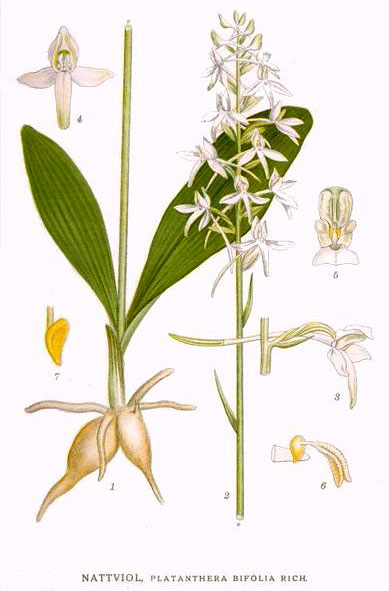
Two-leaved Platanthera — a perennial herb 20—50 cm high with two undivided root tubers. Some individuals reach up to 60 cm. Each year a new replacement tuber develops. The tuberoid is ovoidly thickened, drawn out into a root termination.
Leaves: basal — two, rarely one or three, arranged almost opposite, narrowed into a petiole at the base which merges into a sheath, close together, obtuse, oblong-obovate, light green, glossy, reaching 8—22 cm in length and 3—6 cm in width; stem leaves — one to three, small, sessile, lanceolate.
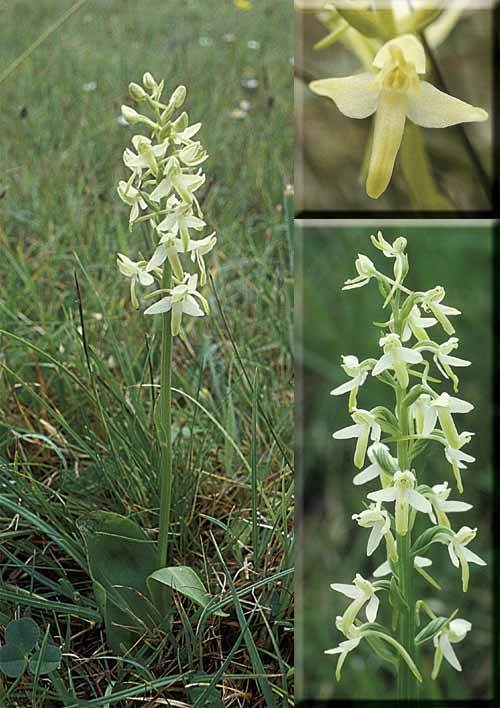
Inflorescence — a rather sparse cylindrical spike, reaching 20 cm in length, composed of 8—40 flowers. Flowers — with white, slightly greenish-tinted perianths at the tips; the lip is narrow, linear or lanceolate, 12 mm long, at the base without tubercles above the median vein; with parallel pollinia 2 mm long. The spur is thin, slightly curved, pointed at the end, horizontal or obliquely upward directed. The viscidia are rounded. The pollinarium is shorter than 2.5 mm. The flowers have a strong pleasant fragrance (especially in the evening and at night or in cloudy weather). Blooms in June — July.
Fruits in August — September.


Location: it requires a place shaded from scorching sunlight; it is undemanding about soil and can grow on both well-fertilized and poor soils, which inevitably affects flowering and development.
Care: apply fertilizer in a timely manner; in very hot weather additional watering is necessary. It does not require winter covering, as it overwinters well.
Reproduction: almost exclusively by seeds. Seed production is very high — about 20,000 seeds in one fruit, on average 11 fruits per generative shoot. Seeds germinate only in the presence of fungi. The seedling leads an underground existence for 2—4 years; only in the 3rd—5th year does the first green leaf appear. The plant typically flowers in the 11th year after seed germination (in favorable conditions — in the 6th year). It can flower for 5—6 years without interruption, but after abundant flowering a pause of 1—2 years usually follows. An individual lives 20—27 years (possibly longer). The flower bud is formed 2 years before flowering. Flowers are usually pollinated by nocturnal moths (noctuids, hawk moths); after pollination the perianth soon withers. Seeds ripen 1.5—2 months after pollination. Seeds are very light and are dispersed even by slight air movement.