
Encyclopedia - Plants for ponds
Pistia or Water Cabbage
Pistia
A representative of the aroid family (Araceae). Pistia is a monotypic genus established by Linnaeus in 1753. The genus name is translated from Ancient Greek as «water».
The distribution area of Pistia, or Water Lettuce, is water bodies in the subtropical and tropical regions of Africa.
A plant with very long, bluish-black, branched roots, usually floating on the water surface in the littoral zone, and when water level drops rooting in the substrate.
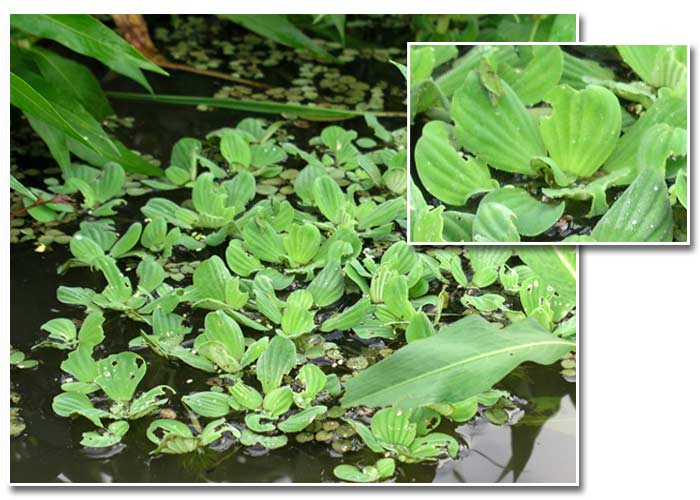
Leaves are arranged in a rosette, sessile, in most cases erect. The leaf blade is obovate to spatulate, slightly emarginate at the apex, up to 25 cm long and 12 cm wide, but usually smaller, silky-pubescent, light green. The underside of the blade has 11 strongly projecting veins. Forms with spongy-thickened leaf blades are also known.
The inflorescence is inconspicuous, on a short peduncle. The spathe is usually about 10 mm long, narrowed, pubescent on the outside; the spadix is shorter than the spathe. The flower is glabrous. There is only one female flower, followed by (2)5—8 ring-arranged male flowers. Each synandrium consists of 2 fused stamens. The fruit is a many-seeded berry with a persistent pistil. Seeds are cylindrical.

This is a magnificent floating plant for garden ponds. But Pistia can also be kept as a floating plant in an aquarium, although it becomes significantly smaller. It grows best in nitrate-rich water and can then form rosettes up to 80 cm in diameter. Plants develop equally well in both soft and hard water and tolerate low to moderate lighting. However, warmth and intense lighting promote the formation of vigorous specimens. Optimal temperature 22—30 °C. Due to prolific reproduction by offsets, Pistia rapidly forms a floating mat that must be regularly thinned. Inflorescences form regularly. Seed germination is possible (store seeds in a moist state). When kept in a pond, remember that the plant is not frost-hardy. Greenhouse specimens slow their growth in winter due to insufficient light.
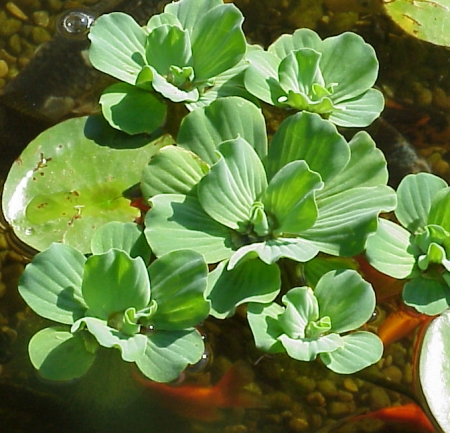
Location: sunny ponds 10-40 cm deep. Pistia is warmth-loving and very light-demanding. The primary requirement for normal plant development is bright light, preferably sunlight, but artificial light will do. Relatively high air humidity is also important for the plant.
Care: Overwinters in a bright winter-garden pond or aquarium at a temperature not below 16 °C. At the end of August—early September, small rosettes should be moved to an indoor aquarium for the winter.
When selecting plants for transfer from a pond to an aquarium, do so very carefully, thoroughly washing the roots and the lower part of the rosette to avoid introducing insect larvae, fish parasites, snails, fungal spores, etc. It is best to place the plant in a separate aquarium for a month for quarantine.
In winter, Pistia should be kept under bright lighting; cover the aquarium with glass to maintain sufficient air humidity. Optimal lighting duration for Pistia is 12 hours a day. It often dies from lack of light and nutrients. It suffers from snails. Prefers fairly soft water. If an aquarium is not available in the winter period, plants can be kept in a moist chamber on a cushion of peat moss at 12—14 °C.
Propagation: it propagates itself and constantly produces stolons, at the ends of which new rosettes form. Divide the plant in summer.
