
Conifers
Dwarf mountain pine 'Mops'
Pinus mugo 'Mops'
Synonyms: Pinus montana Mops, dwarf mountain pine
Mountain pine 'Mops' – a popular dwarf cultivar of mountain pine. It was obtained and introduced into cultivation by H. Hoftman from Boskoop (Netherlands) in 1915. The cultivar quickly became popular due to its dense globular crown, small size and low maintenance requirements.
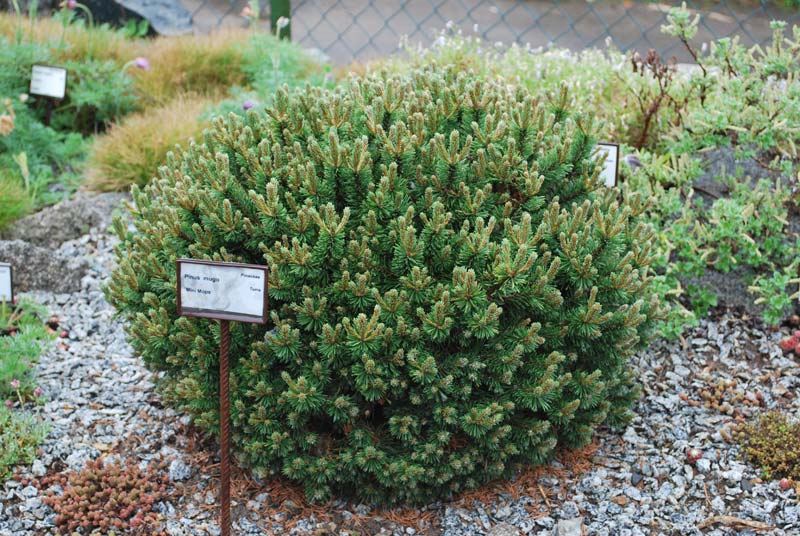
It is a dwarf shrub with a dense compact globular, cushion-like crown. It reaches 0.5-1.5 (2) m in height and 0.5-1.5 (2) m in width. It grows slowly, with an annual increase of up to 10 cm in height and width. Branches are very short, stiff and densely arranged. Buds grow densely, 1-2 cm long, resinous, thin, brown. The root system is superficial, well-branched, and sensitive to soil compaction.
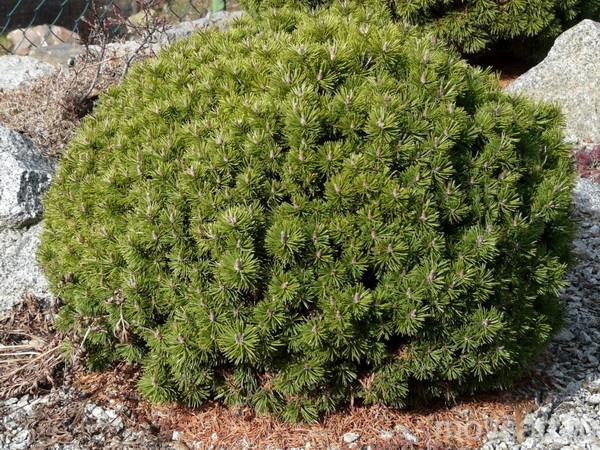
The needles are acicular, borne in pairs, almost straight; on young shoots they are very short, 2-4.5 cm long and 1.5-1.8 mm wide, dark green. Sheaths are short, dark brown.
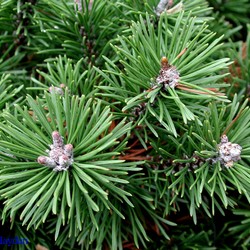
Male strobili are numerous, yellow and very decorative. Cones are usually not formed.
Hardiness zone: 2-7
Location: prefers full sun, grows poorly in shade. Not demanding regarding soil, grows on any well-drained soil from acidic to alkaline. Tolerates air pollution. Does not suffer from heavy snowfall. pH 6-7. May suffer from high temperatures and low humidity. Does not suffer from snow loads, heat and high humidity.
Planting: soil mix: turf soil, clay or sand in a ratio of 2:1. At planting, apply nitroammophoska in an amount of 100 g. If the soil contains a lot of sand, it is recommended to add clay; lime can also be added if necessary.
Care: in cold winters the shoot tips may be slightly damaged by frost. During the first 2 years after planting, it is recommended to apply 30-40 g of mineral fertilizer for conifers. Mature plants are drought-tolerant and do not require watering. In young plants during dry periods additional watering is recommended, as well as evening misting of the crown. To retain moisture, mulch with peat to a layer of 5-6 cm. The peat is subsequently not removed but mixed into the soil.
Pruning: pruning is carried out to increase crown density and slow growth. For this, part of the annual shoot growth should be cut.
Diseases: resin canker (seryanka), blister rust
Pests: resistance to pests is high; sometimes affected by the pine adelgid.
Propagation: propagated by cuttings and by grafting.
Uses: used in solitary and group plantings, in rock gardens, alpine gardens, and as a container plant.