
Deciduous shrubs
Pieris japonica
Pieris japonica
Synonyms: Andromeda japonica Thunb., Andromeda japonica elegantissima Carriere, Lyonia polita (W.W.Sm. & Jeffrey) Chun, Lyonia popowii (Palib.) Chun, Pieris polita W.W.Sm. & Jeffrey, Pieris popowii Palib., Pieris ryukuensis Hort, Pieris ryukyuensis Hort, Pieris yakushimensis Hort.
Pieris japonica (Pieris japonica (Thunb.) D.Don ex G.Don) – a species of shrubs of the genus Pieris (Pieris) in the family Ericaceae. It was first described in 1834 by the Scottish botanist George Don in his Edinburgh New Philos. J. 17: 159. In cultivation since 1870.
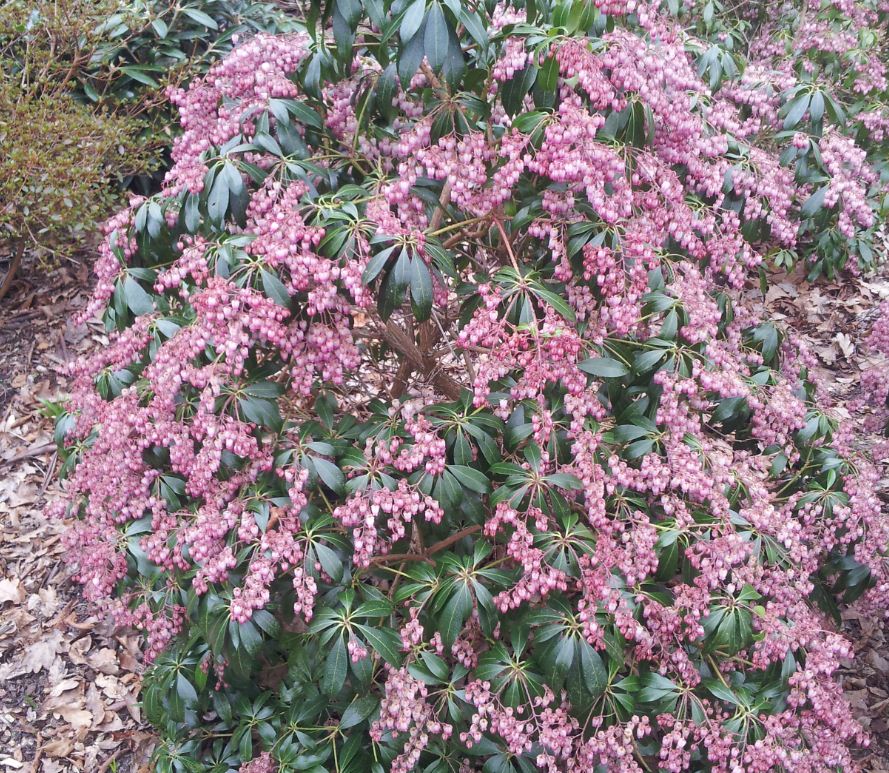
Pieris japonica Katsura
Occurs in the wild in Anhui, Fujian, Hubei, Jiangxi, Taiwan, Zhejiang (Japan). It grows in mountains at 800-1900 (2100) m above sea level.
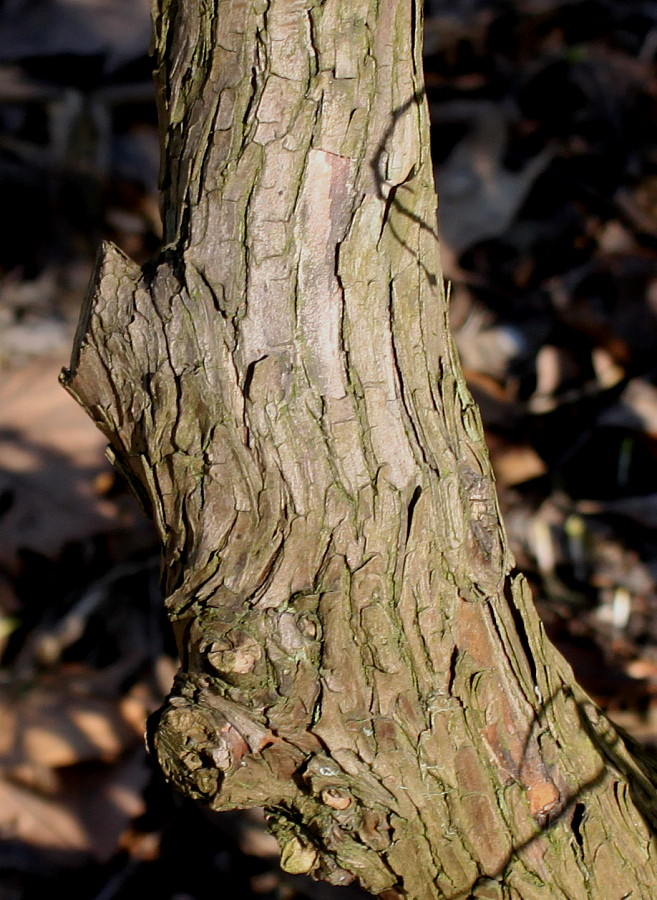
Photo by V.Kudelia
A slow-growing shrub 0.5-2 (in the wild 3) m tall. Crown rounded, very densely branched. Bark gray or brownish, fissured. Young shoots glabrous, grooved.
Leaves oval or lanceolate, glossy, 3-10 cm long and 1-2.5 cm wide, somewhat clustered at twig tips, with an acute or obtuse apex, long-acuminate, cuneately narrowed to the base, finely serrate toward the tip, glabrous, leathery, firm; when unfolding pink or red to copper or bronze, in summer densely green, shiny, sparsely glandular-hairy.
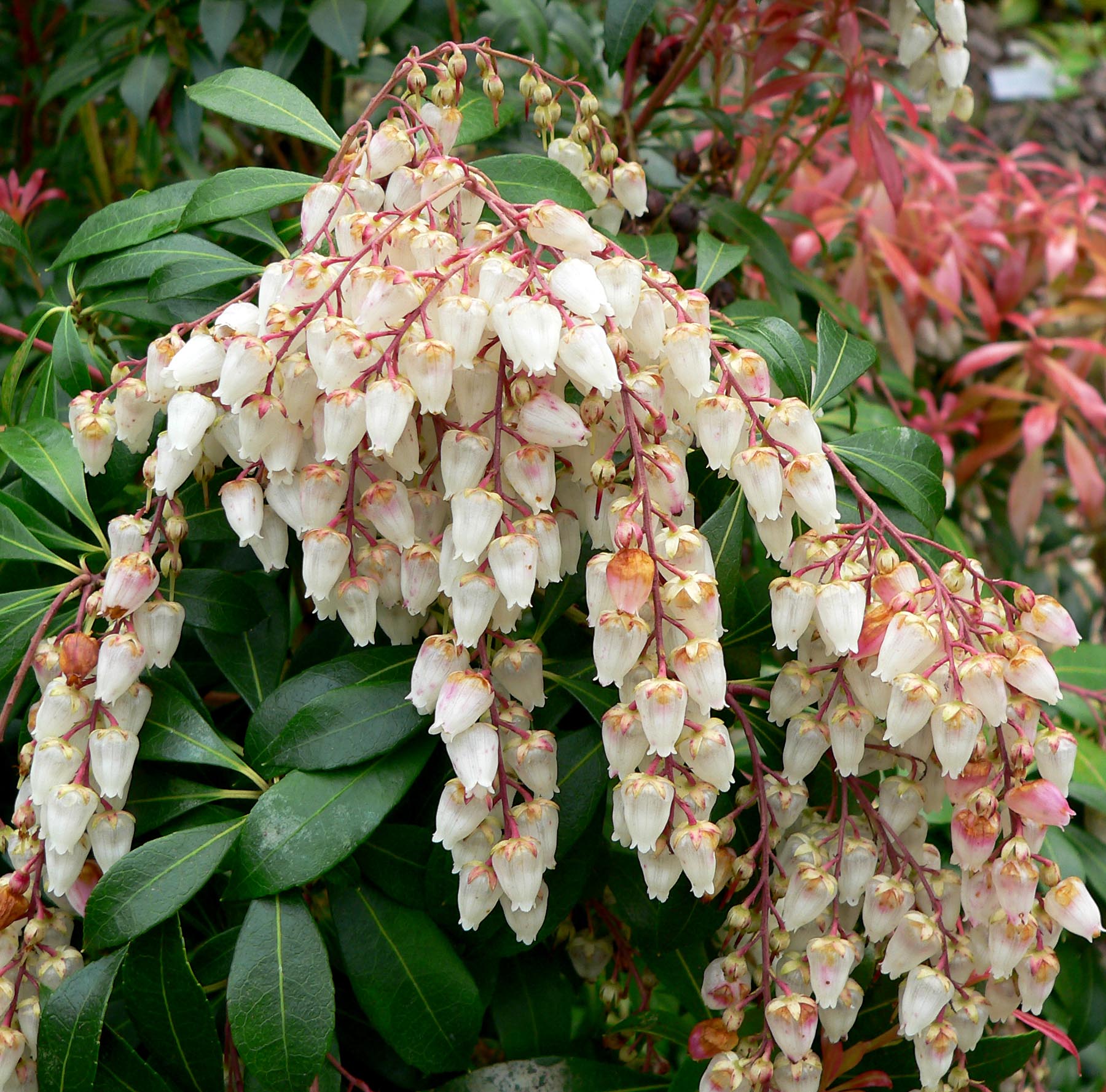
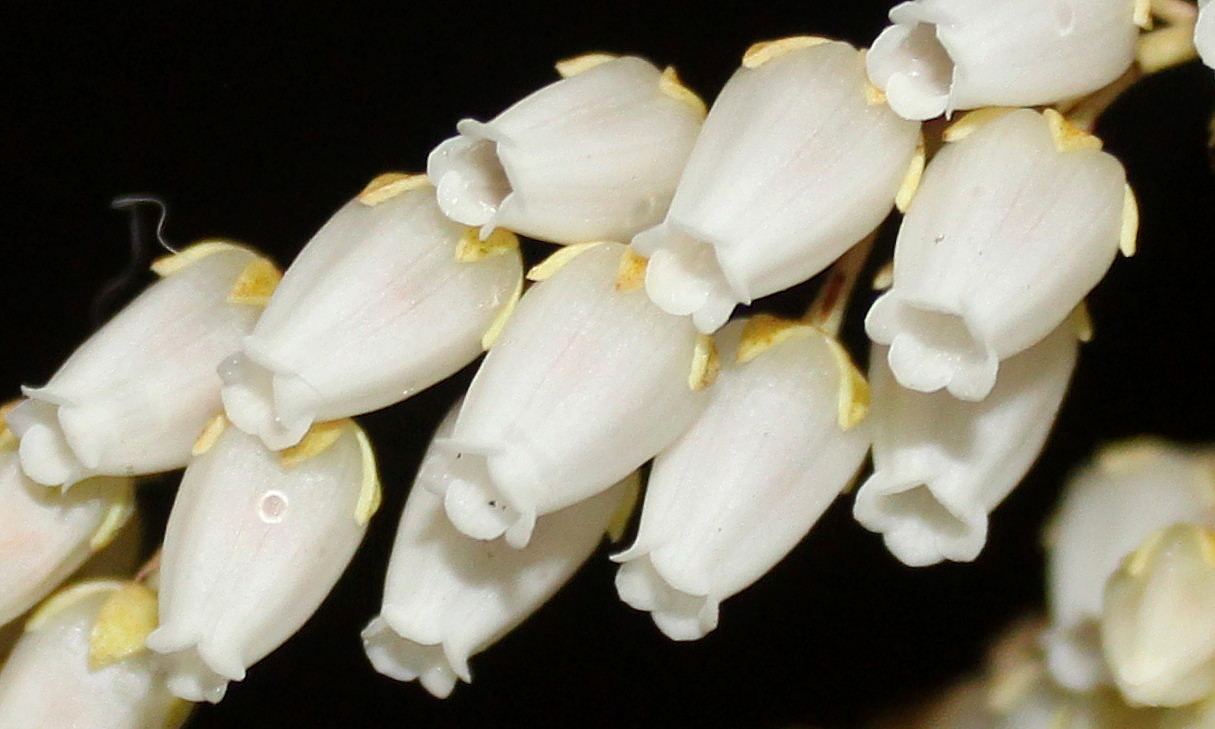
Photo by V.Kudelia
Flowers white, bell-shaped, numerous, arranged in long pendulous or drooping axillary racemes forming terminal panicle-like inflorescences up to 12 cm long. Corolla 0.5-0.9 cm long and 0.3-0.5 cm in diameter, urn-shaped to cylindrical, with short, broad lobes. Calyx lobes narrowly ovate, acute, green, with small reddish-brown bristles on the outside and pubescent near the apex on the inside. Blooms abundantly in March-April.
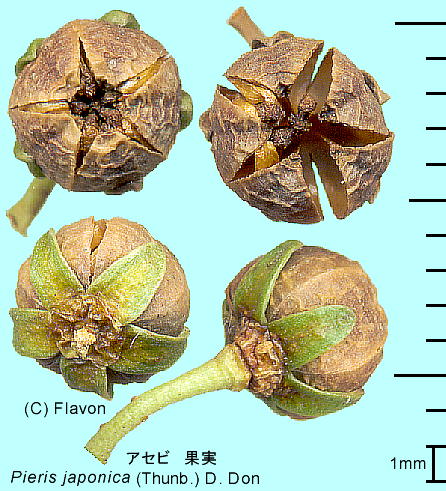
Fruits – woody five-valved capsules.
Poisonous plant.
Forms:
- Pieris japonica f. crispa Rehder, J. Arnold Arbor. 27: 17. 1946.
- Pieris japonica f. elegantissima (Carrière) Nakai, Tr. & Shr. Jap. rev. ed., 1: 202. 1927.
- Pieris japonica f. monostachya (Nakai) H.Hara, Enum. Spermatophytarum Japon. 1: 26. 1949.
- Pieris japonica f. rosea Makino
- Pieris japonica var. monostachya Nakai, Tr. & Shr. Jap. 1: 152. 1922.
- Pieris japonica var. yakushimensis T.Yamaz.
Forms:
- Pieris japonica f. crispa Rehde
- Pieris japonica f. rosea Makino
- Pieris japonica var. taiwanensis (Hayata) Kitam.
- Pieris japonica var. yakushimensis T.Yamaz.
Cultivars: Katsura, Little Heath, Mountain Fire, Purity, Ricuensis, Splendens, Valley Rose, Red Mill, White Pearl, Blush, Сristmas Cheer, Pink Delight, Variegata, Flaming Silver, Valley Valentine.
Hardiness zone: 4b (-30°C)
Site: needs a location sheltered from cold winds, and also a place where sunlight reaches the plant only after midday.
Soil: grows on acidic (pH = 3.5-4.5), air- and water-permeable soil.
Planting: Soil mix: acidic peat (2 parts) and river sand (1 part), to which the following components can later be added: leaf mold (2 parts), coniferous soil (1 part), pine sawdust (1 part), fallen needles (1 part). When planting add mineral fertilizer (200 g/m3) and sulfur (40 g/m2). Planting hole dimensions – width up to 1 m (on light soils 60-70 cm), depth 15-20 cm (on light soils 30-40 cm). Before planting place the plant in water. The root collar at ground level. After planting mulch the trunk circle with sawdust, peat or pine bark.
Care: requires abundant watering; the soil under the plant must not be allowed to dry out. For a young plant about 3 L of water is sufficient and about one bucket for an adult plant. Watering 2-3 times a week. Increase watering during flowering; during drought or heat mist the plant. Water pieris with rainwater acidified with any acid: oxalic, citric, acetic (3-4 g per 10 liters of water); sulfuric (1 ml per 10 liters of water) or you can use electrolyte for an acid battery (2-3 ml per 10 liters of water). With the onset of frosts it is recommended to cover the plant with spunbond to protect it from frost and spring sun.
Pruning: does not require special pruning. In late February the pieris can be lightly trimmed to increase the number of young shoots.
Propagation: propagates well by seed. Growing medium consists of 2 parts acidic peat, 2 parts coniferous soil and 1 part coarse river sand. Boxes with sown seeds are covered with glass to retain moisture and placed indoors at normal room temperature in a sunny spot (but without direct sunlight). Also propagated by cuttings; for this cuttings are taken in autumn from the tips of shoots.
Pests and diseases: practically not affected.
Companion plants: azaleas, hydrangeas, heather and trillium
Uses: used in single and group plantings, looks striking on forest edges, in compositions on rockeries, in "Japanese gardens", in heather gardens, and in various containers near porches, gazebos and garden benches.