
Conifers
Red Spruce
Picea rubens Sarg
Synonyms: American Red Spruce
Red spruce – a species of evergreen trees in the genus Spruce of the family Pinaceae. The species was classified by the American botanist C.S. Sargent. Its native range is the northeastern part of North America (the Appalachian Mountains) in the zone of mixed coniferous and broadleaf forests, where it forms mixed and pure stands. It is also widespread in New England, North Carolina and on the Atlantic coast of Canada. It grows in boggy sites together with American larch, black spruce and balsam fir. In the mountains it rises to 1000-1800 m above sea level. It is one of the symbols of Nova Scotia. Lives 350-400 (450-500) years. Introduced to Europe in 1755, and to Russia since 1833.
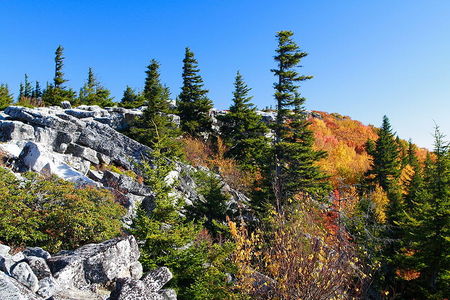
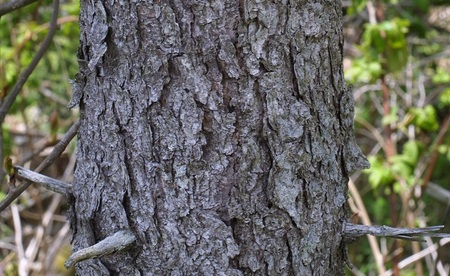
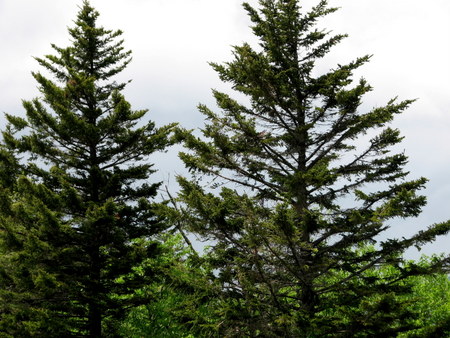
It is a medium-tall slender tree 25-30 m high and 1.5 m in diameter; in cultivation it grows up to 10 m in height. It grows more slowly than the common spruce. Crown broad-conical or narrow-pyramidal, loose, branches descend to the ground. Bark scaly, fissured, reddish-brown.
Young shoots thin, short, densely pubescent, reddish-brown. Buds ovoid, with an acute tip, 5-8 mm long, slightly resinous, begin growing later than those of other spruces.
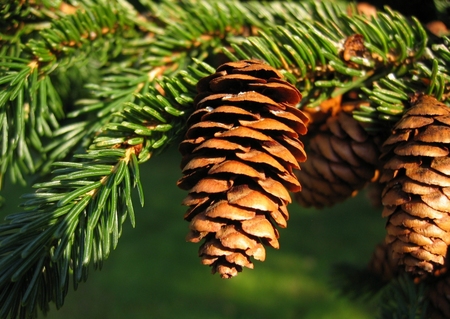
Needles short, 10-15 mm long and 1 mm wide, four-sided, partly curved, with 3-5 rows of stomatal lines on each face, strongly glossy, yellowish-green. Retained on the tree for 5-7 (8-11) years.
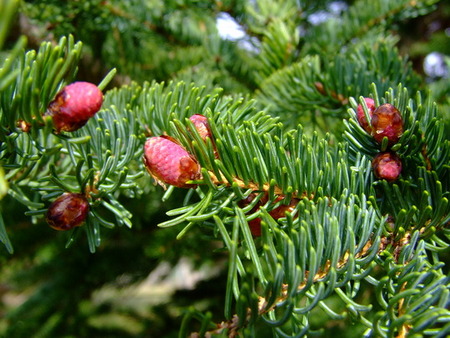
Cones ovoid or oblong-ovoid, 3-4 (5) cm long and 1.5-3.5 cm in diameter, resinous, purple or green, turning reddish-brown when mature, glossy, with stiff and woody scales, rounded at the upper edge and irregularly finely toothed. Cones fall off quickly after ripening. Seeds dark brown, 2-3 mm long. Seed wing light or orange-brown, 2-3 times larger than the seed.
Forms: «Nana» ("Nana"), "Virgata" ("Virgata")
Hardiness zone: 4a (-35°)
Location: does not tolerate chalky soils. Not demanding as to soil fertility. Requires high air humidity. Does not like drought.
Planting: Soil mix: topsoil and leaf mold, peat, sand in the ratio 2:2:1:1. Drainage made of crushed brick, layer 15-20 cm. Planting depth: 50-70 cm. Root collar at ground level.
Care: after planting you can apply 100-150 g of nitroammophoska. In dry periods it is recommended to water at least once a week with 10-12 L per plant. Loosening is done to a depth of 5-6 cm, mixing the peat with the soil rather than removing it. Young seedlings need to be covered with conifer branches for the winter.
Pruning: sanitary pruning is applied.
Diseases: shutte, snow shutte, fusariosis, stem and root rot, bark necrosis, canker (wound) disease, cone rust, spruce vertun. Suffers less from spring scorch than other varieties of Canadian spruce.
Pests: spruce leafroller, spider mite, Sitka spruce aphid.
Propagation: summer cuttings do not root without treatment. Seeds do not require stratification.
Uses: Shows well as a specimen tree, thanks to its terracotta-red numerous cones against the backdrop of velvety foliage, and the brick-brown trunk of the tree.