
Conifers
Colorado Blue Spruce 'Hoopsii'
Picea pungens "Hoopsii"
Synonyms: Colorado spruce 'Hoopsii', Hoop's Blue Spruce, ель колючая хопси, ель голубая хупси, ель голубая хопси
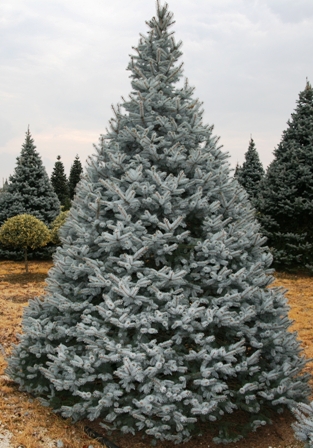
It is a relatively small tree with a regular broad-conical, dense crown that droops to the ground. It reaches 10–15 m in height and 3.5–4 m in width. Branches are wide and raised along their entire length. The tree is fast-growing, with an annual height increase of 20–30 cm and about 10 cm in width. At 30 years of age it reaches 10 m in height and 4 m in width. Shoots are light brown, grow horizontally and are densely arranged. They do not break under the weight of snow.
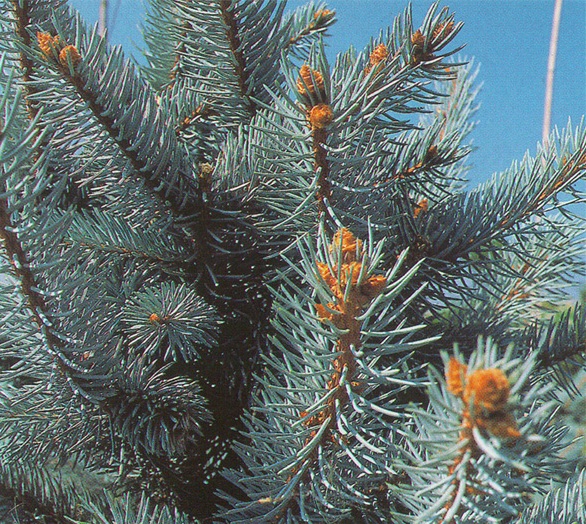
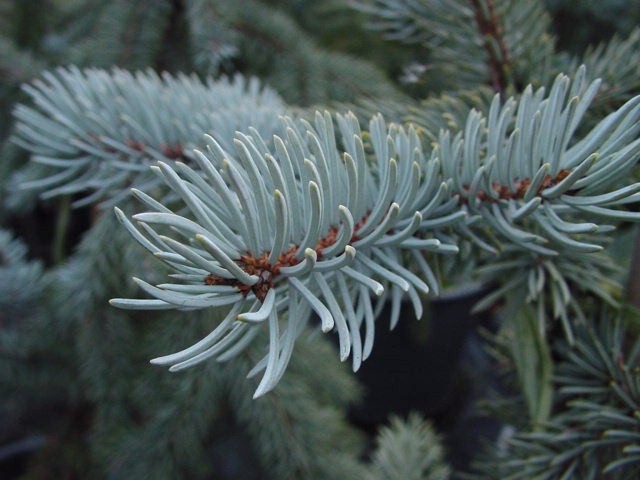
Needles are needle-like, stiff, sharp, 2–3 cm long, of a beautiful intense blue color with a silvery tint. They remain on the branches for 4–6 years. Young new growth has a light blue color. It is especially striking in May due to the contrast between old and new foliage.
Cones are very decorative, cylindrical, purple-violet, and appear in early spring. Mature cones are light brown.
Hardiness zone: 4-8
Site: Prefers full sun but tolerates light partial shade. Likes moist, fertile soil, light or medium loam. The top layer of soil should be well-drained so the roots receive sufficient air. Poorly tolerates waterlogging and soil compaction. Not very demanding regarding moisture. Resistant to urban conditions, soot, smoke and dirt.
Planting: Optimal planting time is late April – late June. Soil mix: turf soil, leaf mold, sand, peat in a ratio of 2:2:1:1.
Care: Responds well to fertilization. The tree circle around the trunk should be periodically weeded and loosened, but not dug over. It is also advisable to mulch the trunk circle with peat or loose compost and incorporate it lightly. During dry periods regular watering is recommended, avoiding complete drying of the root zone, as well as evening foliar sprinkling. Manure or compost can be applied as top dressing at the beginning of summer. When grown in polluted areas, the spruce should be washed at least once a month.
Pruning: Tolerates clipping well; trim once a year after shoot growth has finished. By pinching the central buds of lateral shoots and shortening the growth in summer, a more compact crown can be obtained.
Diseases: shutte, snow shutte, fusariosis, stem and root rot, bark necrosis, canker (ulcerous/wound canker), cone rust, spruce budworm. Suffers less from spring burn than other cultivars of spruce.
Pests: red spider mite, spruce sawfly.
Propagation: Propagated by cuttings, which are best taken in early June. Untreated winter cuttings do not root. For cuttings, take matured lower branches from the mother plant that do not exceed 10–12 cm in size. The cutting removed from the mother plant must have a "heel"; otherwise the plant will quickly perish. The lower part of the prepared cuttings should be treated with rooting stimulants. Plant cuttings to a depth of 2–2.5 cm. The substrate should not dry out while the plants are rooting, but overwatering is not recommended. For seed propagation, seeds should be pre-soaked in water and sown in spring or autumn. With spring sowing, the first seedlings appear after 14 days.
Uses: Can be used to create clipped mono-varietal or mixed hedges. Used for landscaping formal sites, avenues, and squares. Looks good as a specimen tree in a large garden or park. Can be used as a Christmas tree or an accent in landscape compositions,