
Conifers
Blue spruce 'Fat Albert'
Picea pungens Fat Albert
Blue spruce 'Fat Albert' (Picea pungens Fat Albert) – a popular cultivar of blue spruce. The form appeared as a result of natural selection at the Iseli Nursery in Oregon (USA) in 1978. It was named by Don Hovsom in honor of the fictional character Fat Albert, created by the well-known American comedian Bill Cosby. Since then it has become extremely popular among gardeners. In 2012 the cultivar received the Royal Horticultural Society's Award of Garden Merit (AGM).
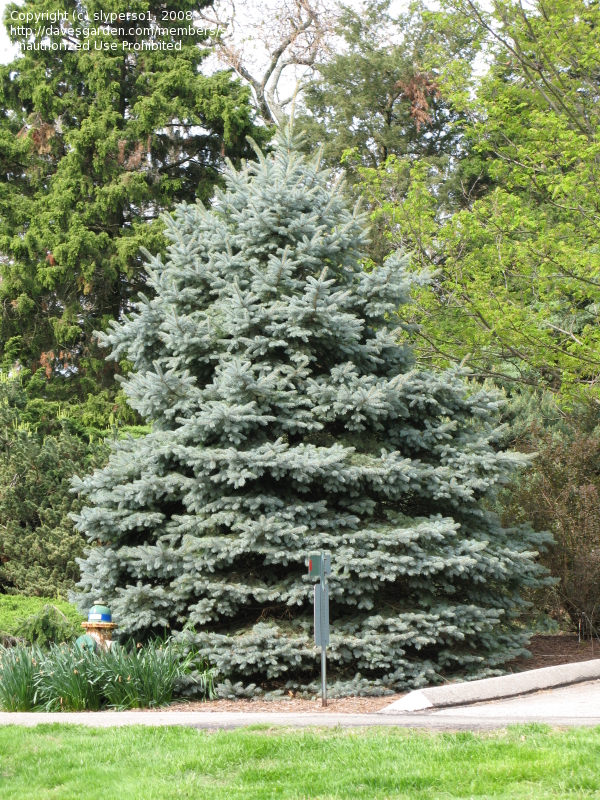
It is a tall tree with a regular, dense conical crown. The regular shape of the crown is maintained by a dominant leading shoot that persists throughout the life of the plant. It grows fast, with an annual increment of 15–20 cm; by 30 years it reaches about 10 m in height, and at 15 years has a crown diameter of 3–4.5 m. Branches are rigid and strong, growing at right angles from the trunk and forming regular tiers. Shoots are ascending and directed upward.
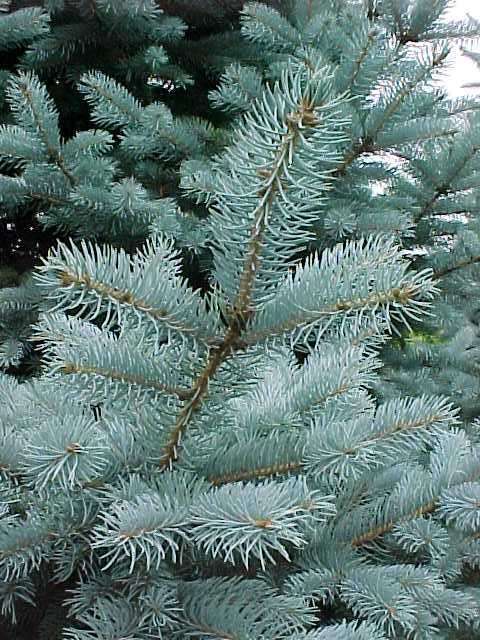
Needles are acicular, prickly, stiff, arranged radially, 2–3 cm long, of a beautiful silvery-blue color that does not change during the tree's life.
Cones are pendulous, large, elongated-cylindrical or ovoid in shape. Young cones are greenish-purple, turning brownish when ripe.
Hardiness zone: 4a (-34°C).
Position/exposure: less shade-tolerant than Norway spruce. Relatively resistant to smoke and gas. Demanding with respect to air humidity, but tolerates dryness better than Norway spruce.
Soil: The top layer of soil should be well-draining so that roots receive sufficient aeration. Poorly tolerates waterlogging and soil compaction. Has low moisture requirements.
Planting: The optimal time for planting is late April – late June. Soil mix: topsoil, leaf mould, sand, peat in the ratio 2:2:1:1.
Care: responds well to fertilization. The area around the trunk should be periodically weeded and loosened, but not deeply dug. It is also advisable to mulch the trunk circle with peat or loose compost followed by incorporation. During dry periods regular watering is recommended, avoiding complete drying of the root zone, as well as evening overhead watering of the crown. Manure or compost can be applied in early summer. When grown in polluted areas, it is recommended to wash the spruce at least once a month.
Diseases: Shütte, snow Shütte, fusariosis, stem and root rot, bark necrosis, canker (ulcerous/rhizic) rot, cone rust, spruce vertun.
Pests: red spider mite, spruce sawfly.
Propagation: propagated by grafting.
Uses: used as solitary specimens and in group plantings, for landscaping formal and prominent locations in gardens and parks. Also looks good in small gardens.