
Conifers
Blue spruce (P. pungens Engelm)
Picea pungens Engelm
Synonyms: Colorado spruce, blue spruce
Blue spruce – a species of evergreen trees of the genus Spruce in the family Pinaceae. The natural range is western North America from the southeast of Idaho and Colorado to New Mexico and Arizona. It grows at elevations of 1750-3000 m above sea level. It is most often found in mountain valleys along streams and rivers where the soil is more moist.
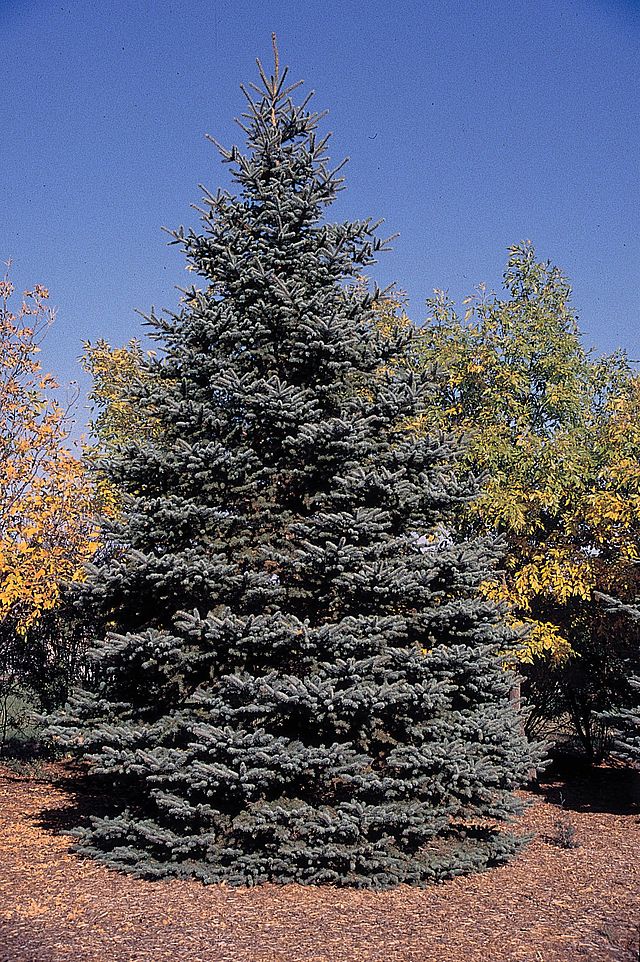
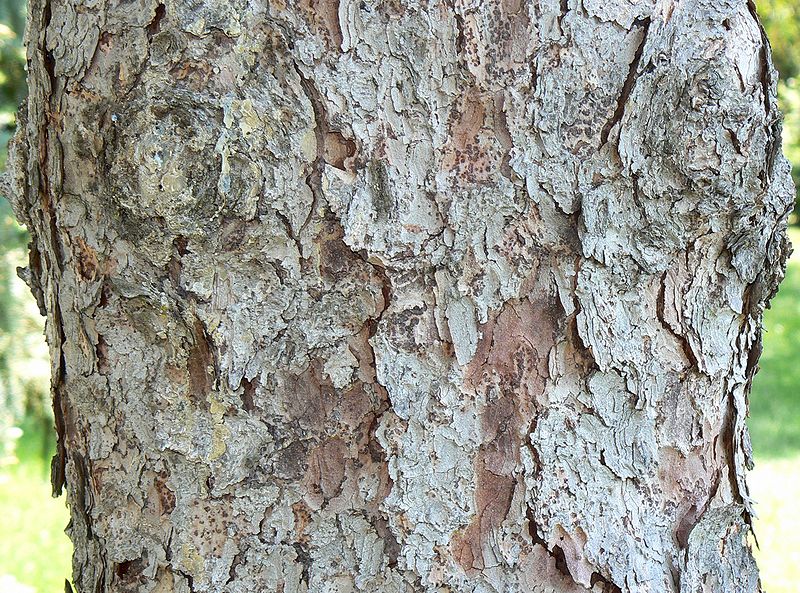
It is an evergreen coniferous tree. In youth the crown is narrowly conical, becoming cylindrical in maturity. It reaches a height of 25-30 (46) m. Trunk diameter reaches 1.5 m. Bark scaly, thin. Branches form dense regular tiers, drooping at various angles or horizontal. Lives up to 100 years. Introduced in 1862.
Needles are prickly, short, reaching 15-30 mm, rhombic in cross-section, persist on the tree for 3-4 years, under good cultivation conditions 5-7 years. Color varies from silvery-green to bright blue.
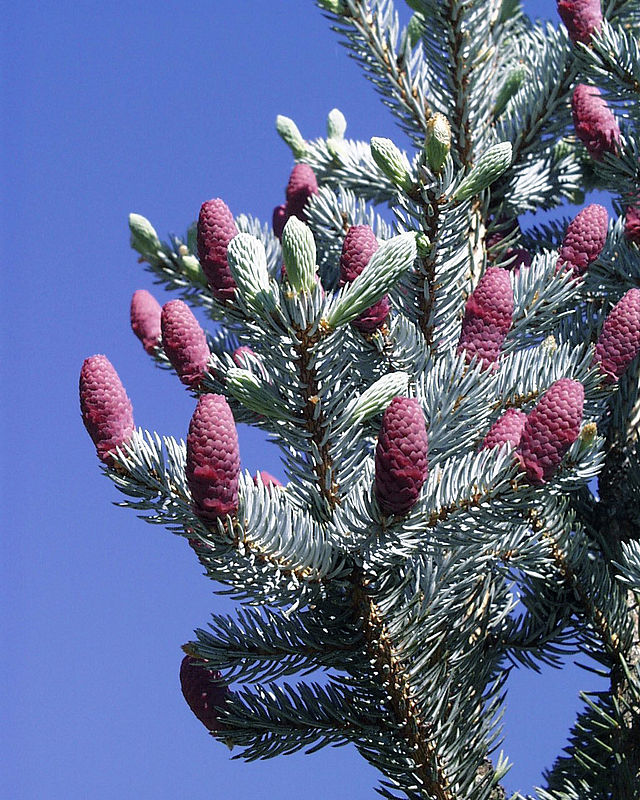
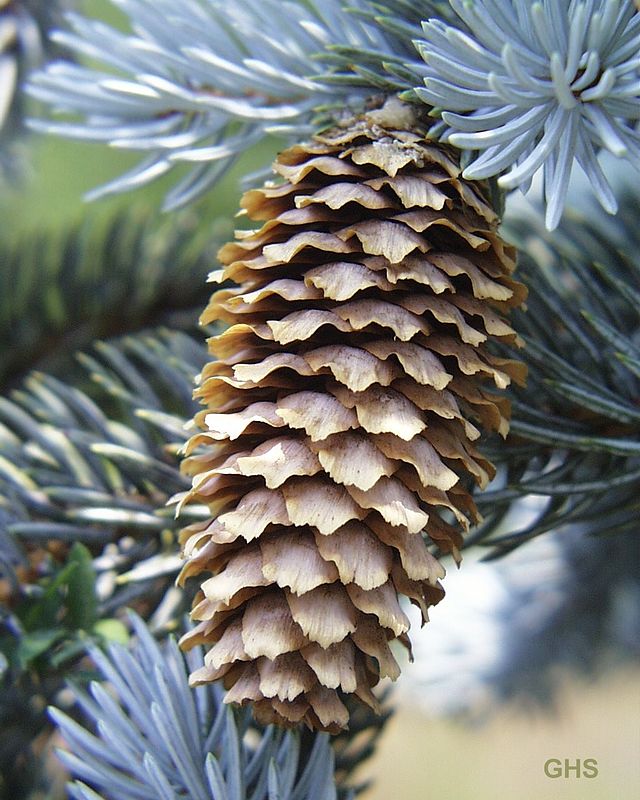
Cones are slightly cylindrical, 6-11 cm long, when closed up to 2 cm wide, when open up to 4 cm. Color ranges from reddish to purple, becoming light brown at maturity. Seeds are small, 3-4 mm long, black with a light brown wing. Wing length – 10—13 mm.
Cultivars: f. glauca, 'Glauca globosa','Glauca pendula', 'Glauca procumbens', 'Glauca prostrata', 'Misty Blue', 'Filip's Blue Compact', 'Hermann Naue', 'Hoopsii', 'Koster', 'Moerheimi', 'Moll', 'Montgomery', 'Oldenburg', 'Spek'
Hardiness zone: 4-8
Location: Light-loving, but tolerates light partial shade. Prefers moist and fertile soil, light or medium loam. The topsoil should be well-drained so that the roots receive the necessary amount of air. Poorly tolerates waterlogging and soil compaction. Low water demand.
Planting: The optimal time for planting is late April – late June. Soil mix: turf, leaf mold, sand, peat in ratio 2:2:1:1.
Care: responds well to fertilization. The root collar area is recommended to be periodically weeded and loosened, but not dug over. It is also advisable to mulch the trunk circle with peat or loose compost with subsequent incorporation. During dry periods, regular watering is recommended, avoiding complete drying of the root-inhabited soil layer, as well as evening canopy spraying. Manure or compost fertilization can also be applied at the beginning of summer. When grown in polluted areas, it is recommended to wash the spruce at least once a month.
Pruning: Tolerates trimming well, which is performed once a year after the growth of shoots has finished. By pinching out the terminal buds of lateral shoots and shortening growth in summer you can obtain a more compact crown.
Diseases: shoot blight, snow blight, fusariosis, stem and root rot, bark necrosis, canker (wound) cancer, cone rust, spruce vertun. Suffers less from spring scorch than other varieties of Canadian spruce.
Pests: red spider mite, spruce sawfly.
Propagation: propagated by cuttings, seeds, grafting. Cuttings are best taken in early June. Untreated winter cuttings root poorly (rooting rate 45%). For cuttings, take matured lower branches from the mother plant that do not exceed 10-12 cm in size. The cutting separated from the mother plant must have a "heel", otherwise the plant will quickly die. The lower part of prepared cuttings should be treated with growth stimulants. Plant cuttings to a depth of 2-2.5 cm. The substrate should not dry out during rooting, but overwatering is not recommended. For seed propagation, seeds should be pre-soaked in water and sown in spring or autumn. With spring sowing, the first seedlings appear after 14 days.
Uses: can be used to create clipped mono-varietal or mixed hedges. Used for landscaping ceremonial places, alleys, squares. Looks good as a specimen in a large garden or park. Can be used as a Christmas tree, an accent in landscape compositions. Combines well with pseudotsuga, Serbian spruce, white fir.