
Conifers
Serbian spruce
Picea omorika
Serbian spruce – a rare species of evergreen trees of the genus Spruce of the family Pinaceae. It is endemic to eastern Bosnia and Herzegovina near Višegrad and the Drina river valley in western Serbia. It grows on a small area of 60 ha, at 800-1600 m above sea level. It was discovered by the Serbian botanist Josif Pančić in 1875 on Mount Tara near the village of Zaovine. In cultivation since 1880.
It is an evergreen tree 25-30 (40) m high and 3-4 m wide, with a trunk diameter up to 1 m. The plant is fast-growing, annual increment reaches 35 cm in height and 15 cm in width. With age the growth rate decreases. Crown narrow-pyramidal or columnar, dense, when growing freely drooping to the ground. Branches spaced from each other, short, ascending. Shoots yellowish-brown, densely pubescent. Bark thin, rough, reddish-gray. Buds broadly ovate, acute, 58 mm in length and 2.5-4.5 mm in width, red-brown in color, non-resinous, with long awl-shaped pointed scales.
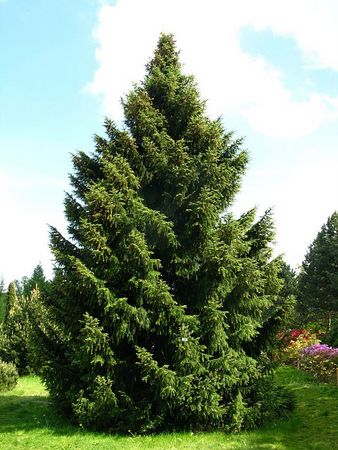
In the wild it lives up to 300 years.
Male flowers red-yellow, very decorative, female flowers vertical, oblong-ovoid, purple-red in color. Blooms in May.
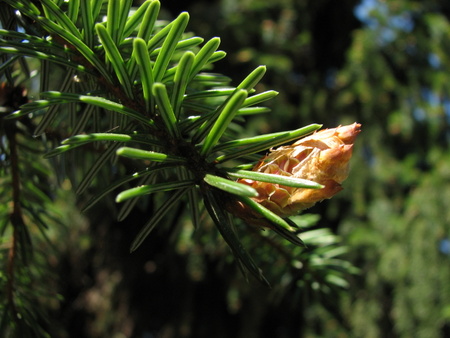
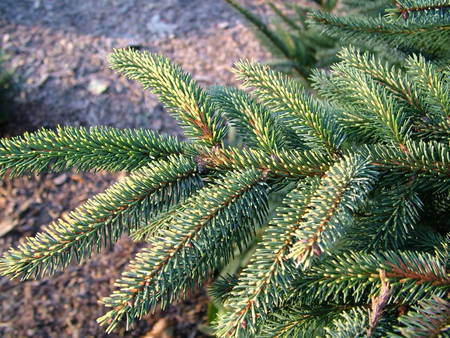
Needles needle-like, short, 10-20 mm long, compressed in cross-section, blue-green above, white-blue beneath. According to another source, needles are dark green with two bluish-white stomatal bands, compressed, keeled on both sides, appressed, reaching 8-18 mm in length and 2 mm in width. Retained on the tree for 8-10 years.
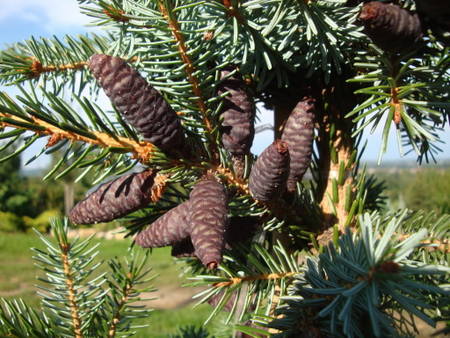
Cones dark purple, less often almost black, after ripening become dark brown, 4-7 cm long, fusiform. According to other sources cones numerous, glossy, brown, ovoid-elongated in shape, 3-6 cm long. Scales weakly toothed, rounded. Begins to bear fruit at 12-15 years. Seeds 3 mm long, brown or reddish-brown, the wing reddish or yellowish-brown, exceeding the seed in length by 3-4 times. Cones ripen in August.
Varieties: 'Aurea', 'Borealis', 'Expansa', "Гном" ("Gnom"), "Минима" ("Minima"), "Нана", Низкая ("Nana"), 'Karel', 'Minima', "Пендула Брунс" ("Pendula Bruns"), 'Pimoko','Schneverdingen', 'Treblitzsch'.
Hardiness zone: 5a
Location: Light-loving, but tolerates light partial shade. Grows poorly on very acidic and compacted soils; in such places the needles begin to yellow. Medium tolerance to smoke and gases. Demanding of air humidity, but tolerates dryness better than the common spruce.
Planting: The optimal time for planting is late April – late June. Distance between plants in group plantings – 2-3 m. Planting hole depth – 60-70 cm. The root collar should remain at ground level. Soil mix: turf and leaf soil, peat and sand in the ratio 2:2:1:1. The bottom of the hole should be filled with drainage of crushed brick and sand 15-20 cm thick.
Care: After planting you can apply 100-150 g of nitroammophoska. In dry periods it is recommended to water at least once a week with 10-12 L per plant. Loosening is done to a depth of 5-6 cm, while peat is not removed but mixed with the soil. Young seedlings require covering with fir boughs for the winter.
Pruning: Extensive pruning is permissible if you use the spruce as a hedge. With ordinary use prune only dead and diseased branches.
Diseases: schütte, snow schütte, fusariosis, trunk and root rot, bark necrosis, ulcerative (wound) canker, cone rust, spruce vertun.
Pests: spruce leafroller, spider mite, Sitka spruce aphid.
Propagation: by grafting onto common spruce, by cuttings and seeds. Seeds germinate in the year of sowing; 2-3 months of stratification accelerates germination.
Uses: widely used in cultivation. Used in solitary and group plantings, for creating green masses in forest parks and parks. Suitable for creating avenues.
Companion plants: larch, pine, deciduous trees and shrubs