
Conifers
Black spruce
Picea mariana
Synonyms: Picea nigra
Siberian spruce – a species of evergreen trees of the genus Spruce in the family Pinaceae. Native to North America, where it occurs from Alaska to Newfoundland; in the north it is limited by the forest-tundra, and to the south it reaches Minnesota and the northern part of Michigan. It grows mainly in the taiga, sometimes in mixed forests, which it forms together with the Canadian spruce and the American larch. It rises into mountains to 150-800 (1500-1800) m above sea level. Widely distributed in permafrost areas, on sphagnum bogs and wet lowlands. Cultivated in Europe since 1700. Introduced into Russia in the mid-19th century.
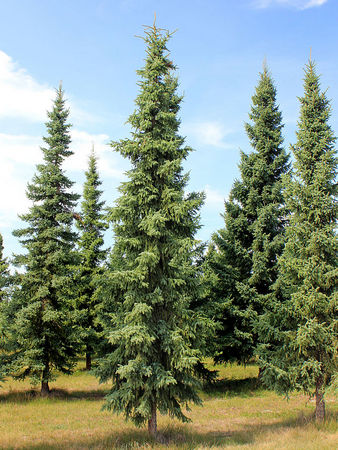
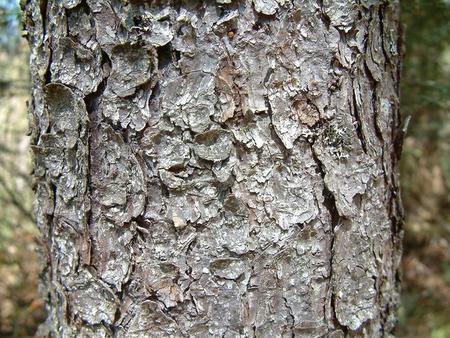
It is a small to medium tree 7-15 (30) m tall, with a trunk diameter of 15-50 cm. A slow-growing tree, annual increment 15-25 cm. Crown narrow, irregularly conical, branches of mature trees droop to the ground. Bark gray or reddish-brown, thin, fissured, scaly. Young shoots reddish-brown with dense glandular reddish pubescence. Buds ovoid-conical, 5 mm long, slightly resinous or non-resinous. Bud scales triangular, elongated-pointed or keeled, pubescent, purplish-brown.
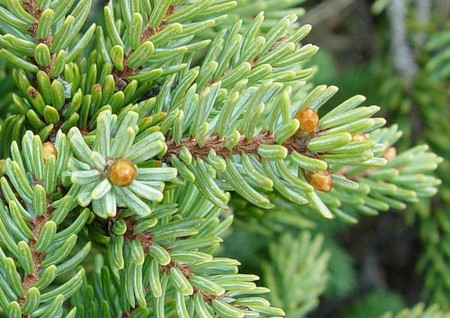
Needles are the thinnest of all spruce species, quadrangular, 6-12 (18) mm long and 0.7-0.8 mm wide, prickly, less often blunt, very densely arranged, dark bluish-green. On the upper side of the needles there are 1-2 stomatal lines, below 3-4. Needles are retained on the tree for 8-9 (14) years. When crushed they have a pleasant scent.
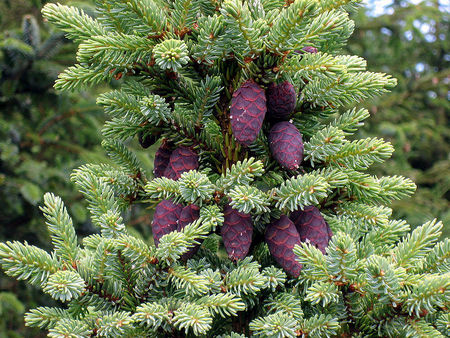
Cones numerous, small, 2-3.5 cm long and 1.5-1.8 cm wide, ovoid or almost globular in shape, purplish-brown, becoming dull brown after ripening, produced on the periphery of the crown. Scales thin, obovate, wavy, with characteristic streaks on the back, remain on the tree for 20-30 years.
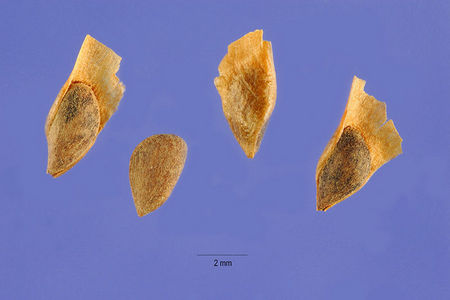
Seeds dark brown, 2 mm long. Seed wing orange-brown, 2-3 times longer than the seed. Fruits annually and abundantly.
Cultivars: "Beissneri" ("Beissneri"), "Beissneri Compacta" ("Beissneri Compacta"), "Doumetii" ("Doumetii"), "Nana" (Low, "Nana"), "Argenteo-variegata", "Aurea", "Pendula", "Empetroides", "Ericoides".
Hardiness zone: 1a (-62°)
Site: in cultivation it is undemanding to soil. Shade-tolerant, but grows well in sunny locations. Requires high air humidity. Can tolerate slight waterlogging. Suffers from air pollution, which affects needle longevity. In youth it may be particular about soil and moisture. Does not tolerate trampling, shallow groundwater or soil compaction.
Planting: Does not like transplanting. Soil mix: turf and leaf soil, peat, sand in a ratio of 2:2:1:1. Drainage of broken bricks, layer 15-20 cm. Planting depth: 50-70 cm. Root collar at ground level. Recommended spacing between plants – 2-3 m.
Care: after planting you can apply 100-150 g of nitroammophoska/. During dry periods it is recommended to water daily 10-12 L per plant. Crown spraying is also desirable. Loosen soil to a depth of 5-6 cm, do not remove the peat, but mix it with the soil. Young seedlings need protection with fir boughs for the winter. In youth it needs protection from the spring sun; for this you can throw non-woven fabric in 2 layers over the tree or place special protective shields on the south side.
Pruning: tolerates pruning well. With proper training of a hedge, the effect of an "impenetrable green wall" can be achieved. It is recommended to pinch out dominant shoots and shorten lateral shoots during growth.
Diseases: Schütte, snow Schütte, fusariosis, stem and root rot, bark necrosis, ulcerous (wound) canker, cone rust, spruce vertun.
Pests: spruce leafroller, spider mite, Sitka spruce aphid.
Propagation: by seeds, cuttings, grafting or layering.
Uses: used in solitary plantings in large parks and gardens, for creating clipped hedges; dwarf forms can be used in rock gardens and also for container cultivation.