
Conifers
Canadian spruce 'Laurin'
Picea glauca 'Laurin'
Canadian spruce 'Laurin' (Picea glauca 'Laurin') – a cultivar of Canadian spruce (Picea glauca). The form was obtained from a seedling of 'Conica' and was discovered in 1952 by R. Arnold in Holstein (East Germany). It appeared on the market in 1970.
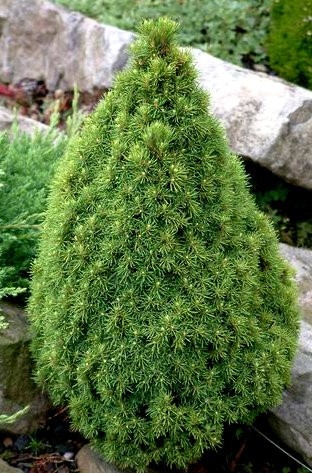
It is a very slow-growing coniferous tree, 0.5-0.8 m tall. Annual growth is only 2 cm, reaching 0.4 m in 10 years. Crown narrow-conical, dense, resembling a traffic cone. Young shoots light green.
Needles soft, delicate, green, up to 2.5 cm long, thin, slightly curved, mildly sharp, densely arranged on the shoots.
Hardiness zone: 3a (-39°C).
Site: less sensitive to smoke and gases than the European spruce. Can tolerate considerable shade, but a beautiful, low-hanging, dense and symmetrical crown forms only in sunny, open locations. Prefers moist and fertile soil, light or medium loam. Does not tolerate dry sandy-loam soil. The topsoil should be well permeable so that the roots receive the necessary amount of air. Drought tolerance is moderate.
Planting: tolerates transplanting well. Planting hole size: 70x70x70 cm. Soil mix: topsoil (sod), humus and sand in the ratio 3:2:1.
Care: it is recommended to periodically weed and loosen the area around the trunk, but not to dig it over. It is also advisable to mulch the trunk circle with peat or loose compost followed by incorporation. During dry periods regular watering is recommended, avoiding complete drying of the root-inhabited soil layer. Manure or compost fertilization can also be applied. Most forms require shading from the scorching spring sun.
Pruning: tolerates shaping and trimming well. Can be grown in bonsai style.
Diseases: Schütte, snow Schütte, fusariosis, stem and root rot, bark necrosis, canker (wound) disease, cone rust, spruce vertun.
Pests: Sitka spruce aphid, red and yellow gall aphids, caterpillars of the nun moth, green spruce adelgid, spruce leafroller/needle-eating tortricid, spruce spider mite, spruce false scale, root aphid, conifer mealybugs, spruce sawfly, spruce bud sawfly, spruce moths, weevil, caterpillars of spotted noctuids, dark gray geometrid and angle-winged conifer geometer, cone moth, typograph bark beetle, large spruce bark borer, black spruce longhorn beetle, spruce longhorn (timber) borer.
Uses: used in small gardens and for decorating the front parts of flower beds. Looks attractive in rockeries, heather and rock gardens, and also for container cultivation.