
Conifers
Canadian (glaucous) spruce 'Conica'
Picea glauca Conica
Synonyms: Canadian spruce Conica, glaucous spruce Conica, white spruce Conica, Picea сanadensis Conica, Picea alba Conica, Picea canadensis cv. conica, Picea glauca f. albertiana cv. conica
Canadian (glaucous) spruce 'Conica' is a decorative dwarf form of Canadian spruce. It was first discovered in the Canadian mountains at Lake Lagan by North American dendrologists J. G. Jack and A. Reder in 1904, after which it spread widely in parks and gardens around the world.
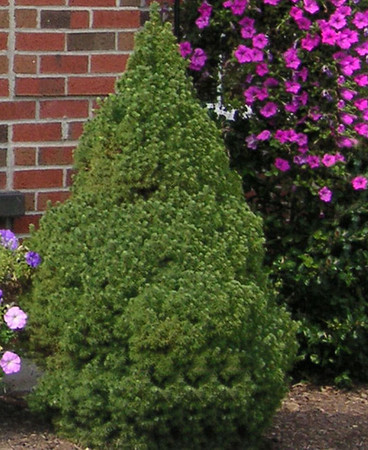
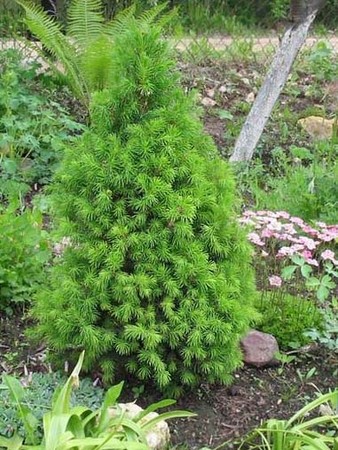
It is a dwarf tree up to 3 (4) m tall and 2 m in diameter. Slow-growing: annual increment for up to 10–15 years is 3–4 cm per year in width and 6–10 cm per year in height; afterward growth decreases to 1.5–3 cm per year. At 10 years it reaches 1 m in height. Lifespan 300-500 years. Crown dense, narrowly conical. Root system compact, taproot weakly developed. Most roots are located close to the soil surface. Shoots short, brown, later becoming grayish, not pendulous. Buds spherical, non-resinous. Scales bluntly ovate, light brown. Vegetation begins around 25.IV ± 6.
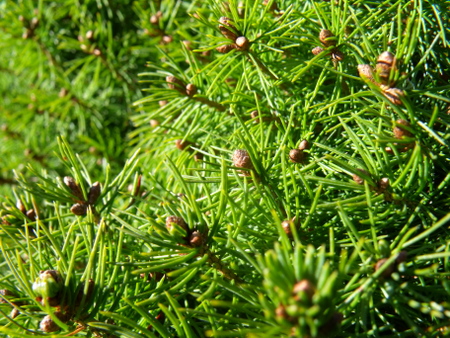
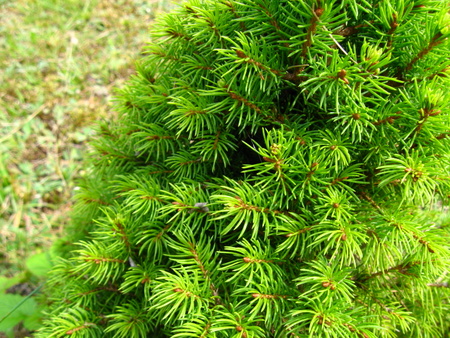
The plant is monoecious. Foliage needle-like, short, up to 10 mm long, thin, radial, sparsely arranged, glaucous-green, very soft.
Cones cylindrical, pale brown, up to 6 cm long, appear rarely.
Hardiness zone: 2-6.
Location: Light-loving, but tolerates light partial shade. Prefers moist, fertile soil, light- or medium-heavy loam. The topsoil layer should be well permeable so roots receive adequate air. Poorly tolerates drought, waterlogging and soil compaction. Poor tolerance to air pollution.
Planting: when planted too densely it loses its decorative appearance, since part of the crown may dry out. Soil mixture: sod soil, leaf mold, sand, peat in ratio 2:2:1:1.
Care: the area around the trunk should be periodically weeded and loosened, but not dug over. It is also advisable to mulch the trunk circle with peat or loose compost with subsequent incorporation. During dry periods regular watering is recommended, avoiding complete drying of the root zone. Manure or compost top-dressing can also be applied in early summer. Very susceptible to early spring sunburn, so requires shading during that period (e.g. with burlap). Spring browning of shoots is not a disease; the color of the foliage is restored with the onset of sap flow.
Pruning: Has an attractive even and symmetrical crown, so does not require pruning. However, formative pruning can be applied – spiral, pompons or balls.
Diseases: shütte, snow shütte, fusariosis, trunk and root rot, bark necrosis, canker (wound cancer), cone rust, spruce 'vertun'.
Pests: red spider mite, spruce sawfly.
Propagation: propagated by cuttings, best performed in early June. Winter cuttings without rooting hormone do not take. For cuttings, take matured lower branches from the mother plant that do not exceed 10–12 cm in length. The cutting removed from the mother plant must have a "heel" (a small piece of older wood), otherwise the plant will quickly die. Treat the lower part of prepared cuttings with growth stimulants. Plant cuttings to a depth of 2–2.5 cm. The substrate should not dry out during rooting, but overwatering is not recommended. Rooting percentage of cuttings is 75%.
Uses: looks impressive in parterres, compositions, mixed borders, rock gardens, near houses, in group and solitary plantings, and for decorating rock gardens, roofs or terraces in containers. Looks good as a backdrop and harmoniously combines with other low-growing conifers. Widely used in containers as a Christmas tree.