
Conifers
Engelmann Spruce
Picea engelmannii Engelm.
Engelmann spruce – a species of evergreen trees of the genus Spruce in the family Pinaceae. In the wild it grows in the forest belt of the Rocky Mountains, where it rises to elevations of 1500-3500 m above sea level to the upper tree line in valleys and on shaded mountain slopes. It forms pure and mixed forests in the lower belt with Engelmann or white fir, noble and mountain hemlock, Menzies' pseudo-tsuga, western hemlock and western larch, western white pine and twisted broad-needled pine, in the upper belt with mountain hemlock, subalpine fir, Lyle's larch, soft, white-barked and bristle pines, as well as Nootka cypress. Cultivated as an ornamental tree in Europe since 1863; introduced into Russia at the end of the 19th century. Lifespan 300-400 (up to 600) years.
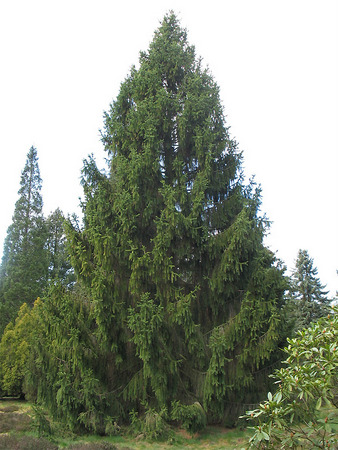
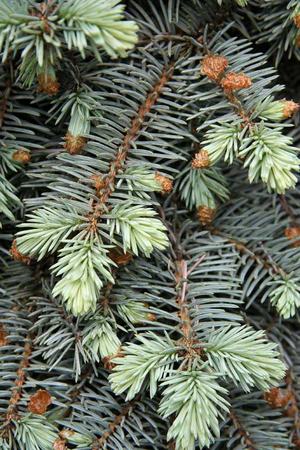
It is a tall tree 30-50 m in height, trunk diameter reaching 90 cm. Slow-growing, annual increment up to 20 cm. Crown conical, asymmetrical, dense, with slightly drooping branches. Bark scaly, fissured, thin, reddish-brown. Young shoots with rusty pubescence, yellowish-brown. Buds ovoid-conical, 5-6 mm long, resinous at the tip. Bud scales reddish-brown, blunt-triangular, with recurved tips.
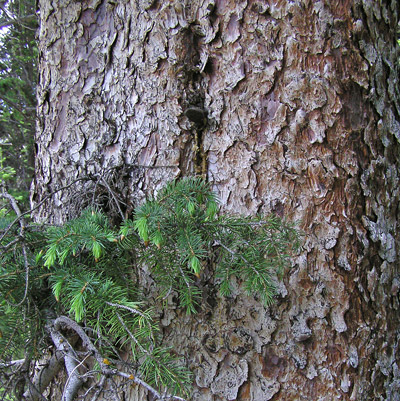
Needles four-sided, 15-25 (30) mm long, 1.5-2 mm wide, sharp, stiff (softer than those of Norway spruce), straight or slightly curved, directed toward the shoot tip, glaucous-green, fading with age. Persist on the tree 5-10 (15) years. When crushed, the needles have a sharp specific smell.
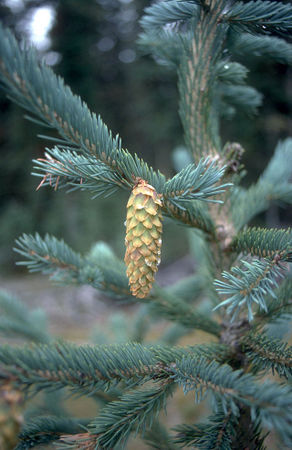
Cones 4-7 cm long and 2-2.5 cm wide, ovoid-cylindrical; immature cones are purple, later light brown. Scales ovoid in shape, thin, flexible, wavy or coarsely toothed along the upper edge. Seeds from grayish-brown to black, 2-3 mm long, with a yellowish-brown wing which is 4-5 times the length of the seed. Cones ripen in August-September and fall the following spring. 160,000-350,000 seeds per 1 kg. Weight of 1000 seeds approximately 3 g.
Subspecies: Picea engelmannii mexicana
Decorative forms: "Glauca", Blue ("Glauca"), silver (f. argentea), weeping blue (f. glauca pendula), Fendler's (f. Fendleri), small-needled (f. microphilla), Picea engelmannii 'Blue Magoo'
Hardiness zone: 2a (-45.6° C)
Location: tolerant of adverse climatic factors. Undemanding to soil, with sufficient moisture can grow on any soil. Total annual precipitation > 600 mm. In nature it grows in a cold and humid climate, with long snowy winters and a cold short summer. Grows on various mountain soils (calcareous and non-calcareous).
Planting: Soil mix: topsoil and leaf mold, peat, sand in ratio 2:2:1:1. Drainage made of crushed brick, layer 15-20 cm. Planting depth: 50-70 cm. Root collar at ground level. Recommended spacing between plants – 2-3 m.
Care: after planting you can apply 100-150 g of nitroammophoska. During dry periods daily watering of 10-12 L per plant is recommended. It is also desirable to water the crown (spray). Loosen the soil to a depth of 5-6 cm, mixing the peat with the soil rather than removing it. Young seedlings need covering with conifer boughs for the winter. In youth needs protection from spring sun; you can drape the tree with a non-woven fabric in 2 layers or place special protective shields on the south side.
Pruning: Recommended to pinch dominant shoots and shorten lateral shoots during growth.
Diseases: shoot blight (Schütte), snow blight, fusariosis, stem and root rot, bark necrosis, canker (wound) cancer, cone rust, spruce weevil.
Pests: spruce tortrix, spider mite, Sitka spruce aphid.
Propagation: by seeds, cuttings, grafting. Seeds remain viable for up to 5 years.
Conservation status: not under protection.
Uses: shows well in solitary plantings and small groups, on streets, squares, for urban greening, in avenue plantings.