
Conifers
Rough spruce
Picea asperata
Synonyms: dragon spruce, Chinese spruce.
Rough spruce – a species of evergreen trees of the genus Spruce (family Pinaceae). Native to western regions of China, where it grows in the subalpine forests of eastern Tibet at altitudes of 2700-3500 m above sea level in the provinces of Gansu, Hubei, Yunnan, Sichuan. It occurs on brown podzolic mountain soils. Annual precipitation is less than 500 mm. One of the important forest-forming species. It was introduced to Europe in 1910 by Ernest Wilson.
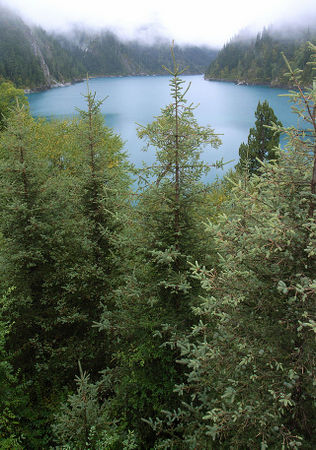
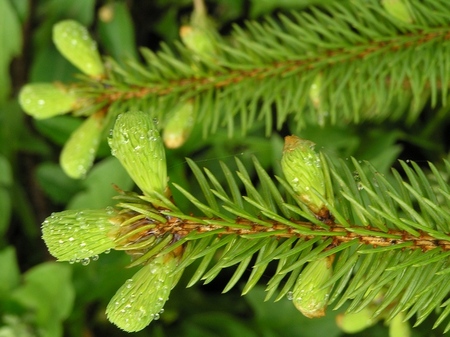
It is a medium-tall tree 20-35 (45) m in height, trunk diameter reaching 50-60 (100-150) cm. Annual increment up to 10 years reaches 2.5 cm, at a more mature age – up to 25 cm. Crown conical, broadly conical or oval, dense, less often rather loose, branches spreading in various directions. In form it resembles the European spruce, but the tips of the lower branches are slightly bent downward. Bark on the trunk is gray-brown, scaly, with rough plates (hence the name). Young shoots are yellow, orange or yellowish-light brown, slightly pubescent or glabrous, deeply furrowed. Buds large, 12-15 mm long and 5-8 mm wide, conical, darker than the shoots. Bud scales yellow-brown, not tightly appressed, slightly turned upward, resinous.
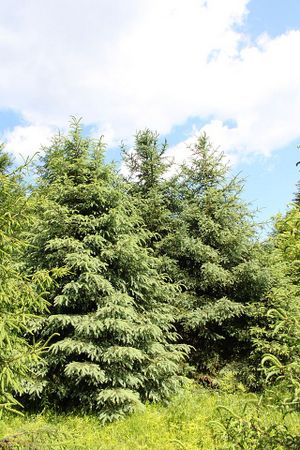
Needles are four-sided, 10-15 (20) mm long and 1-1.8 mm wide, with 4-8 stomatal lines on each side, stiff, sharp, dull grayish-green, less often glaucous- or blue-green. On main shoots the foliage is appressed, on lateral shoots it is radially arranged and directed forward.
Blooms in April-May. Male inflorescences are carmine-red.
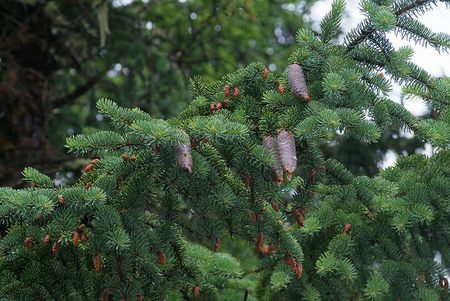
Cones cylindrical, 5-10 (16) cm long and 2.5-4 cm in diameter, immature green, at maturity chestnut-brown or reddish-brown.
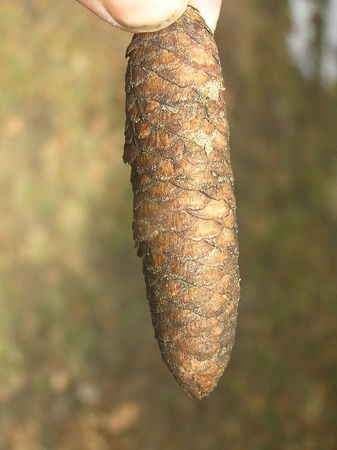
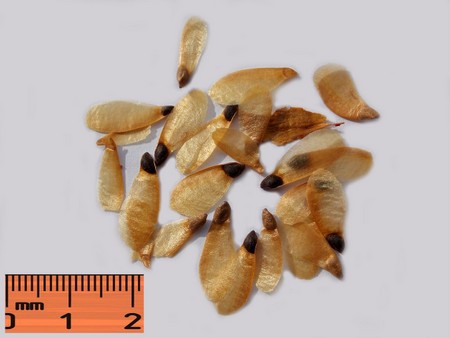
Seed scales evenly rounded at the apex. Seeds small, 3-4 mm long and 2-3 mm wide, black. Wing short, up to 1 cm long, light brown. Seeds mature in September-October.
Decorative forms: Picea asperata var. heterolepis (Rehder et Wilson) Cheng ex Rehder (synonym: P. heterolepis Rehder et Wilson; P. asperata var. nobilis Rehder et Wilson), Picea asperata var. Asperata, Picea asperata var. Aurantiaca, Picea asperata glauca, Picea asperata var. Retroflexa., picea asperata mongolei, P. asperata var. ponderosa Rehder et Wilson.
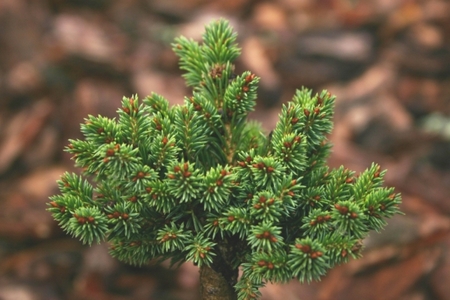
Picea asperata Mongolei
Hardiness zone: 6a (-23.2 - 17.8 °C)
Location: prefers light, drought-tolerant. Tolerates urban conditions well. Can withstand slight soil waterlogging. Not demanding regarding soil fertility.
Planting: Does not like transplanting. Soil mixture: turf and leaf soil, peat, sand in a ratio of 2:2:1:1. Drainage made of crushed brick, layer 15-20 cm. Planting depth: 50-70 cm. Root collar at ground level. Recommended spacing between plants – 2-3 m.
Care: after planting you can apply 100-150 g of nitroammophoska. In dry periods it is recommended to water daily 10-12 L per plant. Crown sprinkling is also desirable. Loosening is done to a depth of 5-6 cm, while peat is not removed but mixed with the soil. Young seedlings need shelter with fir branches for the winter. In young age it needs protection from spring sun; for this you can throw a non-woven fabric over the tree in 2 layers or install special protective shields on the southern side.
Pruning: Pinching of dominant shoots and shortening of lateral shoots during growth is recommended.
Diseases: Schütte, snow Schütte, fusariosis, stem and root rot, bark necrosis, canker (wound cancer), cone rust, spruce weevil.
Pests: spruce leafroller, spider mite, Sitka spruce aphid.
Propagation: by seeds, cuttings, grafting or layering. Without treatment, winter cuttings do not root.
Conservation status: has been under protective status in China since 1998.
Uses: recommended for use in landscape and park planting. Can be used in single and group plantings. Dwarf forms are suitable for decorating rock gardens. In decorative value it is not inferior to the sharp spruce.