
Conifers
Norway spruce Ohlendorffii
Picea abies Ohlendorffii
Synonyms: P. excelsa var. ohlendorffii Spaeth
Norway spruce Ohlendorffii (Picea abies Ohlendorffii) – a cultivar of Norway spruce. Obtained by T. Ohlendorff in a nursery near Hamburg between 1840 and 1850 from seeds brought from the Nikita Botanical Garden. Named in 1904 by Franz Ludwig Späth and introduced into cultivation by him from Berlin.
It represents a dwarf form, rounded in youth. It reaches 3-5 m in height. Annual growth 2-6 cm. Later it becomes broad-tapering and broadly conical with several leaders in old age. Branches ascending, spreading. Dense branches are not flat-plane-like, but uneven. Young shoots are light brown or yellow-gray, paler beneath, glossy, glabrous, curved not in one plane. Buds brown or dark orange-brown, acutely conical: terminal buds reach 2-3 mm in length, others smaller; often borne at the tips in uneven clusters of 3-5, on strong shoots the number may reach 10.
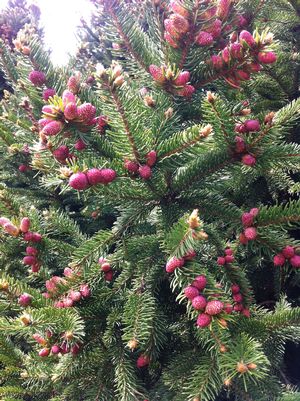
Needles acicular, on young plants and on leading shoots radial, on the upper part semi-radial, beneath gathered in tufts, yellow-green in color, 4-8 mm long, glossy, very thin, four-angled or circular in cross-section, acute at both ends, with small stomata on both sides in 1—4 unequal rows, stiff, dense.
Fruits – conical pink cones, becoming brown at maturity.
Hardiness zone: zone 3 (-40°С).
Site: light-loving but shade-tolerant. In youth it suffers from spring scorch. Grows well on fresh, well-drained acidic, sandy or loamy soil. Does not tolerate waterlogging, drought or soil salinity. Dislikes air pollution. In monoculture it can lead to soil acidification.
Planting: Soil mix: turf and leaf soil, peat, sand in a ratio of 2:2:1:1. Drainage is made of broken brick, layer 15-20 cm. Planting depth: 50-70 cm. Root collar at ground level.
Care: after planting a fertilizer can be applied - 100-150 g of nitroammophoska. During dry periods it is recommended to water daily 10-12 L per plant. It is also desirable to spray the crown. Loosening is carried out to a depth of 5-6 cm, with peat not being removed but mixed with the soil. Young seedlings need to be covered with conifer boughs for the winter.
Pruning: tolerates pruning well. With proper training for a hedge, the effect of an «impassable green wall» can be achieved. When forming two leaders, one must be removed.
Diseases: Schütte, snow Schütte, fusariosis, stem and root rot, bark necrosis, canker (ulcerative canker), cone rust, spruce vertun.
Pests: spruce leafroller, spider mite, Sitka spruce aphid.
Propagation: by seed, cuttings, grafting or layering. Lower branches root well in soil. When propagated by seed decorative characteristics are lost. Seed germination 60-80%. Seeds germinate without presowing treatment, but soaking in water (18-22 hours) or cold stratification (2-8 weeks) increases germination percentage. In closed containers seeds can be stored up to 5 years.
Uses: used in solitary and group plantings. Can be used as a container plant for greening roofs, balconies, porches, and underpasses.