
Conifers
Norway spruce
Picea abies
Synonyms: ель европейская, Abies abies (L.) Druce nom. inval., Abies alpestris Brügger, Picea excelsa (Lam.), Picea montana Schur, Picea rubra A.Dietr., Picea vulgaris, Pinus abies L.basionym, Pinus excelsa Lam., Pinus viminalis Sparrm. ex Alstr.
Norway spruce – the typical species of evergreen trees of the genus Spruce in the family Pinaceae. Widely distributed in the northeastern part of Europe, where it grows in continuous forest stands. In western Europe it occurs only in the Carpathians, the Alps, and in the mountains of the Balkan Peninsula. Locally naturalized in North America, the British Isles and the Pyrenees. A forest-forming species; in the taiga it forms pure stands – spruce forests. Often occurs alongside Scots pine, Siberian spruce and deciduous trees, forming mixed forests.
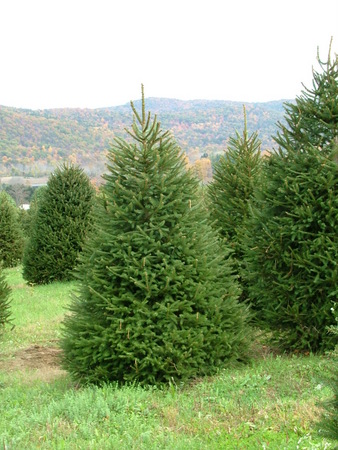
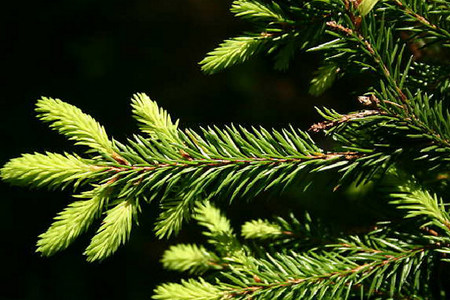
It is a medium-tall tree 30 (50) m in height, 6-8 m in width, with trunk diameter up to 1.2 (2.4) m. In youth (up to 10-15 years) it grows slowly, later faster. Annual increment can reach 50 cm in height and 15 cm in width. Crown broad-conical, dense, with a sharp apex. Branches pendulous or spreading, arranged in whorls. Bark gray, peeling in thin plates, scaly, rough. Trunk fully woody, straight. Shoots nearly horizontal or pendulous, thin, sparsely pubescent or naked, glandular-hairy, with small resin exudations, from greenish-rusty-yellow to brown in color, dull; by autumn they become reddish-brown from corky layering.
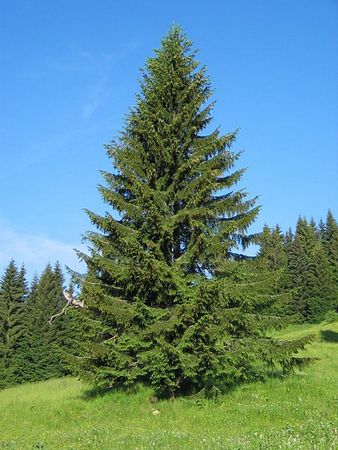
Norway spruce is heterogeneous in branching types. Five types are distinguished: comb-like – first-order branches are horizontal, second-order ones are thin and arranged comb-like, hanging down; irregularly comb-like – second-order branches grow irregularly comb-like; compact – first-order branches relatively horizontal, medium in length, densely covered with short-branched second-order branches; flat – second-order branches horizontal and widely branched; brush-like – first-order branches have thick short offshoots from which small twigs hang in a shield-like manner.
The root system is shallow, therefore the plant is susceptible to windthrow.
Buds oval or conical, dark brown, blunt-tipped or slightly pointed, non-resinous. Bud scales dry, numerous, membranous, yellow-brown in color.
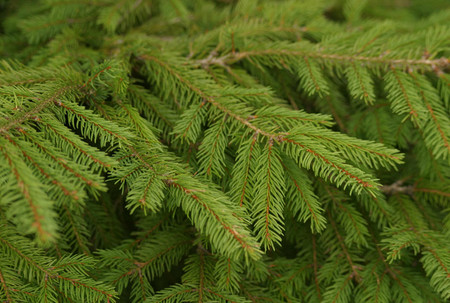
Needles quadrangular, short, 2-2.5 cm long, prickly, arranged spirally, slightly curved, borne singly on leaf cushions, dark green, glossy, with faint stomatal bands between which a green ridge projects. Retained on the tree for 6-12 years.
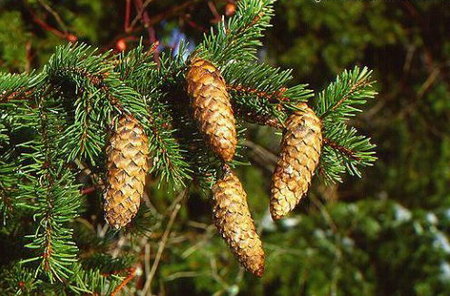
Flowering buds 4-8 mm long and 4 mm in diameter. Male catkins (microstrobili) axillary, reddish-yellow, 20-25 mm long, grow on the ends of last year's shoots and are surrounded at the base by scales. Pollen is shed in May. Female cones (megastrobili) purple or green, develop on the ends of two-year-old shoots, positioned above the males – several at the top part of the crown. At first they are oriented vertically, later gradually turning tip-down and becoming pendulous. They ripen in October.
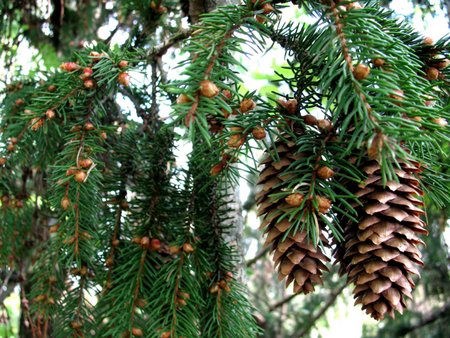
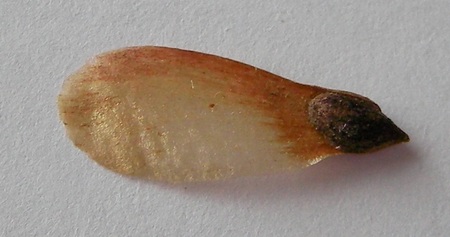
Cones elongated, 15 cm long and 4 cm wide, green in early summer, later dark purple, at maturity light brown. Seed scales convex, rhombic, narrowed above, less often truncate at the edge, wavy-notched or toothed at the margin. Bracts (covering scales) significantly shorter than the seed scales, elongated. Seeds ovoid-pointed, up to 4 mm long and 2 mm wide. Wing reddish-brown, shiny, up to 15 mm long, easily separable from the seed. Seeds remain in the cones until winter, falling out in January-March.
Begins to bear seed from the age of 20 years and continues until about 60 years, depending on stand density (solitary individuals begin seeding earlier). Seed production is not annual, occurring once every 4-5 years.
Life span 250-300 years. The age of a spruce is determined by the number of branch whorls, since they are formed once a year. To the number of whorls add 3-4 years (time for formation of the first whorl).
Varieties: Picea × fennica (Regel) Komarov – a hybrid between Siberian spruce and Norway spruce; Picea abies var. acuminata (Beck) Dallim. & A.B.Jacks.; Picea abies var. alpestris (Brügger) P.Schmidt.
Forms: "Акрокона" ("Асrосопа"), "Ауреа" ('Аurеа"), "Ауреа Магнифика" Золотистая Великолепная ("Аигеа Magnifica"), "Берри" ("Barryi"), "Кланбрассилиана" ("Clanbrassiliana"), "Колумнарис" ("Columnaris"), "Компакта" ("Compacta"), "Коника" ("Conica"),"Кранстони"("Cranstonii"), "Эхиниформис", Колючковидная ("Echiniformis"), "Форманек"("Formanek"), "Грегориана" ("Gregoryana"), "Инверса", Перевернутая ("Inversa"), "Литтл Джем" ("Little Gem"), "Максвелли" ("Maxwellii"), "Нана" ("Nana"), "Нидиформис", Гнездовидная ("Nidiformis"), "Олендорффи" ("Ohlendorffii"), "Пирамидата", Пирамидальная ("Pyramidata"), "Пигмея", Карликовая ("Pygmaea"), "Прокумбенс" ("Procumbens"), "Пумила", Низкорослая ("Pumila"), "Пумила Глаука", Низкорослая Сизая ("Pumila Glauca"), "Рефлекса"("Reflexa"), "Ремонти" ("Remontii"), "Репенс", Ползучая ("Repens"), "Виминалис", Прутовидная ("Viminalis"), "Виргата", Змеевидная ("Virgata"), "Уиллс Цверг" ("Will's Zwerg").
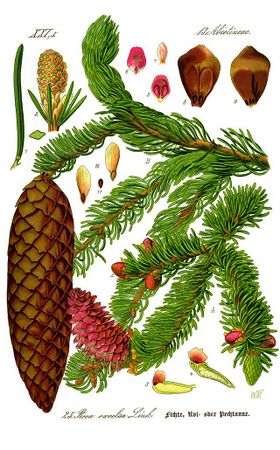
O. V. Tome «Flora von Deutschland, Österreich und der Schweiz», 1885
Hardiness zone: 2a (-45°)
Site: Light-demanding but shade-tolerant. In young age may suffer from spring sunscald. Grows well on fresh, well-drained acidic sandy or loamy soils. Does not tolerate waterlogging, drought or soil salinity. Dislikes air pollution. In monocultures it can lead to soil acidification.
Planting: Soil mix: turf and leaf soil, peat, sand in the ratio 2:2:1:1. Drainage is made of crushed brick, layer 15-20 cm. Planting depth: 50-70 cm. The root collar at ground level.
Care: After planting you can apply 100-150 g of nitroammophoska. In dry periods it is recommended to water daily 10-12 L per plant. Crown irrigation (overhead watering) is also desirable. Loosen to a depth of 5-6 cm, mixing peat with soil rather than removing it. Young seedlings need to be covered with fir branches for the winter.
Pruning: tolerates pruning well. With proper formation of a hedge, an effect of an "impassable green wall" can be achieved. When forming two leaders, one should be removed.
Diseases: Schütte, snow Schütte, fusariosis, stem and root rot, bark necrosis, canker (wound) cancer, cone rust, spruce vertun.
Pests: spruce leafroller, spider mite, Sitka spruce aphid.
Propagation: by seed, cuttings, grafting or layering. Lower branches root well in soil. When propagated by seed decorative properties may be lost. Seed germination 60-80%. Seeds germinate without pre-sowing treatment, but soaking in water (18-22 hours) or cold stratification (2-8 weeks) increases germination percentage. In closed containers seeds can be stored up to 5 years.
Uses: The wood is widely used in construction, for making musical instruments, furniture, in the pulp and paper industry. Tannins are obtained from the bark. Cones and buds are used in medicine. In landscape design Norway spruce is widely used in solitary and group plantings. Used for creating avenues, stands, hedges. Popular for urban greening as well as for creating snow-protection plantings along roads. In many countries widely used as a Christmas or New Year tree.